
Undeclared Overseas Income? How the Worldwide Disclosure Facility Works
September 1, 2026
UK Tax on Foreign Rental Income: What Property Owners Need to Declare
September 3, 2026
Closing a Limited Company: Dividend or Capital Distribution?
Closing a Limited Company is not simply an administrative exercise at Companies House. That distinction can materially change the amount of tax a shareholder pays.
When Closing a Limited Company, directors should therefore consider the company’s final profits, cash balance, outstanding liabilities, shareholder circumstances and the legal method used to bring the company to an end. A straightforward strike-off may be appropriate for a company with modest reserves, while a solvent company with substantial retained profits may need a Members’ Voluntary Liquidation, often shortened to MVL.
This guide explains the main tax considerations when Closing a Limited Company in the UK, the difference between dividend and capital treatment, the £25,000 strike-off rule, Business Asset Disposal Relief, anti-phoenixing rules and practical planning points before distributions are made.
When Closing a Limited Company, remember that tax rules depend on individual circumstances and can change. This article reflects the UK position for 2026/27.
Why tax treatment matters when a company closes
Closing a Limited Company can leave a significant amount of cash in the business bank account after Corporation Tax, suppliers, employees and other creditors have been paid. That money belongs to the company until it is lawfully distributed.
When Closing a Limited Company, if a payment is treated as a dividend, it falls within the Income Tax regime. If it is treated as capital, the shareholder normally calculates a capital gain by comparing the amount received with the allowable cost of the shares. Capital treatment can be especially attractive where Business Asset Disposal Relief is available, although the difference between dividend and capital rates has narrowed following recent tax changes.
The method of Closing a Limited Company therefore matters just as much as the amount available for distribution. The company must also deal with final accounts, Corporation Tax, VAT, PAYE, creditors, debtors, assets and Companies House requirements before the closure is complete.
Dividend distributions before closure
One option when Closing a Limited Company is to pay some or all available reserves as dividends before applying for strike-off or commencing liquidation. Dividends can only be paid from distributable profits, and directors should ensure that the company has sufficient realised profits at the date each dividend is declared.
When Closing a Limited Company, an individual shareholder’s dividend is generally taxed as dividend income in the tax year in which it is received. The effective rate depends on the shareholder’s other income, available dividend allowance and tax band.
Closing a Limited Company through a series of dividends may nevertheless make sense where reserves are small, where shareholders have low taxable income, where distributions can be spread across tax years, or where capital treatment would not produce a meaningful advantage.
Directors should also distinguish genuine dividends from repayment of money already owed to them. If a director’s loan account is in credit because the director previously lent money to the company, repayment of that loan is generally not a dividend. That can be an important step before Closing a Limited Company, provided the accounting records genuinely support the amount owed.
Capital distributions explained
Closing a Limited Company can result in capital treatment when distributions are made in a formal winding-up. In broad terms, distributions made by a liquidator during a winding-up are normally treated as capital receipts in the shareholder’s hands rather than ordinary dividends, subject to anti-avoidance rules. HMRC confirms that the normal distribution of a company’s net assets to shareholders during a winding-up is generally treated as a capital distribution for Capital Gains Tax purposes.
When Closing a Limited Company, capital treatment means the shareholder usually deducts the allowable cost of the shares and any relevant losses or annual exempt amount before calculating Capital Gains Tax. The tax rate then depends on the shareholder’s circumstances and whether a relief such as Business Asset Disposal Relief applies.
For some shareholders, Closing a Limited Company using a capital route can therefore reduce the overall personal tax cost. However, it is essential not to assume that every company closure automatically creates a capital distribution. The legal route used is central to the treatment.
Closing a Limited Company by voluntary strike-off
Closing a Limited Company through voluntary strike-off is often the simplest route for a dormant company or a solvent company whose affairs have been fully wound down. The directors apply to Companies House to remove the company from the register after satisfying the relevant conditions.
Before Closing a Limited Company by strike-off, the directors should normally stop trading, collect debts, settle creditors, deal with employees, close payroll where relevant, submit final VAT returns, pay tax liabilities, dispose of business assets and extract the remaining funds. It is important to empty the company bank account before dissolution because assets left in a dissolved company can pass to the Crown. Companies House specifically warns that remaining assets, including money in the bank account, can pass to the Crown once the company is dissolved.
When Closing a Limited Company, the tax treatment of the final distributions is where the £25,000 limit becomes crucial.
The £25,000 strike-off rule
When Closing a Limited Company without a formal liquidation, distributions made in anticipation of dissolution can potentially be treated as capital where the statutory conditions are met and the total distributions do not exceed £25,000.
When Closing a Limited Company, if the total amount distributed exceeds £25,000, the special capital treatment for an informal dissolution is generally not available in the same way. Amounts paid before strike-off may instead be treated as income distributions, depending on the facts. HMRC’s guidance confirms that the statutory capital treatment for distributions made in anticipation of dissolution is subject to an aggregate £25,000 limit.
This means that Closing a Limited Company with £10,000 or £20,000 of surplus cash may be very different from closing one with £100,000 or £300,000 of retained reserves. Where the amount exceeds £25,000 and capital treatment is desired, an MVL is commonly considered.
Closing a Limited Company efficiently requires looking at the whole extraction plan rather than focusing only on the balance remaining on the final day.
Closing a Limited Company through an MVL
Closing a Limited Company using a Members’ Voluntary Liquidation is a formal process for a solvent company. A licensed insolvency practitioner is appointed as liquidator and the directors make a declaration of solvency confirming that the company is expected to pay its debts, with applicable interest, within the required period.
GOV.UK states that an MVL can be used where the company is solvent and that the directors’ declaration of solvency must state that the company can pay its debts within no more than 12 months from liquidation.
An MVL is often considered when Closing a Limited Company that holds substantial cash or assets after all liabilities have been settled. The liquidator realises the assets, pays creditors and distributes the remaining funds to shareholders.
When Closing a Limited Company, the attraction is that distributions made in the winding-up are generally treated as capital, subject to the anti-avoidance provisions discussed later. That can make an MVL more tax-efficient than simply paying a large dividend before dissolution.
However, an MVL has professional costs and formal requirements. Closing a Limited Company with only a small amount of surplus cash may not justify those costs.
Business Asset Disposal Relief when Closing a Limited Company
Closing a Limited Company may qualify for Business Asset Disposal Relief, commonly known as BADR, if the relevant conditions are satisfied. BADR can reduce the Capital Gains Tax rate applying to qualifying gains.
When Closing a Limited Company, note that for disposals on or after 6 April 2026, qualifying BADR gains are taxed at 18%. This is higher than the previous 14% rate that applied from 6 April 2025 to 5 April 2026. The relief is therefore less generous than it once was, but it can still reduce tax where the alternative capital rate would be 24%.
For a shareholder Closing a Limited Company, eligibility commonly requires the company to have been the individual’s “personal company” and a trading company, or the holding company of a trading group, throughout the relevant qualifying period. Broadly, the shareholder usually needs at least 5% of the ordinary share capital and voting rights and must satisfy the economic entitlement conditions. The individual must also normally be an officer or employee of the company.
The qualifying conditions are technical, particularly where the company holds investments, cash, property or non-trading assets. Closing a Limited Company after trading has ceased can also introduce timing considerations. HMRC guidance states that when a business is closed, qualifying business assets generally need to be disposed of within three years for BADR purposes.
BADR also has a lifetime limit. Any previous qualifying gains on which the shareholder has claimed the relief can reduce the remaining amount available. Before Closing a Limited Company, shareholders should therefore check their historic BADR claims rather than assume the full lifetime amount remains available.
What if BADR does not apply?
Closing a Limited Company through an MVL can still produce capital treatment even when BADR is unavailable. The gain would simply be taxed using the normal Capital Gains Tax rules and rates, subject to the shareholder’s circumstances.
When Closing a Limited Company, this can still be preferable to dividend treatment in some cases, but not always. The tax saving may be reduced once liquidation costs are considered, particularly if the shareholder is a basic-rate taxpayer or has only modest reserves.
There are several reasons why BADR might fail when Closing a Limited Company. The shareholder may not have held the required percentage, may not have been an employee or officer for long enough, the company may not satisfy the trading-company test, or the relevant qualifying period may not be met.
When Closing a Limited Company, the company’s activities should therefore be reviewed well before closure rather than after the liquidator has already made a distribution.
The anti-phoenixing rules
Closing a Limited Company cannot be used simply as a method of repeatedly converting what would otherwise be dividends into capital gains. HMRC has targeted this type of planning through rules commonly described as the anti-phoenixing targeted anti-avoidance rule.
When Closing a Limited Company, a distribution in a winding-up can be treated as income where several conditions are met. These include the individual having at least a 5% interest before the winding-up, the company being a close company during the relevant period, the individual continuing to carry on or be involved with the same or a similar trade within two years, and it being reasonable to assume that avoiding or reducing Income Tax was a main purpose or one of the main purposes of the winding-up.
For somebody Closing a Limited Company and genuinely retiring, taking permanent employment in a different field or ceasing the trade altogether, the facts may look very different from somebody who liquidates one consultancy company and immediately starts an almost identical consultancy through a new company.
The two-year rule does not mean that every person who starts any business after Closing a Limited Company automatically loses capital treatment. The statutory conditions and purpose test need to be considered together. Nevertheless, shareholders planning to continue substantially the same trade should take specialist advice before relying on capital taxation.
Strike-off versus MVL: practical comparison
For a small company with little cash remaining, Closing a Limited Company by voluntary strike-off can be simple and inexpensive. Where distributions before dissolution are no more than £25,000 and the conditions for capital treatment are satisfied, formal liquidation may be unnecessary solely for tax purposes.
For a company with substantial reserves, Closing a Limited Company through an MVL may offer clearer access to capital treatment for liquidation distributions. The additional professional cost can be worthwhile where the tax difference is significant.
When Closing a Limited Company, the decision should not be based on a single threshold alone. A shareholder who does not qualify for BADR may obtain less benefit from an MVL than expected. Conversely, a higher-rate shareholder with large retained profits and a qualifying BADR position may find the capital route materially more efficient.
Common mistakes to avoid
One mistake when Closing a Limited Company is applying for strike-off while cash, equipment or other assets remain in the company. Assets that remain when the company is dissolved can pass to the Crown, and recovering them may require restoration of the company.
When Closing a Limited Company, another mistake is assuming that an informal strike-off automatically turns unlimited reserves into capital. The £25,000 distribution limit is a key consideration.
A third mistake when Closing a Limited Company is assuming that BADR is guaranteed simply because the shareholder has owned the business for several years. The shareholding, employment/officer status, trading status and qualifying period all need to be checked.
A fourth mistake is ignoring the anti-phoenixing rules. Closing a Limited Company followed shortly by carrying on the same trade through a new company may result in a distribution being taxed as income if the statutory conditions are met.
Finally, directors sometimes calculate the distribution using the bank balance rather than the company’s true net assets. Closing a Limited Company should only proceed after final liabilities, taxes and professional costs have been properly provided for.
A sensible pre-closure checklist
Before Closing a Limited Company, confirm that trading has genuinely ceased or establish the intended cessation date. Raise final invoices, collect amounts owed to the company and settle suppliers.
When Closing a Limited Company, review Corporation Tax, VAT, PAYE and any other HMRC liabilities. Submit the appropriate final returns and keep enough cash available to pay amounts that have not yet fallen due.
When Closing a Limited Company, reconcile director’s loan accounts and check whether the company owns assets that need to be sold or transferred. Review distributable reserves before declaring dividends.
When Closing a Limited Company, calculate the expected amount left for shareholders. If the anticipated distribution is modest, compare voluntary strike-off with other options. If the company has more than £25,000 to distribute and capital treatment is important, consider whether an MVL is appropriate.
Before Closing a Limited Company through an MVL, check whether each shareholder could qualify for BADR and whether previous BADR claims have used any of the lifetime limit.
When Closing a Limited Company, consider future plans. If a shareholder intends to continue the same or a similar trade, the anti-phoenixing provisions should be reviewed carefully before any liquidation distribution is made.
Dividend or capital: which is better?
There is no universal answer when Closing a Limited Company. Dividend treatment may be perfectly reasonable where the reserves are low, the shareholder has unused basic-rate band, liquidation fees would outweigh the tax saving, or the shareholder does not qualify for favourable capital treatment.
Capital treatment may be attractive when Closing a Limited Company with substantial reserves, particularly where the shareholder qualifies for BADR and the distribution is made through a proper winding-up.
When Closing a Limited Company, the comparison should be based on actual numbers. Directors should model the dividend tax cost, CGT cost, BADR position, annual exempt amount, liquidation costs and any effect on other income-related tax charges.
For 2026/27, the Capital Gains Tax annual exempt amount for most individuals is £3,000, meaning taxpayers generally pay CGT only on overall taxable gains above the available exemption after taking account of relevant losses and reliefs.
A tax-efficient closure should also be commercially defensible. Closing a Limited Company purely to obtain capital treatment before restarting the same activity can create avoidable risk.
Final thoughts
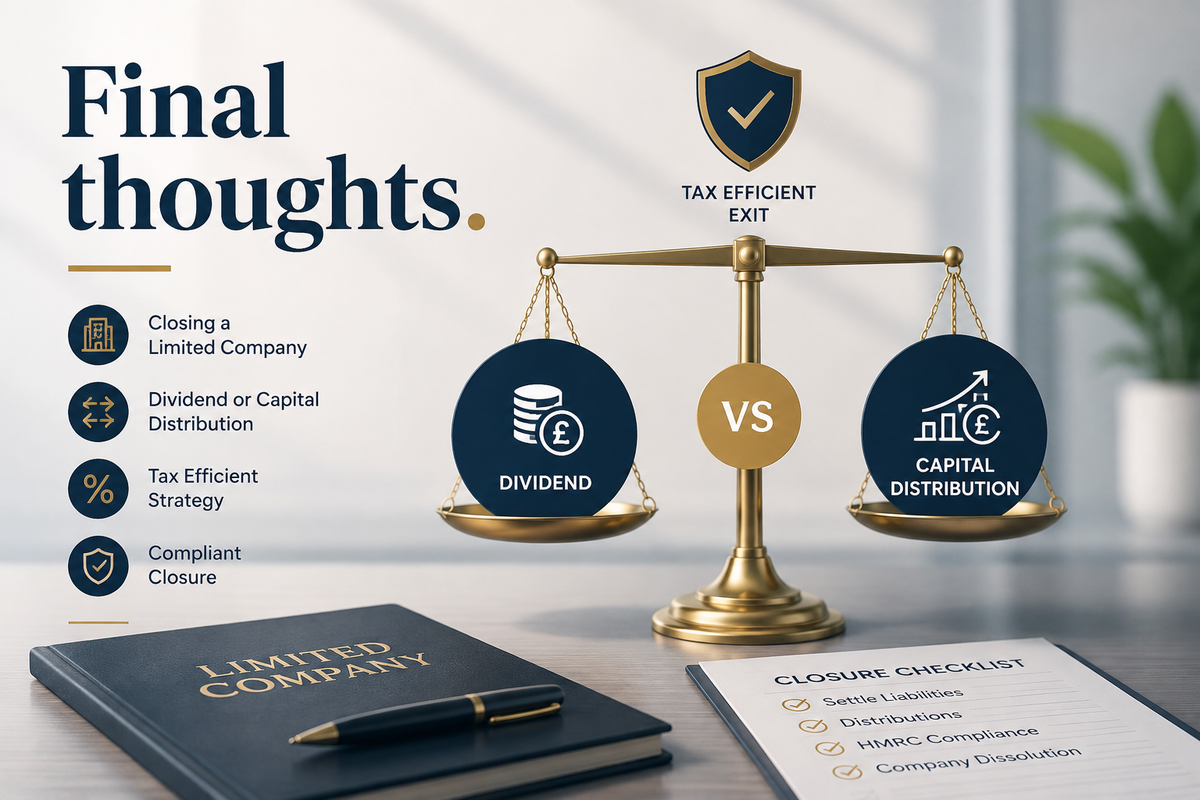
Closing a Limited Company is a point at which tax planning and legal process come together. The decision to take remaining funds as dividends or capital should be made before the company is dissolved, not after.
For small balances, Closing a Limited Company by voluntary strike-off may be the most practical route. Where larger reserves remain, an MVL can potentially secure capital treatment, but the cost and qualifying conditions need to be assessed.
When Closing a Limited Company, Business Asset Disposal Relief can still be valuable, although the rate for qualifying disposals is 18% from 6 April 2026. Shareholders must meet the relevant conditions, and the relief should never be assumed.
The anti-phoenixing rules are equally important. Closing a Limited Company and then carrying on the same or similar trade within two years can lead to income treatment where the statutory conditions and tax-avoidance purpose test are satisfied.
Good planning means reviewing the company’s accounts, liabilities, assets, shareholder tax position and future business plans together. If you are considering Closing a Limited Company, obtaining advice before making distributions can help you choose the appropriate route, avoid unexpected tax charges and complete the closure correctly.
Need help deciding what’s best for your situation?
📞 Call 0161 710 1901
📧 Email Tax@TaxesDoneRight.co.uk
Visit www.taxesdoneright.co.uk