
Changing Accountants: Is It Easier Than You Think?
October 8, 2026
Closing Your Limited Company: What Happens to the Money Left Inside?
Closing Your Limited Company raises one question that matters enormously to directors: what happens to the money still sitting in the business bank account? Perhaps your contracts have ended, you are retiring, or the business has simply achieved its purpose. Whatever your reason, the remaining cash is not automatically yours to transfer without consequences. A limited company is legally separate from its shareholders, even where one person owns every share. Understanding that distinction is essential when Closing Your Limited Company.
When Closing Your Limited Company, cash may represent accumulated profits, share capital, money you previously lent to the business, customer deposits, or funds needed to meet outstanding bills and taxes. Each has a different legal or tax treatment. Closing Your Limited Company without identifying those balances can create an unexpected tax bill, leave creditors unpaid, or even result in assets passing to the Crown. This guide explains how to plan the process, choose an appropriate closure route, and extract funds responsibly.
Closing Your Limited Company: Start With the Actual Cash Position
Before Closing Your Limited Company, prepare an up-to-date balance sheet rather than relying on the balance visible in online banking. Closing Your Limited Company begins with accurate liabilities. A balance of £60,000 does not mean £60,000 is available for shareholders. There may be unpaid Corporation Tax, VAT, PAYE, suppliers, loans, redundancy costs, professional fees, or customer refunds. Some income might also have been received for work not yet completed.
For example, suppose the company has £60,000 in the bank, owes £9,000 Corporation Tax, has £4,000 of supplier invoices, and expects £2,000 of closure expenses. The apparent £60,000 becomes just £45,000 before considering other liabilities. When Closing Your Limited Company, establish which money belongs to creditors and which remains available for distribution. Keep sufficient reserves for any estimated final tax charges and adjustments.
What Happens to Retained Profits?
When Closing Your Limited Company, retained profits are profits accumulated after company-level taxes and previous distributions. They remain the company’s funds until properly distributed. Closing Your Limited Company does not turn retained earnings into tax-free personal savings. Closing Your Limited Company needs a lawful distribution. The shareholders may eventually receive the remaining value, but the method of withdrawal determines whether dividend Income Tax or Capital Gains Tax might apply.
Closing Your Limited Company can involve different types of payments. Alternatively, qualifying distributions made in anticipation of strike-off or during a formal members’ voluntary liquidation may be capital receipts. That distinction can substantially change the personal tax calculation. Closing Your Limited Company should involve comparing the available routes before making payments, particularly where accumulated profits are significant.
Closing Your Limited Company Through Voluntary Strike-Off
When Closing Your Limited Company, for a solvent business with straightforward affairs, voluntary strike-off is often the least expensive closure method. Directors apply to Companies House to remove the company from the register, normally using its online service or form DS01. Closing Your Limited Company this way is only suitable when statutory eligibility requirements are met, including restrictions on trading and certain activities during the preceding three months.
Closing Your Limited Company requires tax planning. Importantly, a strike-off application does not itself determine the shareholder’s tax bill. Closing Your Limited Company through this route requires particular attention to the rules governing distributions made before dissolution. The amount and character of those payments matter much more than the relatively modest application fee.
The £25,000 Capital Distribution Limit
When Closing Your Limited Company, under section 1030A of the Corporation Tax Act 2010, qualifying distributions in anticipation of dissolution can receive capital treatment if the conditions are met and the aggregate amount does not exceed £25,000. When Closing Your Limited Company, this is a total limit on relevant distributions by the company, not a £25,000 allowance for every shareholder. It is also not a blanket exemption from Capital Gains Tax.
The company must have settled, or intend to settle, its liabilities and secure amounts owed to it. If it has not been dissolved within the relevant two-year period, the intended capital treatment may be lost. Closing Your Limited Company using this concession therefore demands genuine intention to dissolve and proper records of the distributions. The shareholder’s actual gain also depends on the allowable cost of their shares and other relevant factors.
Closing Your Limited Company with multiple owners needs collective calculations. Imagine two equal shareholders receiving £10,000 each as part of an eligible £20,000 final distribution. Capital treatment may be available, although personal gains and allowances still require calculation. But Closing Your Limited Company with £40,000 distributed under the informal strike-off route cannot simply treat the first £25,000 as capital and the excess as income. The statutory aggregate limit must be respected; splitting payments does not circumvent it.
What if the Company Has More Than £25,000?
When Closing Your Limited Company with substantial reserves, a members’ voluntary liquidation, or MVL, may be worth investigating. This is a formal liquidation for a solvent company. An authorised insolvency practitioner is appointed, assets are realised, liabilities are paid, and the surplus is distributed to shareholders. The directors must make a formal declaration of solvency and follow the prescribed procedures.
When Closing Your Limited Company, distributions made in a genuine winding-up are generally capital in nature, which can make an MVL attractive where substantial retained profits exist. However, Closing Your Limited Company through an MVL involves liquidator fees, compliance work and possible additional costs. Those expenses should be weighed against any expected tax savings. A higher company bank balance alone does not establish that liquidation is best.
Closing Your Limited Company with larger reserves needs a comparison. For example, a shareholder expecting a £100,000 distribution might compare the tax cost of a dividend with capital treatment after liquidator fees and any available relief. Closing Your Limited Company should be assessed using the shareholder’s income, share base cost, other gains, tax residence and future business plans. An accountant can model scenarios, while the insolvency practitioner handles the formal winding-up.
Dividend Tax Versus Capital Gains Tax
The tax difference is frequently the deciding factor when Closing Your Limited Company. For 2026/27, dividend tax rates are 10.75% for basic-rate taxpayers, 35.75% for higher-rate taxpayers and 39.35% for additional-rate taxpayers, after considering the applicable dividend allowance and available tax bands. Dividends can also affect the effective tax position where personal allowances are tapered.
Closing Your Limited Company through capital distributions means considering CGT. For gains arising from 6 April 2026, the main individual Capital Gains Tax rates are 18% and 24%, depending on income and the applicable bands. The annual exempt amount is £3,000 for 2026/27, assuming it has not been used elsewhere. Closing Your Limited Company through a capital route does not guarantee the lower rate on the whole receipt. Tax is normally assessed on the relevant chargeable gain, taking account of allowable share costs and reliefs.
Could Business Asset Disposal Relief Apply?
When Closing Your Limited Company, Business Asset Disposal Relief, commonly called BADR, can reduce the tax on qualifying business disposals. For disposals from 6 April 2026, the BADR rate is 18%, subject to the relevant lifetime limit and eligibility conditions. When Closing Your Limited Company, do not assume that being a director or owning a trading company automatically qualifies you for relief.
Closing Your Limited Company with investment activities requires care. A company mainly holding rental investment properties, for example, will not ordinarily meet the same trading-company conditions as an active consultancy business. Closing Your Limited Company after years of activity should therefore start with a review of what the company actually did, not just its registered SIC code. Professional advice is especially important where there are investment assets, company groups, reorganisations or periods of inactivity.
Director’s Loan Accounts: Who Owes Whom?
When Closing Your Limited Company, a director’s loan account can dramatically affect the outcome. If you personally lent £20,000 to the company and the accounting records support that liability, repayment of the loan principal is generally not a dividend or taxable profit. Closing Your Limited Company may therefore involve repaying genuine creditor balances before making a shareholder distribution, provided other obligations and solvency requirements are respected.
Closing Your Limited Company with an overdrawn loan requires particular attention. The reverse is more complicated. If you owe the company money because you previously withdrew funds that were not salary, dividends or expenses, that overdrawn balance is a company asset. Closing Your Limited Company does not erase it. The company or liquidator should consider recovery, repayment or a properly documented set-off; write-offs can have separate personal and company tax consequences.
Overdrawn loans may also have triggered a section 455 Corporation Tax charge and beneficial loan considerations. Closing Your Limited Company requires reconciling historic transactions and ensuring that any relief claims are handled properly. Avoid retrospectively relabelling drawings as dividends unless lawful dividends were genuinely declared and supported by reserves and documentation.
Outstanding Corporation Tax, VAT and Payroll
Before Closing Your Limited Company, finalise bookkeeping and identify the correct cessation date. Companies can remain liable for Corporation Tax on final trading profits, chargeable gains from asset sales and other adjustments. Selling equipment or property may itself produce taxable profits. A final accounting period and required Corporation Tax returns should be dealt with even if the company has stopped invoicing customers.
Closing Your Limited Company requires a final VAT check. VAT registration may need cancellation and a final VAT return. Assets or stock retained on deregistration can potentially create a VAT adjustment, depending on the rules and thresholds. When Closing Your Limited Company, do not simply stop submitting returns because there is no new business. VAT refunds should be received and liabilities cleared before dissolution wherever possible.
Closing Your Limited Company can affect your employees. If the company operates PAYE, submit the required final payroll information, settle deductions and address any employment rights and pension obligations. Closing Your Limited Company may also require informing suppliers, landlords, lenders and customers. Keeping a clear cessation file helps explain the financial position if HMRC raises questions later.
What Happens to Equipment, Vehicles and Property?
Depending on the asset, Corporation Tax, VAT, Capital Gains Tax or employment-related tax may need consideration. Connected-party market value rules can apply. Closing Your Limited Company while a property remains in the company’s name is particularly risky: legal title, finance arrangements, conveyancing costs and tax charges cannot safely be ignored.
Beware of the Anti-Phoenix Rules
Some owners close one company and shortly afterwards trade through another company or business carrying out substantially similar activities. This can be commercially legitimate, but special anti-avoidance rules may change the tax treatment of winding-up distributions. When Closing Your Limited Company, plans for the next two years deserve as much attention as historic accounts.
Closing Your Limited Company to resume the same activity deserves scrutiny. A targeted anti-avoidance rule can apply where conditions include a sufficiently large ownership interest, a close company, involvement in the same or similar trade within two years, and an income-tax avoidance purpose. If it applies, what appeared to be capital proceeds can instead be taxed as income. Closing Your Limited Company solely to access favourable capital treatment before recommencing essentially the same business presents a clear risk.
What if the Company Cannot Pay Its Debts?
The position changes fundamentally if the company is insolvent. Closing Your Limited Company then involves protecting creditors’ interests rather than distributing whatever cash remains to shareholders. Directors must consider their duties carefully and avoid payments that unfairly favour particular parties or improperly reduce assets available to creditors.
A creditors’ voluntary liquidation may be appropriate, and an insolvency practitioner should be consulted promptly. Closing Your Limited Company by strike-off does not make unpaid debts disappear, and creditors can object or seek restoration. Directors should not assume that limited liability prevents all personal consequences where misconduct, guarantees or other liabilities are involved.
Do Not Leave Money in the Bank After Dissolution
One of the most costly mistakes when Closing Your Limited Company is assuming the bank account can stay open until you decide what to do with the balance. On dissolution, the company ceases to exist and its bank account will be frozen. Remaining company property and funds normally pass to the Crown under the bona vacantia rules.
Closing Your Limited Company involves overlooked assets too. The problem can extend beyond visible cash. A later HMRC refund, an outstanding customer payment, a domain name or another asset may also be affected. Closing Your Limited Company should therefore involve identifying and dealing with all rights and property before the company disappears from the register. Recovering assets later may require company restoration and extra expense.
Close accounts and transfer legitimate balances only after resolving liabilities and documenting how the money is paid. Closing Your Limited Company should finish with confirmation that funds, contracts and assets have been dealt with, rather than an unexplained bank balance left behind.
A Practical Example: £80,000 in the Bank
When Closing Your Limited Company, consider a sole shareholder who has stopped trading and whose company holds £80,000 in cash. Assume £12,000 is required for Corporation Tax and other outstanding liabilities, while £8,000 represents a properly evidenced loan that the shareholder previously advanced. Closing Your Limited Company starts by recognising that only £60,000 remains after paying those amounts, rather than assuming all £80,000 is distributable profit.
Closing Your Limited Company includes careful loan reconciliation. The £8,000 loan principal can generally be repaid according to its terms without treating it as a dividend. The residual £60,000 needs a separate extraction strategy. Closing Your Limited Company through strike-off does not bring the entire £60,000 within the £25,000 capital-distribution provision. The shareholder might compare a dividend route with an MVL, taking professional fees, personal tax, share cost and anti-avoidance considerations into account.
Step-by-Step Closure Checklist
A properly planned timetable reduces risks when Closing Your Limited Company. Start by deciding when trading will stop and whether there are ongoing warranties, customer obligations or contractual commitments. Then prepare accounts showing assets, liabilities, retained earnings and director balances. Confirm solvency, calculate the expected tax position and consider the available closure routes.
Frequently Asked Questions
Can I just transfer the remaining bank balance to myself?
Not automatically. Closing Your Limited Company requires identifying what is available after liabilities and choosing a lawful payment category. A transfer might be loan repayment, salary, dividend or capital distribution, each with different conditions. An unexplained withdrawal may create an overdrawn director’s loan rather than settle anything.
Is everything under £25,000 tax-free?
No. Closing Your Limited Company with a qualifying distribution of no more than £25,000 may permit capital treatment; it does not mean the receipt is automatically exempt from CGT. The shareholder’s chargeable gain, available annual exemption and relevant reliefs determine the personal tax liability.
Do I need an accountant or liquidator?
Final Thoughts
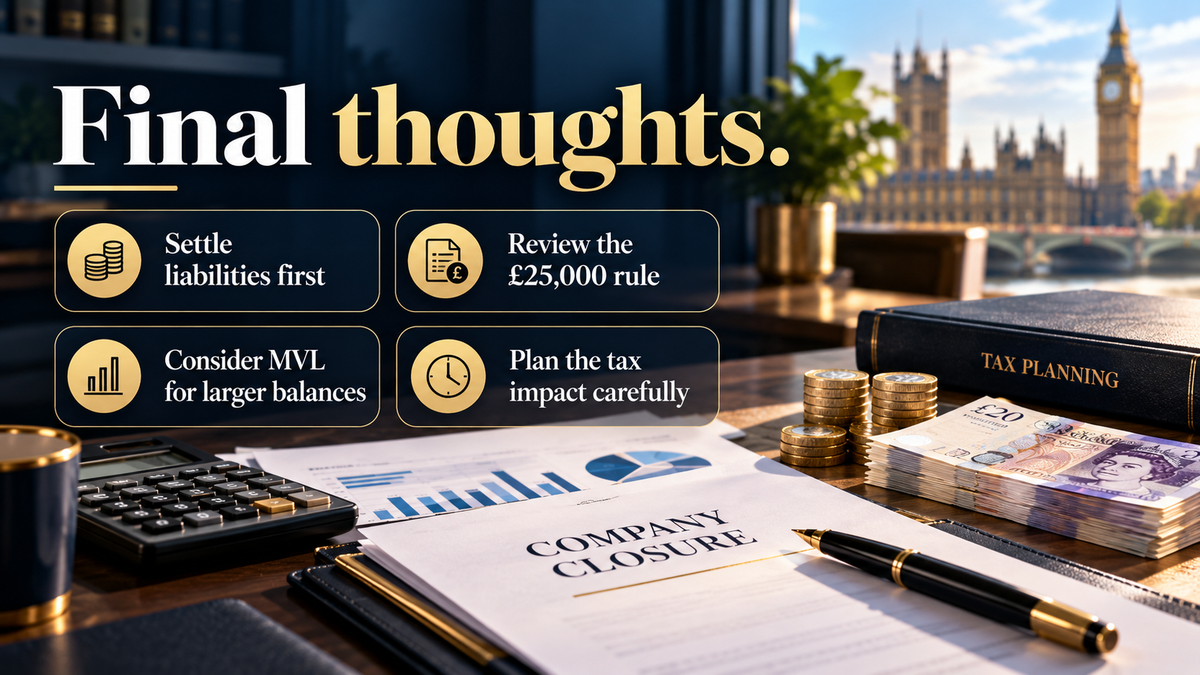
Closing Your Limited Company should be a planned financial and tax decision, not merely a request to Companies House. Start with the true balance after debts and taxes; distinguish director loans from retained profits; and compare dividends, eligible strike-off distributions and formal liquidation where appropriate. The biggest avoidable errors involve distributing too much, assuming the £25,000 rule is tax-free, overlooking anti-avoidance rules or leaving assets behind.
At Taxes Done Right Ltd, we help UK directors review their final accounts, assess extraction options and understand the personal tax consequences before the company closes. If you are considering Closing Your Limited Company, seeking tailored advice early can help protect the value you have built and bring the business to a properly documented end.
This article provides general UK information based on rules applicable in October 2026. Individual outcomes depend on the company’s and shareholders’ circumstances; obtain tailored advice before acting.
Need help deciding what’s best for your situation?
📞 Call 0161 710 1901
📧 Email Tax@TaxesDoneRight.co.uk
Visit www.taxesdoneright.co.uk