
MTD No Show: HMRC to Start Signing Up Taxpayers Who Missed the MTD Deadline
August 13, 2026
New Director Tax Requirements Raise More Questions: What Company Directors Need to Know
August 17, 2026
Companies House Changes 2028: 7 Major Accounts Filing Changes Businesses Must Prepare For
Companies House Changes 2028 will significantly change how UK limited companies prepare and submit their annual accounts. From 1 April 2028, businesses will face new requirements covering software filing, profit and loss accounts, abridged accounts, audit exemption statements and accounting reference periods.
The reforms form part of the wider changes introduced through the Economic Crime and Corporate Transparency Act 2023. Companies House Changes 2028 are intended to improve the accuracy, transparency and reliability of information held on the companies register while giving Companies House better-quality financial information.
Companies House Changes 2028 will introduce major reforms to how UK companies prepare and file their annual accounts. From 1 April 2028, companies will need to use commercial software to submit accounts to Companies House, marking a significant move towards fully digital company reporting.
The Companies House Changes 2028 will particularly affect small companies and micro-entities. New requirements will include filing profit and loss information, while abridged accounts will be removed and stronger rules will apply when companies claim audit exemptions.
Although April 2028 may seem some time away, businesses should understand the Companies House Changes 2028 early. Reviewing accounting software, bookkeeping processes and filing arrangements now can help companies avoid disruption, filing problems and unnecessary compliance issues when the new rules take effect.
For directors, accountants and small business owners, the important message is that the existing accounts filing process will not continue indefinitely. Companies House Changes 2028 mean businesses should start reviewing their accounting systems well before the April 2028 deadline.
What Are Companies House Changes 2028?
Companies House Changes 2028 represent a major modernisation of annual accounts filing in the UK. Companies House has confirmed that the reforms will come into effect from 1 April 2028, one year later than the previously planned April 2027 implementation date.
The additional preparation period is important because Companies House Changes 2028 affect virtually every UK registered company. Businesses that currently prepare their accounts themselves, companies using accountants and businesses already using accounting software will all need to consider the new requirements.
One of the objectives behind Companies House Changes 2028 is to improve the quality of financial information held on the public register. Companies House is moving away from filing methods that can result in financial information being submitted in formats that are difficult to analyse electronically.
The reforms are also part of the government’s wider efforts to tackle economic crime. More structured and reliable company information should make it easier for Companies House, HMRC and law enforcement agencies to identify inconsistencies and potentially suspicious activity.
For businesses, however, Companies House Changes 2028 are primarily about preparing for a more digital and structured accounts filing environment.
1. Software Filing Will Become Mandatory
Perhaps the biggest practical change is the move to software-only filing.
From 1 April 2028, all UK registered companies will be required to file their annual accounts using commercial software. Companies House’s existing web and paper filing routes will no longer be available for annual accounts.
This means Companies House Changes 2028 will affect companies that currently log into Companies House and manually submit micro-entity or small company accounts through the online service.
Companies that still file paper accounts will also need to change their processes.
Accounts submitted through commercial software will be filed using Inline eXtensible Business Reporting Language, commonly known as iXBRL. This format combines accounts that can be read normally by people with machine-readable tags that allow financial information to be processed and analysed electronically.
Companies House Changes 2028 therefore represent more than simply changing the website businesses use to submit accounts. The underlying financial information will become more structured and easier to compare and analyse.
Businesses already using accountants may notice relatively little difference because many accountancy practices already use specialist accounts production software capable of electronic filing.
Companies preparing and filing their own accounts will need to make sure they have suitable software in place before April 2028.
2. Companies House Web Filing Will Close for Accounts
Another important part of Companies House Changes 2028 is the closure of Companies House web-based accounts filing.
Currently, qualifying businesses can use Companies House online services to submit certain types of accounts. From 1 April 2028, this will no longer be an option for annual accounts.
It is important to understand that Companies House web services are not disappearing completely.
Businesses will still be able to use online Companies House services for various non-accounts filings, including confirmation statements and updates to company information.
The restriction under Companies House Changes 2028 specifically concerns the filing of annual accounts.
Companies that currently rely on the Companies House website should therefore identify suitable software or consider using an accountant well before the deadline.
Waiting until the company’s accounts are due could create unnecessary pressure and increase the risk of filing late.
3. Small Companies Must File Profit and Loss Accounts
One of the most significant Companies House Changes 2028 concerns small companies.
Under the new rules, small companies will be required to file a profit and loss account with Companies House. This represents a major change for businesses that currently take advantage of reduced filing requirements.
The profit and loss account provides information about a company’s financial performance, including its income and expenditure.
However, the government has recognised concerns that publishing this information could expose commercially sensitive information about smaller businesses.
As a result, small companies will be able to opt out of having their filed profit and loss account published on the public Companies House register.
This distinction is important.
Under Companies House Changes 2028, the company will still have to submit the required profit and loss information to Companies House. Opting out relates to publication of that information rather than the requirement to file it.
Companies House has confirmed that further details about how businesses will opt out of publication will be provided in due course.
4. Micro-Entities Will Also File Profit and Loss Accounts
Companies House Changes 2028 will not apply only to larger small companies. Micro-entities will also be required to file profit and loss accounts.
At present, qualifying micro-entities benefit from some of the simplest Companies House reporting requirements.
That makes this particularly important for owner-managed businesses and very small limited companies.
Under Companies House Changes 2028, micro-entities will provide Companies House with more financial information than many currently submit.
Like small companies, however, qualifying micro-entities will be able to opt out of having their profit and loss information published on the public register.
Even when publication is declined, the information will remain available to Companies House and relevant authorities, including HMRC and law enforcement.
This balance is designed to provide regulators with better financial information without necessarily exposing commercially sensitive figures belonging to smaller businesses to competitors or the general public.
5. Abridged Accounts Will Be Removed
Another major element of Companies House Changes 2028 is the removal of the option to file abridged accounts.
Abridged accounts currently allow qualifying small companies to provide less detailed information on their balance sheet and profit and loss account where the necessary conditions are satisfied.
Once Companies House Changes 2028 take effect, this filing option will disappear.
Small companies should therefore not assume that the accounts format they have used for several years will continue after April 2028.
Businesses should speak with their accountant or software provider about what information will be required under the new regime and whether their existing bookkeeping records provide sufficient detail.
The removal of abridged accounts fits with the wider purpose of Companies House Changes 2028: improving consistency and reliability across the financial information submitted to the register.
6. Stronger Audit Exemption Statements
The reforms will also strengthen requirements for companies claiming exemption from audit.
Many small companies and micro-entities qualify for audit exemption where the relevant statutory conditions are satisfied.
Under Companies House Changes 2028, companies claiming an audit exemption will be required to provide a strengthened eligibility statement.
This means directors need to be confident that the company genuinely meets the relevant conditions rather than treating the audit exemption wording as a routine part of the annual accounts process.
Companies House Changes 2028 therefore increase the importance of correctly establishing a company’s size, status and entitlement to available exemptions before its accounts are filed.
Using an accountant can be particularly valuable where a company is approaching the relevant thresholds or where its circumstances have changed significantly during the accounting period.
7. Accounts and Reports Must Be Filed Together
Another change concerns how the different components of company accounts and reports are submitted.
Companies House Changes 2028 will require the component parts of filed accounts and reports to be delivered together.
The aim is to create a more complete and consistent filing record and reduce situations where related financial information is fragmented.
For most professionally prepared company accounts, this should become part of the software filing process.
However, businesses preparing accounts internally should ensure their chosen software can correctly produce and submit all required components.
Restrictions on Changing Accounting Reference Periods
Companies will also face tighter rules when shortening their accounting reference period.
Currently, companies have greater flexibility to shorten an accounting reference period. From 1 April 2028, Companies House guidance states that a business reason will be required where a company wants to shorten its accounting reference period more than once within five years, subject to forthcoming regulations.
This part of Companies House Changes 2028 is designed to restrict repeated changes to accounting periods without an appropriate commercial reason.
Companies considering restructuring their year-end dates should therefore take professional advice rather than assuming accounting reference periods can repeatedly be shortened as an administrative convenience.
Why Are These Changes Being Introduced?
The government has identified several objectives behind Companies House Changes 2028.
The reforms are intended to improve the transparency, accuracy and reliability of information on the companies register. Better-quality financial data can help lenders, suppliers, investors and other businesses make more informed decisions about the companies they deal with.
Companies House Changes 2028 are also intended to modernise UK company reporting and strengthen Companies House’s role in tackling fraud and economic crime.
Software filing is central to this strategy.
When financial information is submitted using iXBRL, individual elements within accounts can be digitally tagged. This makes information easier for computer systems to identify, compare and analyse.
Rather than Companies House simply operating as a repository of documents, Companies House Changes 2028 support its transition towards a more active and data-driven company register.
What Do the Changes Mean for Small Businesses?
For many small businesses, Companies House Changes 2028 will mean reviewing their accounting arrangements.
Businesses already maintaining digital bookkeeping records and using an accountant may require relatively few operational changes. Their accountant’s accounts production software may already support iXBRL and electronic Companies House filing.
The impact could be greater for businesses that prepare their own annual accounts.
They will need to identify suitable commercial software and understand how to use it correctly. Companies House provides a service to help businesses identify software capable of filing different types of company accounts.
There could also be additional software costs.
However, Companies House Changes 2028 could reduce some administrative problems because software can perform validation checks before submission and provide confirmation when filings have been received, accepted or rejected.
Will Profit and Loss Accounts Become Public?
This is likely to be one of the biggest concerns surrounding Companies House Changes 2028.
Small companies and micro-entities will have to file their profit and loss accounts, but the government has confirmed that they will be able to opt out of publication.
Where the company chooses this option, the profit and loss account will not be made publicly available on the Companies House register.
However, the information will still be accessible to Companies House, HMRC and law enforcement bodies.
Further details about the opt-out process are expected before Companies House Changes 2028 become effective.
Business owners should therefore watch for further Companies House guidance rather than assuming the opt-out will happen automatically.
How Businesses Can Prepare Now
April 2028 may appear some distance away, but companies should avoid leaving preparation until their first filing deadline under the new system.
Start by reviewing how your annual accounts are currently prepared and submitted.
If you file accounts yourself through Companies House, consider moving to compatible accounting or accounts production software before Companies House Changes 2028 become mandatory.
Businesses using accountants should confirm that their accountant will be able to meet the new software filing requirements.
Accurate bookkeeping will also become increasingly important. Structured accounts filing depends on reliable underlying financial records.
Companies should therefore make sure transactions are properly recorded, bank accounts reconciled and supporting documents retained throughout the year.
Preparing early for Companies House Changes 2028 should make the transition considerably easier.
What Happens if You Use an Accountant?
Companies using accountants should generally find the transition easier.
Professional accountants commonly use specialist software to prepare statutory accounts, Corporation Tax returns and iXBRL financial statements.
Nevertheless, Companies House Changes 2028 remain the responsibility of company directors.
Appointing an accountant does not remove the directors’ legal responsibility for ensuring that company accounts are accurate and filed on time.
Directors should discuss the reforms with their accountant before April 2028, particularly if the business currently uses micro-entity or abridged accounts.
Final Thoughts
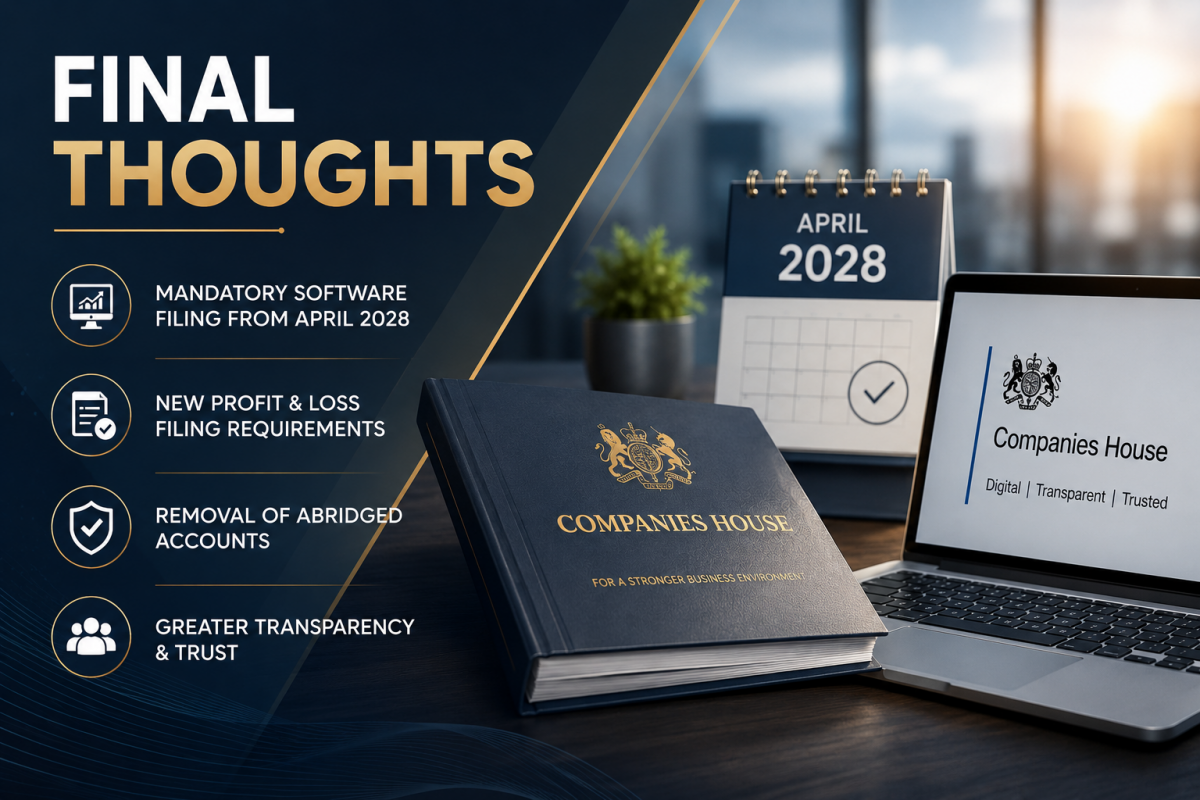
Companies House Changes 2028 represent one of the biggest reforms to UK company accounts filing in recent years. From 1 April 2028, annual accounts will move to commercial software filing, existing web and paper accounts filing routes will close, and accounts will be submitted in iXBRL format.
Companies House Changes 2028 will also require small companies and micro-entities to file profit and loss accounts, although qualifying businesses will have the option to prevent this information from being published publicly. Abridged accounts will disappear, audit exemption statements will be strengthened and accounting reference period changes will face additional restrictions.
Companies House Changes 2028 will represent a major shift in how UK businesses prepare and submit their annual accounts. From 1 April 2028, mandatory software filing will make digital accounts preparation an essential part of company compliance.
Small companies and micro-entities will face some of the most important changes, including new profit and loss account filing requirements and the removal of abridged accounts. Businesses should understand how these requirements could affect their existing accounts preparation process.
Preparing for Companies House Changes 2028 early can help businesses avoid last-minute problems. Reviewing accounting software, bookkeeping procedures and professional support well before the deadline should make the transition considerably easier.
Companies House Changes 2028 are ultimately designed to create a more accurate, transparent and digital company register. With the right preparation, businesses can adapt to the new requirements and remain compliant when the reforms come into force.
The key to managing Companies House Changes 2028 is preparation. Businesses should review their bookkeeping systems, accounts software and filing processes before the deadline rather than waiting until accounts become due.
With the right systems and professional support in place, Companies House Changes 2028 should become a manageable transition towards a more digital Companies House filing system.
Need help deciding what’s best for your situation?
📞 Call 0161 710 1901
📧 Email Tax@TaxesDoneRight.co.uk
Visit www.taxesdoneright.co.uk