January Tax Bill Shock: Why Payments on Account Increase Your Tax
October 27, 2026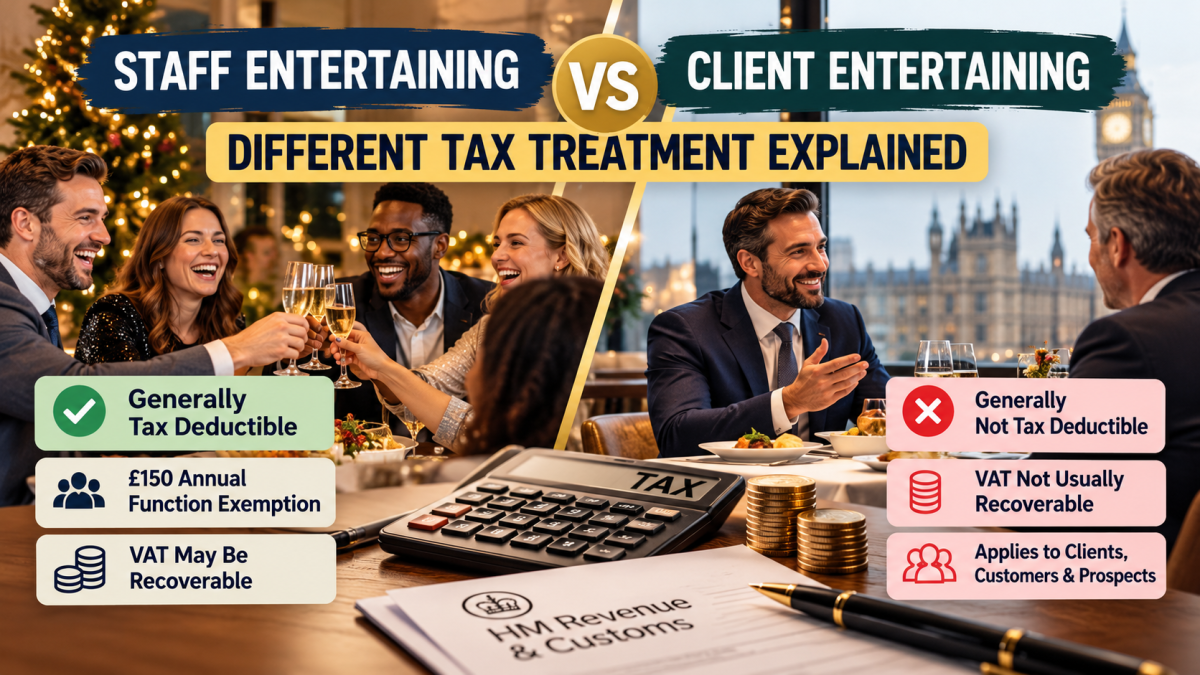
Staff vs Client Entertaining: Tax Treatment Explained for UK Businesses
Entertaining employees and clients is a common part of running a successful business. Whether you are organising a Christmas party, taking employees out for dinner, hosting a corporate event or treating an important client to lunch, these activities can strengthen relationships and create valuable business opportunities.
However, many UK business owners are unaware that the tax treatment of staff entertaining and client entertaining is significantly different.
Although both expenses may have a genuine business purpose, HM Revenue & Customs (HMRC) applies different rules when determining whether the expenditure qualifies for corporation tax relief, whether VAT can be reclaimed and whether employees face additional tax liabilities.
For example, a company Christmas party may qualify for corporation tax relief and potentially benefit from a £150 per-person tax exemption. In contrast, taking a prospective client to an expensive restaurant will normally be disallowed for corporation tax purposes, even if the meeting helps secure a profitable contract.
Understanding these distinctions can help businesses avoid unnecessary tax liabilities, maintain accurate accounting records and make better decisions about hospitality expenditure.
This guide explains the UK tax treatment of staff and client entertaining, including allowable expenses, VAT recovery, annual staff functions, director-only entertaining and common mistakes businesses should avoid.
1. What Counts as Business Entertaining?
Business entertaining generally refers to providing hospitality, meals, drinks, accommodation or recreational activities to individuals connected with a business.
The expenditure might involve:
- Taking clients to restaurants or sporting events.
- Organising Christmas parties for employees.
- Hosting networking dinners.
- Paying for staff social events.
- Providing hospitality to prospective customers.
- Arranging team-building activities.
- Inviting suppliers or business associates to corporate events.
Although these activities might all support commercial relationships, their accounting and tax consequences can differ considerably.
Under HMRC’s business entertaining guidance, entertaining generally involves free or subsidised hospitality provided to another person.
The key question is not simply whether the expense benefits the business.
Instead, HMRC considers who receives the hospitality, why it was provided and whether a specific tax exception applies.
This distinction is particularly important for limited companies, where entertainment expenditure may appear as an ordinary expense in the accounts but require an adjustment when calculating taxable profits.
2. Staff Entertaining: What Is the Tax Treatment?
Staff entertaining refers to hospitality or social activities provided primarily for employees.
Examples include Christmas parties, summer celebrations, staff lunches, organised outings and team-building events.
Generally, staff entertaining expenditure is allowable when incurred wholly and exclusively for business purposes.
This is because employers may reasonably spend money improving employee morale, encouraging teamwork, recognising employees and maintaining positive working relationships.
The relevant exception is explained in HMRC’s staff entertaining rules.
For limited companies, qualifying expenditure can normally be deducted when calculating corporation tax profits.
For example, suppose a company spends £1,200 on an annual staff celebration.
If the expenditure qualifies as genuine business-related staff entertaining, the company can normally deduct the allowable amount when calculating its taxable profits.
However, corporation tax deductibility does not automatically mean employees receive the benefit tax-free.
Employee benefit rules must be considered separately.
This distinction becomes particularly important when applying the £150 annual staff function exemption.
3. Understanding the £150 Annual Staff Party Exemption
One of the most useful exemptions available to employers concerns annual social functions.
Under HMRC’s annual party exemption, qualifying events can be exempt from employee Income Tax and National Insurance.
Three main conditions must be satisfied:
- The event must be annual, such as a Christmas party or summer celebration.
- It must be open to all employees, subject to permitted arrangements for different locations or departments.
- The total cost must not exceed £150 per person.
Importantly, the £150 figure is an exemption rather than an allowance.
This means that if a single event costs £155 per person, the exemption does not simply cover the first £150.
Instead, the full £155 per person may become taxable as an employment benefit.
Employers should therefore calculate the cost carefully before confirming bookings.
The calculation includes relevant expenditure such as venue hire, food, drinks, entertainment, transport and accommodation.
VAT must also be included when calculating the total cost per attendee.
For businesses organising expensive events, even a small increase in spending can create unexpected employee tax consequences.
4. How to Calculate the £150 Limit
The £150 exemption is calculated using the overall cost of providing the function divided by the total number of attendees.
Consider the following example.
A company organises a Christmas party with these costs:
| Expense | Amount |
|---|---|
| Venue hire | £900 |
| Food and drinks | £1,500 |
| Entertainment | £350 |
| Transport | £250 |
| Total | £3,000 |
There are 25 attendees, including employees and invited partners.
The cost per person is:
£3,000 ÷ 25 = £120 per person
Assuming the event meets the other qualifying conditions, the exemption can apply.
Now suppose the business spends £4,000 on the same event.
The cost becomes:
£4,000 ÷ 25 = £160 per person
The event exceeds the exemption threshold.
Consequently, the full cost attributable to employees and relevant guests may become taxable, rather than merely the £10 excess.
Business owners should establish their expected attendance numbers and overall budget before organising events.
5. Can Businesses Hold Multiple Staff Parties?
Yes. Employers can organise more than one annual event during the same tax year.
However, the combined cost of events selected for exemption must remain within the £150-per-person limit.
For example:
- Christmas party: £95 per person.
- Summer barbecue: £45 per person.
- Combined cost: £140 per person.
Both events may qualify for exemption.
Now consider a Christmas party costing £120 per person and a summer event costing £70 per person.
The combined cost is £190.
Both events cannot qualify together under the £150 exemption.
However, the employer may select the qualifying event that provides the most favourable result, with the other event potentially becoming taxable.
The £150 limit is not a flexible amount that can be divided between events to exempt part of an otherwise taxable function.
Employers should also distinguish annual social functions from occasional meals or celebrations.
A one-off dinner or an informal monthly gathering will not automatically qualify simply because employees attend.
The nature and purpose of each event must be considered individually.
6. What Happens When Staff Entertaining Exceeds £150?
Where a staff event does not qualify for exemption, the resulting benefit may need to be reported to HMRC.
Employers may need to report the relevant amount through Form P11D and pay Class 1A National Insurance.
The reporting requirements are explained in HMRC’s social function reporting guidance.
Alternatively, employers may consider a PAYE Settlement Agreement (PSA), where the expenditure qualifies for inclusion.
A PSA allows an employer to settle certain tax liabilities on behalf of employees.
This can be attractive because employees would otherwise potentially face personal tax charges arising from an event intended as a reward.
However, a PSA creates additional costs for the employer, as tax is generally calculated on a grossed-up basis alongside the relevant National Insurance.
The important point is that the £150 exemption relates to employee taxation.
It does not impose a general £150 limit on the amount of genuine staff entertaining expenditure deductible for corporation tax purposes.
7. Client Entertaining: Why Is the Tax Treatment Different?
Client entertaining involves providing hospitality to customers, prospective customers, suppliers or other business contacts.
Common examples include:
- Taking a client to dinner.
- Purchasing football tickets for prospective customers.
- Hosting a corporate hospitality event.
- Paying for drinks after a business meeting.
- Inviting customers to a golf day.
- Providing complimentary entertainment to business associates.
Unlike genuine staff entertaining, client entertaining is generally not deductible when calculating taxable trading profits.
This restriction applies even where the expenditure is incurred entirely for commercial reasons.
A company might spend £500 taking a potential customer to dinner and subsequently win a £50,000 contract.
Despite the clear commercial benefit, the restaurant expenditure would ordinarily remain disallowable.
This is because specific legislation restricts deductions for business hospitality.
Therefore, an expense can be commercially justifiable without qualifying for corporation tax relief.
Business owners should not assume that describing hospitality as marketing, networking or business development automatically changes its tax treatment.
The underlying nature of the expenditure remains important.
8. How Client Entertaining Affects Corporation Tax
Client entertaining expenses can still appear in a company’s accounting profit and loss statement.
However, disallowable expenditure must be added back when calculating taxable profits.
Consider a limited company with the following figures:
| Description | Amount |
|---|---|
| Accounting profit | £80,000 |
| Client entertaining expenses | £2,500 |
| Adjusted profit before other tax adjustments | £82,500 |
The £2,500 expense reduces the company’s accounting profit.
However, it is added back for corporation tax purposes because it does not qualify as a deductible trading expense.
At an illustrative corporation tax rate of 25%, the tax attributable to this adjustment would be £625.
The company has therefore incurred the £2,500 entertainment cost without obtaining corporation tax relief against its trading profits.
This demonstrates why recording expenses correctly is important.
Failing to make the required adjustments can understate taxable profits and potentially result in interest, penalties or additional HMRC enquiries.
The actual tax impact depends on the company’s applicable corporation tax rate and circumstances.
9. What About Employees Attending Client Meetings?
A frequently misunderstood area concerns employees who accompany clients to restaurants or hospitality events.
Suppose a company director takes a customer to lunch.
The meal costs £180, covering both individuals.
The director argues that their own £90 meal should qualify as an allowable staff expense.
Generally, this treatment would be incorrect.
Where the employee attends primarily to entertain the customer, the employee’s own hospitality costs are normally incidental to the client entertaining.
Consequently, the entire £180 is generally disallowed when calculating taxable trading profits.
HMRC explains this distinction in its guidance on incidental staff entertaining.
The position can differ where an employee would have received an ordinary staff meal regardless of whether a customer attended.
For instance, where an employee receives a normal subsidised canteen lunch and a customer joins them, the employee’s usual meal may remain allowable.
The purpose of the expenditure determines the outcome.
10. VAT Recovery on Staff Entertaining
VAT treatment is another important difference between staff and client hospitality.
A VAT-registered business can generally recover VAT incurred on qualifying staff entertaining where the expenditure relates to its taxable business activities.
Examples may include:
- Staff Christmas parties.
- Employee team-building activities.
- Staff outings and celebrations.
- Qualifying employee hospitality events.
However, VAT recovery requires appropriate supporting documentation and compliance with the normal input tax rules.
If an event includes employees and non-employees, the business may need to apportion the VAT.
For example, a party attended by 20 employees and 10 external guests may require the VAT attributable to non-employees to be excluded from recovery.
Furthermore, employee benefit rules and VAT rules are separate.
The fact that an event qualifies for the £150 employee tax exemption does not automatically determine how much VAT can be reclaimed.
Businesses should apply the relevant VAT rules for business entertainment independently.
11. Can VAT Be Reclaimed on Client Entertaining?
Generally, VAT incurred on entertaining UK clients and prospective customers cannot be reclaimed.
For example, suppose a VAT-registered company pays £240 for a restaurant meal, including £40 VAT, to entertain a UK customer.
The £40 VAT would normally be blocked from recovery.
The full £240 would therefore form part of the disallowable entertainment cost in the company’s tax computation.
This restriction applies despite the expenditure potentially benefiting the business.
There are limited exceptions, particularly concerning certain overseas customers.
However, overseas customer entertainment involves additional conditions and possible output VAT implications.
Businesses should not automatically reclaim VAT simply because their customer is based outside the UK.
The correct position depends on the nature of the hospitality and the applicable VAT rules.
For ordinary UK client meals and corporate hospitality, the safest general approach is to treat input VAT as non-recoverable unless a specific exception clearly applies.
12. Director-Only Entertaining: Special Considerations
Owner-managed limited companies should exercise particular care when claiming expenditure relating exclusively to directors.
For example, suppose a company with two directors pays for an expensive dinner attended only by those directors.
The expenditure should not automatically be treated as qualifying staff entertaining.
Although directors can be employees or office holders, HMRC considers the business purpose and circumstances of director-only hospitality.
In particular, VAT incurred on entertainment provided solely for directors is generally not recoverable.
By contrast, directors attending a genuine staff event alongside employees will not normally prevent recovery of the relevant staff entertainment VAT.
Corporation tax treatment requires separate consideration of whether the expenditure is genuinely incurred for business purposes.
A director-only social occasion may raise questions about personal expenditure or employment benefits.
This is especially relevant to companies operated by spouses or family members.
A limited company bank account should not be used to turn ordinary personal celebrations into deductible business expenditure.
Clear records and professional judgement are essential.
13. Entertaining Employees’ Partners and Family Members
Many businesses invite spouses, partners or family members to Christmas parties.
For employee benefit purposes, invited guests can be included when calculating the overall cost per attendee under the annual function exemption.
However, VAT recovery follows different rules.
Spouses and partners are generally non-employees for VAT entertainment purposes.
Therefore, where hospitality is provided to employees and accompanying family members, the VAT attributable to non-employees is normally blocked from recovery.
For example, if an event includes 15 employees and 15 accompanying partners, the business may need to restrict its input VAT claim to the employee-related portion.
The exact allocation should reflect the actual expenditure wherever practicable.
Businesses should not assume that the entire VAT amount is recoverable merely because the event qualifies as an annual staff function.
This difference demonstrates why the corporation tax, VAT and employment tax consequences should always be reviewed separately.
14. Staff Gifts and Trivial Benefits
Staff gifts can create additional opportunities for tax-efficient employee recognition.
Under HMRC’s trivial benefits exemption, certain benefits costing no more than £50 can be provided without creating Income Tax or National Insurance liabilities.
The conditions include:
- The benefit must cost £50 or less.
- It must not be cash or a cash voucher.
- It must not be provided as a reward for work or performance.
- It must not be part of a contractual entitlement.
Examples might include modest birthday gifts, flowers or occasional chocolates.
However, a gift specifically rewarding an employee for achieving sales targets would generally fail the exemption conditions.
Special rules also apply to directors of close companies.
Qualifying trivial benefits for such directors, including relevant benefits provided to their family or household, are subject to an annual £300 limit.
This exemption is separate from the annual staff function rules.
Businesses should avoid confusing the £50 trivial benefit threshold with the £150 annual function exemption.
15. Client Gifts: Are They Tax Deductible?
Client gifts are generally subject to restrictions similar to business entertaining.
However, certain promotional gifts can qualify for tax relief.
For example, a company providing customers with branded pens, diaries or mouse mats may be able to claim the expenditure where the statutory conditions are satisfied.
The gift must incorporate a conspicuous advertisement for the business.
Additionally, the total qualifying gift expenditure for the same recipient must not exceed £50 during the relevant tax period.
Food, drink, tobacco and certain vouchers are excluded from this particular exception.
Therefore, giving a client a £40 bottle of wine would not ordinarily qualify for corporation tax relief simply because the bottle carries the company’s logo.
Similarly, a gift costing £60 would generally fail the small promotional gift exception even where it prominently displays company branding.
The rules are explained in HMRC’s business gift guidance.
Businesses should also remember that VAT rules for gifts can differ from the direct tax rules.
16. Are Business Meetings and Refreshments Entertaining?
Not every expense involving food and drink should automatically be classified as client entertaining.
Ordinary refreshments provided during genuine business meetings may have a different character from hospitality.
For example, providing tea, coffee, water or modest refreshments during a meeting at business premises may be distinguishable from taking a client to an expensive restaurant.
However, simply calling an event a business meeting does not guarantee deductibility.
Where substantial hospitality is provided to customers free of charge, business entertaining restrictions may still apply.
Similarly, conferences, training events and promotional activities should be reviewed according to their actual purpose and content.
A genuine paid training event is not necessarily equivalent to providing complimentary hospitality.
The important distinction is between the cost of carrying out a business activity and expenditure incurred entertaining guests.
Businesses should retain agendas, invoices and explanations supporting the classification adopted.
Where entertainment forms part of a wider event, costs should be analysed carefully rather than categorising everything as an allowable business meeting expense.
17. Common Accounting Mistakes Businesses Should Avoid
Incorrectly recording entertaining expenditure can lead to inaccurate corporation tax calculations and VAT returns.
One common mistake is posting all restaurant bills to staff entertaining, regardless of who attended.
Another is reclaiming VAT on client hospitality simply because the supplier issued a valid VAT invoice.
A VAT invoice alone does not establish entitlement to input tax recovery.
Businesses also frequently misunderstand the £150 exemption and assume that expenditure exceeding the threshold is taxable only on the excess.
Other mistakes include mixing employee and client expenses without appropriate analysis, failing to retain attendees’ details and overlooking taxable employee benefits.
Incorrect treatment may also occur where employees pay for client hospitality personally and subsequently claim reimbursement.
The underlying entertainment expenditure does not become deductible merely because an employee initially paid the bill.
Regular bookkeeping reviews can help identify these issues before year-end accounts and tax returns are finalised.
18. How Should Entertaining Expenses Be Recorded?
Businesses should maintain separate accounting categories for staff entertaining and client entertaining.
This allows their accountant to identify potentially deductible expenditure and prepare appropriate tax adjustments.
For each significant event, useful records include:
- The date and location of the event.
- The business purpose.
- Names or categories of attendees.
- Whether attendees were employees or external guests.
- The total expenditure and VAT charged.
- Relevant invoices, receipts and supporting documentation.
For mixed events, a reasonable cost allocation may also be needed.
A bookkeeping system such as FreeAgent or Xero can help businesses record expenses under suitable categories.
However, selecting an accounting category does not itself determine the correct tax treatment.
The person reviewing the year-end accounts must still consider the relevant legislation.
For employee hospitality, additional information may be needed to assess annual function exemptions and benefit reporting obligations.
Good recordkeeping makes these reviews easier and reduces the risk of incorrect claims.
19. Staff vs Client Entertaining: Comparison Table
The main differences can be summarised as follows.
| Tax consideration | Staff entertaining | Client entertaining |
|---|---|---|
| Corporation tax deduction | Generally allowable if qualifying | Generally disallowed |
| VAT recovery | Generally available for qualifying staff costs | Generally blocked for UK clients |
| £150 annual function exemption | Potentially available | Not applicable |
| Employee benefit implications | Possible where exemptions fail | Depends on arrangements |
| Director-only hospitality | Requires additional scrutiny | Client entertaining rules apply |
| Supporting records | Essential | Essential |
The comparison highlights why businesses should avoid applying a single tax treatment to all hospitality expenditure.
A Christmas party organised exclusively for employees may qualify for corporation tax relief and VAT recovery.
By contrast, a similar event organised primarily to entertain customers will generally face restrictions.
Mixed events require additional consideration because different elements may receive different treatment.
20. Practical Example: A Company’s Annual Hospitality Costs
Consider a limited company that incurs the following expenditure during its accounting year:
| Type of expenditure | Amount |
|---|---|
| Annual staff Christmas party | £1,800 |
| Staff team-building event | £950 |
| Client restaurant meetings | £1,200 |
| Corporate hospitality for customers | £1,500 |
| Total expenditure | £5,450 |
Assume the staff expenditure qualifies as genuine business-related entertaining.
The company could generally claim £2,750 as deductible staff expenditure, subject to the normal accounting and tax rules.
The remaining £2,700 relating to client hospitality would ordinarily be disallowed when calculating taxable trading profits.
At an illustrative corporation tax rate of 25%, the difference in tax treatment represents £675 in potential corporation tax relief not available on the client entertaining.
The business would also need to review VAT recovery and consider whether any staff functions create employee benefit liabilities.
This illustrates why correct classification can materially affect the final tax position.
The example assumes the figures are measured consistently and ignores other tax adjustments.
21. How Can Businesses Manage Entertaining Costs Tax-Efficiently?
Businesses do not necessarily need to reduce hospitality expenditure to manage their tax position effectively.
Instead, they should understand the tax consequences before committing to significant costs.
For staff events, employers should establish a budget that considers the £150 annual function exemption.
Where multiple annual celebrations are planned, their combined costs should be reviewed.
For client entertaining, businesses should recognise that the commercial benefits may still justify the expenditure despite the lack of tax relief.
A profitable client relationship can be worth considerably more than the tax deduction that is unavailable.
However, management should assess the true after-tax cost rather than assuming every business expense reduces the tax bill.
Businesses should also distinguish genuine employee training, ordinary business travel and marketing activities from hospitality.
Accurate classification is more effective than attempting to re-label expenditure after it has occurred.
Where events involve substantial costs or mixed attendees, obtaining professional advice in advance can prevent expensive mistakes.
22. Frequently Asked Questions
Is a company Christmas party tax deductible?
Generally, yes, provided the expenditure qualifies as genuine business-related staff entertaining. The separate £150 annual function exemption determines whether employees may receive the benefit tax-free.
Can a director claim a restaurant meal with a client?
The expenditure can be recorded in the company’s accounts, but genuine client entertaining is generally disallowed when calculating taxable trading profits.
Can businesses reclaim VAT on staff Christmas parties?
VAT may generally be recovered on qualifying staff entertainment, subject to the usual input tax rules. VAT attributable to non-employee guests may need to be restricted.
Does the £150 staff party exemption include VAT?
Yes. The total cost per attendee includes VAT and relevant associated expenditure, even where some VAT may otherwise be recoverable by the employer.
Can clients attend staff Christmas parties?
Yes, but their attendance can complicate the tax treatment. Client hospitality may be disallowable, and VAT attributable to external guests may be blocked. The primary purpose of the event should also be considered.
Is taking employees to lunch tax deductible?
It depends on the circumstances. Genuine business-related staff entertaining may qualify for a deduction, but employee benefit implications must be considered. Ordinary personal meals paid through the company are not automatically allowable.
Final Thoughts

Understanding the tax treatment of staff entertaining versus client entertaining is essential for UK businesses seeking to manage expenses correctly.
While genuine staff entertaining can often qualify for corporation tax relief and VAT recovery, client entertaining is generally restricted, even where the expenditure supports business growth.
The £150 annual staff function exemption provides a useful opportunity to organise qualifying events without creating additional employee tax liabilities. However, it should not be confused with a general corporation tax deduction limit.
Business owners should also consider director-only events, mixed hospitality, employee benefits and the treatment of promotional gifts.
Above all, maintaining accurate records and applying the correct classification helps ensure that legitimate deductions are claimed without creating unnecessary HMRC compliance risks.
Need Help With Your Business Expenses and Tax Returns?
At Taxes Done Right Ltd, we help UK limited companies, directors and small business owners understand allowable expenses, corporation tax calculations, VAT recovery and HMRC compliance.
Whether you need assistance reviewing entertainment expenses, preparing company accounts or checking which costs qualify for tax relief, our experienced accountants can help.
Contact Taxes Done Right Ltd
📞 Call: 0161 710 1901
📧 Email: Tax@TaxesDoneRight.co.uk
Visit: www.taxesdoneright.co.uk
Get professional support to ensure your business expenses are recorded correctly and your tax position is managed efficiently.