VAT On Property: When Does VAT Apply in the UK?
August 25, 2026
National Insurance for Directors: How Is It Calculated in 2026/27?
August 27, 2026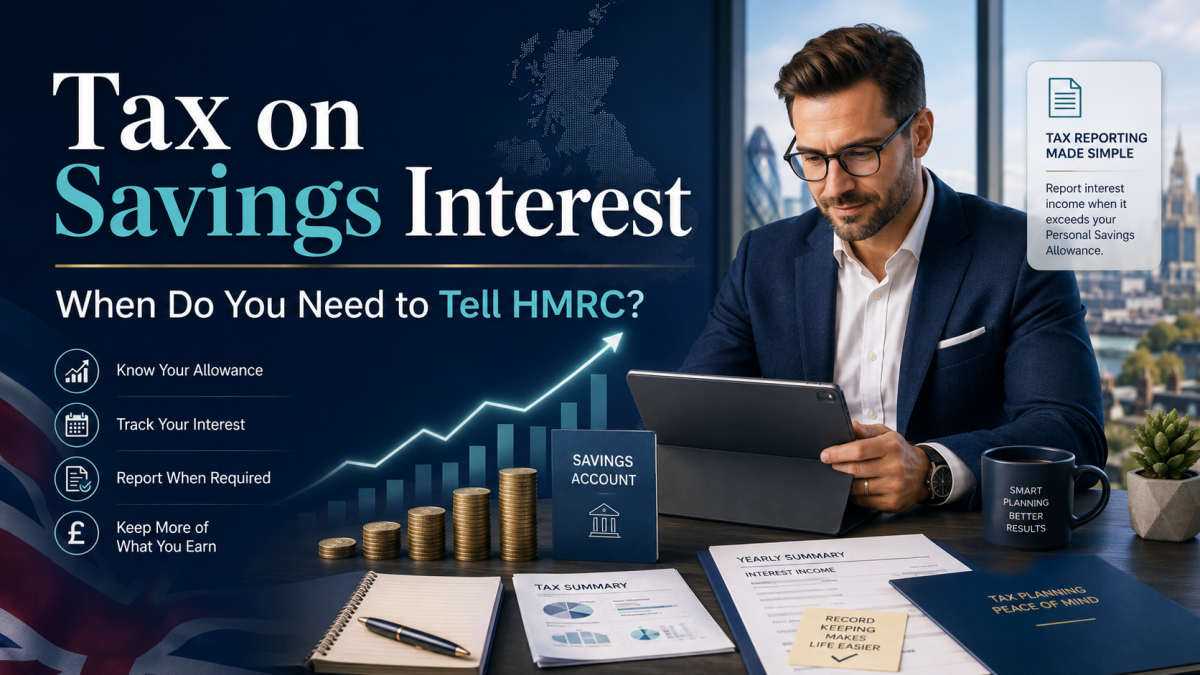
Tax on Savings Interest: When Do You Need to Tell HMRC?
Tax on Savings is becoming increasingly important for UK taxpayers as interest rates have risen and more people are receiving meaningful returns from bank accounts, building societies and other savings products. For many years, relatively low interest rates meant that Tax on Savings was something most ordinary savers rarely had to consider. Today, however, even a modest savings balance can generate enough interest to use some or all of a taxpayer’s tax-free savings allowances.
The important point is that receiving savings interest does not automatically mean that this is payable. UK tax rules provide several allowances that can protect interest from Income Tax. Depending on your other income, these can include your unused Personal Allowance, the starting rate for savings and the Personal Savings Allowance. Understanding how this interacts with your salary, pension, property income and other taxable income is therefore essential before deciding whether anything needs to be reported.
Another common misunderstanding is that you always need to complete a Self Assessment tax return when this becomes due. That is not necessarily the case. Banks and building societies generally report interest directly to HMRC, and HMRC can often collect this through a PAYE tax code. However, there are situations where you must contact HMRC or register for Self Assessment, particularly where savings and investment income becomes substantial.
This guide explains how Tax on Savings works for the 2026/27 tax year, when savings interest becomes taxable, when you need to tell HMRC and what changes are expected from April 2027.
How Tax on Savings works in the UK
Tax on Savings is part of Income Tax. Banks and building societies normally pay interest gross, meaning that Income Tax is not automatically deducted before the interest reaches your account. Whether Tax on Savings is eventually payable therefore depends on the amount of interest received and your overall tax position.
The tax year runs from 6 April to the following 5 April. Tax on Savings is calculated using interest arising during that tax year rather than simply looking at the balance sitting in your savings account. Someone with £80,000 in savings may have no Tax on Savings if their interest is sufficiently covered by available allowances, while someone with a smaller balance earning a particularly high rate could potentially have taxable interest.
For 2026/27, the standard Personal Allowance is £12,570. Where some of this allowance remains unused after considering wages, pensions and other taxable income, it may potentially shelter savings interest. Tax on Savings therefore needs to be considered as part of your entire Income Tax calculation rather than as a completely separate tax.
Savings income is generally considered after non-savings income, such as employment income, pension income or property income, when determining which tax band applies. This ordering can make Tax on Savings particularly important for people whose income is close to the higher-rate threshold. Savings interest itself can sometimes move part of your income into a higher tax band, which may also reduce the Personal Savings Allowance available.
What counts as savings interest?
Tax on Savings can apply to more than the interest earned on an ordinary bank account. HMRC states that relevant interest can include interest from bank and building society accounts, credit union accounts, certain investments, peer-to-peer lending, government or company bonds and some other financial products.
Tax on Savings can therefore arise where somebody has several different accounts even though the interest from each individual account appears relatively small. For example, £300 from one bank, £250 from another savings account, £200 from a fixed-term account and £350 from another institution could produce £1,100 of total interest. For Tax on Savings purposes, it is normally the combined taxable interest that matters.
This makes record keeping important. Tax on Savings should be reviewed using interest certificates, annual statements or online banking records for all relevant accounts. Savers who regularly move money between banks to obtain better rates should be particularly careful not to overlook an old account.
Interest earned inside qualifying tax-free products, particularly ISAs, is normally treated differently. Tax on Savings generally does not apply to interest arising inside an ISA, and that ISA interest does not use the Personal Savings Allowance. For 2026/27, the overall ISA subscription limit remains £20,000.
The Personal Savings Allowance
The Personal Savings Allowance is one of the most important parts of Tax on Savings. It allows many taxpayers to receive a certain amount of savings interest at a 0% rate.
For 2026/27, a basic-rate taxpayer can generally receive up to £1,000 of savings interest within the Personal Savings Allowance. A higher-rate taxpayer normally receives a £500 allowance, while an additional-rate taxpayer receives no Personal Savings Allowance. Tax on Savings becomes payable on interest exceeding the available allowance unless another relief or 0% band applies.
It is important to understand that the Personal Savings Allowance is not a deduction from income in the same way as the Personal Allowance. The interest still forms part of your income when determining your tax position. This means Tax on Savings can become slightly more complicated where savings interest pushes somebody from the basic-rate band into the higher-rate band.
Consider somebody whose other taxable income already places them comfortably within the basic-rate band and who receives £800 of taxable bank interest during 2026/27. Assuming there are no unusual circumstances, the £800 should fall within their £1,000 Personal Savings Allowance, so there would normally be no Tax on Savings to pay.
If the same person received £1,500 of interest, £1,000 could normally fall within the Personal Savings Allowance and the remaining £500 could be exposed to Tax on Savings. For the 2026/27 tax year, savings income falling within the basic-rate band is taxed at 20%.
A higher-rate taxpayer receiving £900 of interest would ordinarily have a £500 Personal Savings Allowance. The remaining £400 may therefore be subject to Tax on Savings at the relevant savings rate. The calculation can differ where income crosses tax bands, so Tax on Savings should ideally be calculated using your total income rather than simply applying a rate to the interest in isolation.
Additional-rate taxpayers have no Personal Savings Allowance. Consequently, Tax on Savings can apply from the first pound of savings interest unless another allowance, exemption or special rule is available.
The starting rate for savings
Another valuable Tax on Savings relief is the starting rate for savings. This mainly benefits individuals with relatively low levels of non-savings income.
For 2026/27, the starting rate for savings can provide a 0% rate on up to £5,000 of savings interest. However, the amount available reduces as your other income increases. If your non-savings income reaches £17,570 or more, you will generally not qualify for the starting rate for savings.
The maximum £5,000 band is available where relevant non-savings income does not exceed the Personal Allowance. Every £1 of qualifying other income above the £12,570 Personal Allowance normally reduces the £5,000 starting-rate band by £1. Tax on Savings can therefore be considerably lower for pensioners and other individuals with relatively modest non-savings income.
For example, imagine someone has pension income of £14,000 and savings interest of £2,500. The amount of pension income above the £12,570 Personal Allowance is £1,430. This reduces the £5,000 starting-rate band to £3,570. Their £2,500 interest could therefore potentially fall completely within the starting rate, meaning no Tax on Savings would arise on that interest.
The starting rate can also interact with the Personal Savings Allowance. In suitable circumstances, somebody with low earned or pension income can potentially receive savings interest covered by their remaining Personal Allowance, the starting rate for savings and the Personal Savings Allowance. This is why Tax on Savings for lower-income individuals should not be calculated by looking only at the £1,000 Personal Savings Allowance.
When Tax on Savings needs to be reported to HMRC
Whether you need to actively report Tax on Savings depends partly on how much interest you receive and whether you already complete Self Assessment.
If you already file a Self Assessment tax return, taxable and reportable savings interest should normally be entered on the return. Tax on Savings will then form part of your overall Self Assessment calculation. This can apply to sole traders, landlords, company directors or anyone else already required to submit a return.
HMRC specifically states that you need to register for Self Assessment if your income from savings and investments is more than £10,000. Therefore, if Tax on Savings arises and your savings and investment income exceeds this level, you should not simply assume that your bank will deal with everything automatically.
If you are employed or receive a pension through PAYE, HMRC can often collect Tax on Savings by adjusting your tax code. HMRC normally estimates your current-year savings interest using information from the previous tax year. The additional Tax on Savings is then collected gradually through PAYE rather than requiring a separate lump-sum payment.
Banks and building societies generally report the amount of interest paid to customers directly to HMRC after the end of the tax year. HMRC can use this information to calculate Tax on Savings. If you are not employed, do not receive a pension and do not normally complete Self Assessment, HMRC may contact you explaining whether Tax on Savings is payable and how it should be paid.
However, automatic reporting by banks does not remove your responsibility to ensure your tax affairs are correct. If you know that Tax on Savings should be due but HMRC has not contacted you, you should not assume that no tax is payable.
HMRC states that where someone exceeds their savings allowance and does not receive a calculation letter by 31 March following the relevant tax year, they should contact HMRC as soon as possible. This is particularly important where interest records may be incomplete or HMRC’s estimate does not reflect your actual Tax on Savings position.
What happens if you are employed?
For an employee, Tax on Savings is often handled through PAYE.
Suppose you earn £35,000 from employment and receive £1,600 of bank interest. Assuming you remain a basic-rate taxpayer after considering all relevant income and allowances, the first £1,000 may fall within your Personal Savings Allowance. The remaining £600 could be subject to Tax on Savings.
Rather than requiring you to file a tax return purely because of this amount, HMRC may adjust your PAYE code to collect the Tax on Savings through your salary. The following year’s tax code may also include an estimate of expected savings interest.
This estimation process can cause problems where interest changes significantly from year to year. Someone may move a large amount into savings following a property sale, inheritance or business transaction and suddenly earn considerably more interest. Tax on Savings based on the previous year’s figure may therefore be understated.
The opposite can also occur. If your savings balance falls substantially, HMRC may continue estimating Tax on Savings using an older, higher interest figure. Checking your PAYE coding notice can therefore help prevent unnecessary deductions.
When a Self Assessment tax return may be required
Tax on Savings by itself does not always create a Self Assessment requirement, but there are circumstances where a return becomes necessary.
As noted earlier, HMRC says registration is required where savings and investment income exceeds £10,000. A return may also already be required because you are self-employed, a business partner, have certain untaxed income, need to report foreign income or meet another Self Assessment condition.
If you need to register for Self Assessment for the previous tax year and have not already been required to file, the normal deadline for notifying HMRC is 5 October following the end of that tax year. Tax on Savings should therefore be reviewed before this deadline rather than being left until the January filing deadline.
For example, interest received between 6 April 2026 and 5 April 2027 belongs to the 2026/27 tax year. Where that Tax on Savings position creates a new Self Assessment requirement, the notification deadline would generally be 5 October 2027.
Keeping annual bank-interest statements makes completing the return considerably easier. Tax on Savings should normally be entered using the gross interest figure where appropriate rather than simply the cash remaining after any deductions.
Joint savings accounts
Joint accounts can also create questions about Tax on Savings.
HMRC’s general approach is that interest from a joint account is split equally between the account holders. A joint account producing £2,000 of interest would therefore normally result in £1,000 being attributed to each holder for Tax on Savings purposes.
This can be important where one account holder is a basic-rate taxpayer and the other is a higher-rate taxpayer. Their respective Tax on Savings liabilities may differ even though the money is held in the same account.
HMRC advises taxpayers to contact them where they believe the interest should be divided differently. Tax on Savings should therefore not automatically be allocated using whatever percentage produces the lowest tax bill without considering the underlying beneficial ownership and relevant evidence.
Married couples and civil partners may also consider whether their overall savings arrangements remain tax-efficient. Holding savings legitimately in the name of a spouse with unused allowances can sometimes reduce Tax on Savings, but ownership of the funds should reflect the actual legal and beneficial arrangements.
Children’s savings accounts
Special rules can affect Tax on Savings where parents give money to their children.
There is usually no tax problem with ordinary children’s savings, but where money provided by a parent generates more than £100 of income for the child during the tax year, settlement rules can apply. HMRC explains that where the relevant interest exceeds £100, the income can be treated as belonging to the parent for tax purposes.
This £100 rule applies separately to each parent. Tax on Savings can therefore arise for a parent even though the bank account itself is held in the child’s name.
The rule does not apply in the same way to money provided by grandparents, other relatives or friends, and interest inside a Junior ISA or Child Trust Fund is also treated differently. Tax on Savings planning for children should therefore distinguish between ordinary savings accounts and tax-free children’s products.
Parents making significant gifts into children’s savings accounts should keep records showing where funds originated. This helps determine whether any Tax on Savings needs to be attributed back to a parent.
Foreign savings interest
Tax on Savings can also apply to overseas bank accounts.
A UK resident can generally be liable to UK Income Tax on foreign interest, not just interest from UK banks. HMRC’s guidance confirms that savings and investment income arising abroad can fall within the UK tax system for UK residents, subject to residence rules and any available Foreign Income and Gains relief.
Foreign Tax on Savings can be more complicated because the overseas bank may not report information in exactly the same way as a UK institution. Foreign income may also create a Self Assessment requirement even where the amount involved seems relatively modest.
Where foreign tax has already been deducted, double-taxation relief may sometimes be available so that the same interest is not fully taxed twice. Tax on Savings should therefore be calculated using both the UK rules and the relevant foreign tax position.
Anyone holding overseas accounts should avoid assuming that foreign interest can be ignored because the funds remain abroad. Tax on Savings can still arise depending on UK residence and the applicable foreign-income regime.
Fixed-term accounts and when interest is taxable
Fixed-term savings products can create confusion over when Tax on Savings arises.
The relevant point is generally when interest becomes taxable or available under the terms of the product rather than simply dividing the total expected interest evenly across every year. Different savings products may credit interest monthly, annually or at maturity.
For example, an account paying annual interest may create Tax on Savings each year, while another product may credit interest differently. Large fixed-term deposits can therefore lead to a significant amount of interest being recognised during one tax year.
This can affect the Personal Savings Allowance and even the taxpayer’s Income Tax band. Tax on Savings planning should therefore include checking exactly when the bank credits or makes interest available.
Before placing a large sum into a multi-year savings bond, consider the tax timing as well as the headline interest rate. Tax on Savings can materially affect the true return where large amounts of interest arise in a single year.
How much Tax on Savings could you pay?
For the 2026/27 tax year, savings income above available 0% allowances is generally taxed at 20% within the basic-rate band, 40% within the higher-rate band and 45% at the additional rate.
Imagine a basic-rate taxpayer receives £2,000 of bank interest and has no starting-rate entitlement. The first £1,000 may be covered by the Personal Savings Allowance, leaving £1,000 potentially exposed to Tax on Savings. At a 20% savings rate, this would produce £200 of tax.
If a higher-rate taxpayer receives £2,000 of interest, the Personal Savings Allowance may be only £500. That could leave £1,500 exposed to Tax on Savings. If all of it falls within the higher-rate savings band at 40%, the resulting Tax on Savings would be £600.
For an additional-rate taxpayer, there is no Personal Savings Allowance. If £2,000 of interest is taxable at 45%, Tax on Savings could therefore reach £900.
These examples are simplified. Your actual Tax on Savings calculation can change where income crosses bands, the Personal Allowance is restricted, the starting rate applies or other income and reliefs affect your overall position.
Why higher interest rates have increased the issue
Tax on Savings has become relevant to considerably more people because savings accounts can now generate much greater interest than during periods of extremely low rates.
Consider someone holding £50,000 in taxable savings at an average interest rate of 4%. That could produce approximately £2,000 of annual interest. Even a basic-rate taxpayer with a £1,000 Personal Savings Allowance may therefore have Tax on Savings to pay.
A higher-rate taxpayer may reach their £500 allowance much sooner. At 4%, savings of only £12,500 could generate £500 of interest. Any additional interest could potentially create Tax on Savings.
This means taxpayers should review Tax on Savings annually rather than assuming that because they did not pay tax on interest several years ago, the same result automatically applies now.
Higher savings balances created by inheritances, property sales, business disposals or temporarily holding mortgage funds can create particularly large Tax on Savings liabilities.
Reducing Tax on Savings legally
One of the simplest ways to reduce Tax on Savings is to make appropriate use of ISAs. Interest and qualifying investment returns generated inside an ISA are generally tax-free, so ISA income does not normally use your Personal Savings Allowance.
For 2026/27, the overall ISA subscription limit is £20,000 per individual. Tax on Savings planning between spouses or civil partners can therefore involve considering both individuals’ ISA allowances where appropriate.
You can also review the ownership of ordinary savings. Where one spouse has unused allowances or pays tax at a lower rate, legitimate transfers of savings may sometimes reduce the household’s Tax on Savings. The ownership must genuinely transfer rather than simply being changed on paper solely for reporting purposes.
Low-income taxpayers should also check their starting-rate entitlement carefully. Someone who assumes that only the £1,000 Personal Savings Allowance is available could unnecessarily believe Tax on Savings is due when some or all of their interest actually falls within the £5,000 starting-rate band.
Similarly, maintaining accurate records can prevent excessive Tax on Savings being collected through an incorrect PAYE estimate. If HMRC’s estimated interest no longer reflects your circumstances, updating HMRC may prevent an incorrect tax code.
Changes coming from April 2027
Tax on Savings is particularly important to review now because savings tax rates are scheduled to rise from 6 April 2027.
For the 2027/28 tax year, the savings basic rate is set to increase from 20% to 22%, the savings higher rate from 40% to 42% and the savings additional rate from 45% to 47%. The government has stated that the Personal Savings Allowance and starting-rate structure will remain unchanged.
This means Tax on Savings above the available allowances will become more expensive from April 2027. Someone with £5,000 of taxable savings income above their allowances could potentially pay an additional £100 purely because of a two-percentage-point increase in the applicable rate.
ISA rules are also changing from 6 April 2027. The government has announced a £12,000 annual cash ISA limit within the overall £20,000 ISA limit, although savers aged over 65 are expected to continue being able to contribute up to £20,000 to a cash ISA.
These changes mean Tax on Savings planning should increasingly form part of wider personal tax planning rather than being considered only after the end of the tax year.
Common mistakes to avoid
A frequent Tax on Savings mistake is looking at only one bank account. HMRC considers the taxpayer’s overall taxable savings interest, so interest across multiple institutions should be combined.
Another Tax on Savings mistake is assuming that the Personal Savings Allowance means everyone receives £1,000 of tax-free interest. Higher-rate taxpayers generally receive only £500, while additional-rate taxpayers receive no Personal Savings Allowance.
Some taxpayers also confuse the £1,000 Personal Savings Allowance with the £5,000 starting rate for savings. They are different provisions. Tax on Savings calculations can involve both, but eligibility for the starting rate depends heavily on the level of non-savings income.
Another mistake is assuming that because banks report interest to HMRC, the taxpayer has no responsibility. If Tax on Savings is due and HMRC does not correctly collect it, the taxpayer may still need to contact HMRC.
Foreign accounts are another area where Tax on Savings can easily be overlooked. UK residents should review overseas interest alongside their UK savings and consider whether Self Assessment is required.
Finally, taxpayers should check tax codes rather than simply accepting them. HMRC may use previous-year interest to estimate current Tax on Savings, which can produce incorrect deductions when savings balances or interest rates change significantly.
What records should you keep?
Good records make Tax on Savings much easier to manage.
Keep annual interest statements, certificates of interest, bank statements and details of accounts opened or closed during the tax year. If you have foreign accounts, retain information showing the foreign interest received and any overseas tax deducted.
For joint accounts, keep evidence supporting the beneficial ownership of the funds if interest is not intended to be treated equally. For children’s accounts, records of who provided the money can be important when determining whether Tax on Savings belongs to the parent or child.
You should also compare the interest shown on your own records with any figures HMRC uses in your PAYE tax code or Self Assessment calculation. Tax on Savings errors are easier to correct when clear documentation is available.
Keeping records by tax year rather than calendar year also makes the process easier, because Tax on Savings is assessed for the period from 6 April to 5 April.
Do you need to tell HMRC?
The key question is not simply whether you received interest. Instead, determine whether the interest is covered by your Personal Allowance, starting rate for savings, Personal Savings Allowance or another tax exemption.
If everything is covered, Tax on Savings may be nil. If there is taxable interest and you are employed or receiving a pension, HMRC may be able to collect the Tax on Savings automatically through PAYE.
If savings and investment income exceeds £10,000, HMRC states that registration for Self Assessment is required. If you already complete a tax return, the relevant savings interest should normally be included on it.
If Tax on Savings appears to be due but HMRC has not contacted you, do not automatically assume the interest has been ignored legitimately. Check your Personal Tax Account, PAYE coding information and annual interest statements, and contact HMRC where appropriate.
Final thoughts

Tax on Savings is easy to overlook because interest is usually paid directly into a bank account without tax being deducted first. However, higher savings rates mean that more taxpayers can now exceed their allowances. Tax on Savings should therefore be reviewed each tax year alongside employment income, pensions, rental profits, dividends and other taxable income.
The amount of Tax on Savings you pay depends on much more than your bank balance. Your tax band, Personal Savings Allowance, Personal Allowance and possible entitlement to the starting rate for savings can all affect the calculation. Tax on Savings can also require additional consideration where you have joint accounts, foreign savings, children’s accounts or large fixed-term deposits.
Most importantly, do not assume that Tax on Savings is automatically dealt with simply because your bank reports interest to HMRC. Check the figures, understand whether a PAYE adjustment or Self Assessment return is required and keep appropriate records. With careful planning, Tax on Savings can often be managed efficiently while ensuring that the correct amount is reported and paid to HMRC.
Need help deciding what’s best for your situation?
📞 Call 0161 710 1901
📧 Email Tax@TaxesDoneRight.co.uk
Visit www.taxesdoneright.co.uk