Family Investment Companies: benefits, costs and common misconceptions
November 5, 2026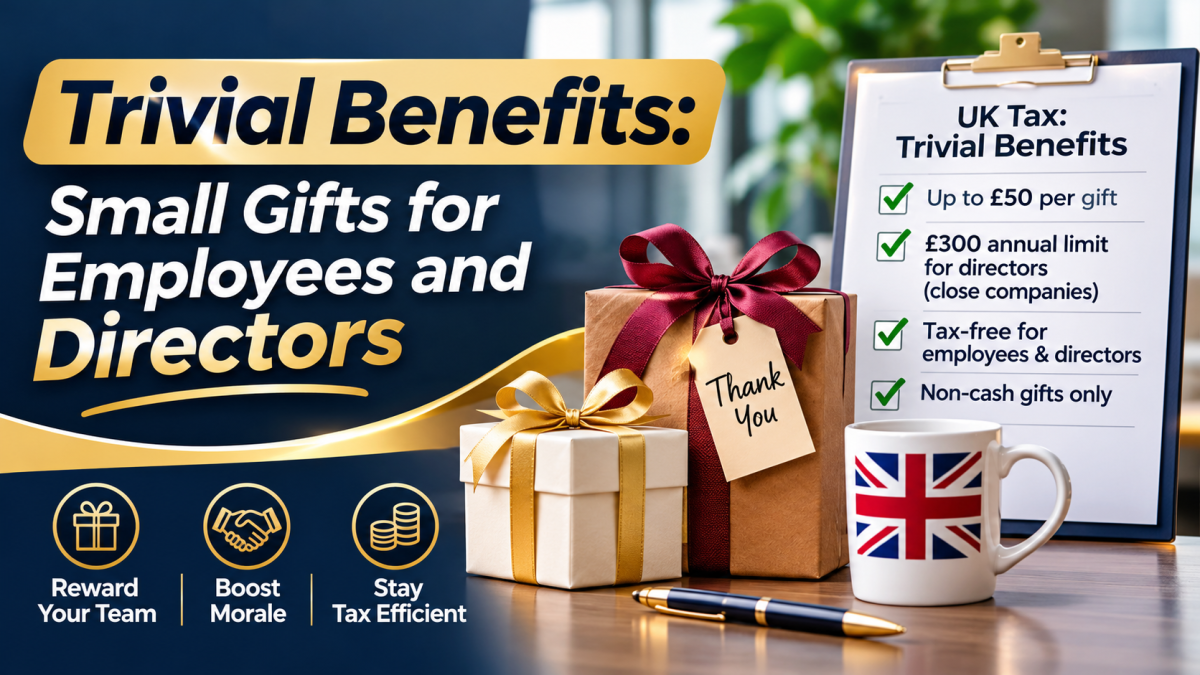
Trivial benefits: small gifts for employees and directors
Running a business involves more than managing finances, meeting deadlines and generating profits. Recognising employees, celebrating special occasions and maintaining a positive working environment are equally important. However, many UK business owners are unaware that certain small gifts can be provided without creating additional tax liabilities.
This is where Trivial benefits can make a difference.
Under HMRC rules, employers can provide qualifying small gifts to employees and directors without triggering Income Tax or National Insurance contributions. These gifts can include chocolates, flowers, gift vouchers and other modest gestures of appreciation.
For limited company directors, the exemption can also provide a useful opportunity to receive occasional tax-free benefits from their company, subject to specific restrictions.
Nevertheless, the exemption is not as straightforward as simply spending £50 on a gift. The nature of the benefit, the reason for providing it and the recipient’s circumstances all matter.
This guide explains how the rules work, which gifts qualify, what company directors need to consider and how businesses can avoid expensive mistakes.
1. What Are Trivial Benefits?
Trivial benefits are small, non-cash benefits provided by an employer that meet specific conditions for exemption from Income Tax and National Insurance.
The exemption is governed by Section 323A of the Income Tax (Earnings and Pensions) Act 2003.
According to HMRC’s official guidance on trivial benefits, an employer can provide a qualifying benefit costing £50 or less without reporting it to HMRC.
For example, a company might provide an employee with a £30 birthday gift or a £40 Christmas hamper.
Provided the qualifying conditions are satisfied, neither the employer nor the employee needs to pay Income Tax or National Insurance on the benefit.
The important distinction is that these gifts must be genuine gestures rather than disguised remuneration.
Businesses should therefore distinguish occasional gifts from bonuses, commission payments and contractual employee rewards.
Understanding this distinction is essential for using the exemption correctly.
2. The Four Essential HMRC Conditions
To qualify for the exemption, a benefit must satisfy four requirements.
Condition 1: The benefit must cost £50 or less.
The total cost of providing each benefit cannot exceed £50, including VAT and associated costs.
Condition 2: The benefit cannot be cash or a cash voucher.
Physical gifts and qualifying non-cash gift vouchers are permitted, but cash payments are excluded.
Condition 3: The benefit cannot be contractual.
Employees must not be entitled to receive the gift under their employment contract or salary sacrifice arrangements.
Condition 4: The benefit cannot reward employment performance.
The gift must not recognise particular services performed, or anticipated, as part of the employee’s duties.
All four conditions must be satisfied simultaneously.
A £20 gift awarded for exceeding sales targets, for instance, would not qualify despite falling below the monetary threshold.
Where the conditions are not met, normal employment tax rules apply unless another exemption is available.
3. Understanding the £50 Limit
The £50 limit is one of the most important aspects of the exemption.
It applies to the total cost of providing an individual benefit, rather than the amount the employee personally values it at.
For example:
- A £25 box of chocolates can qualify.
- A £45 restaurant gift voucher can qualify.
- A £50 birthday hamper can qualify.
- A £55 gift cannot qualify under this exemption.
Importantly, the £50 limit is not a tax-free allowance with tax payable only on the excess.
If a benefit costs £51, the entire £51 falls outside the trivial benefit exemption.
Businesses must also include VAT and relevant delivery or packaging expenses when calculating the cost.
A gift priced at £45 plus £9 VAT costs £54 and therefore exceeds the threshold.
If several items are combined into one gift package, their total cost must be considered.
Checking the complete purchase cost before ordering gifts prevents avoidable tax complications.
4. Trivial Benefits for Limited Company Directors
Limited company directors can also benefit from these rules, but an additional restriction applies to directors and other office holders of close companies.
A close company is broadly a company controlled by five or fewer participators, or by participators who are directors.
Most small owner-managed limited companies fall within this definition.
For qualifying directors, the maximum exemption is £300 per tax year, in addition to the £50 limit for each individual benefit.
For example, a director could potentially receive:
- Birthday gift: £50
- Christmas gift: £50
- Easter gift: £50
- Anniversary gift: £50
- Summer gift: £50
- Another occasional gift: £50
Total annual value: £300.
Each gift must independently satisfy the qualifying conditions.
The annual restriction runs from 6 April to 5 April, following the UK personal tax year rather than the company’s accounting year.
Directors should maintain a record of the date and cost of every benefit.
5. Can Directors Receive More Than £300?
A director of a close company cannot claim the exemption on unlimited gifts throughout the year.
Once the £300 annual exempt amount has been exhausted, further benefits cannot qualify under this exemption for that individual.
There is also an important restriction where an additional gift causes the annual limit to be exceeded.
Suppose a director has already received qualifying benefits costing £280.
The company then provides another gift costing £40.
Although the individual gift is below £50, it takes the year’s total to £320.
The additional £40 gift is not exempt; it is not simply the £20 excess that becomes taxable.
The £300 restriction applies per individual and per employer.
It can also cover benefits supplied to members of the director’s family or household, rather than creating a separate £300 allowance for every family member.
Planning gifts in advance can help directors remain within the permitted limits.
6. Ten Examples of Tax-Free Employee Gifts
Businesses have considerable flexibility when selecting suitable gifts.
The following examples may qualify where all the statutory conditions are satisfied.
1. Birthday chocolates: A £20 chocolate selection provided to celebrate an employee’s birthday.
2. Christmas hampers: A festive hamper costing £45, including VAT and delivery.
3. Flowers: A £35 bouquet to congratulate an employee on a personal milestone.
4. Non-cash gift cards: A £40 voucher redeemable for goods at a particular retailer.
5. Restaurant vouchers: A £50 voucher for a restaurant meal, given as a personal gift rather than a performance reward.
6. New baby gifts: Baby clothes or a gift basket costing £30.
7. Wedding presents: A £45 household gift to celebrate an employee’s marriage.
8. Easter treats: A £15 chocolate hamper or similar seasonal present.
9. Sympathy gifts: Flowers or a suitable gift provided during bereavement.
10. Small experience gifts: A £45 cinema or leisure voucher that meets the non-cash requirements.
These examples demonstrate how relatively modest spending can support employee relationships without creating unnecessary tax liabilities.
The reason for providing each gift remains crucial.
7. Are Gift Cards and Vouchers Allowed?
Gift cards are popular because employees can choose something they genuinely want.
Fortunately, many non-cash gift vouchers can qualify for the exemption.
For example, a £40 retailer voucher that can only be exchanged for goods may be eligible.
However, not every type of voucher receives identical tax treatment.
A voucher redeemable for cash, or effectively operating as a cash substitute, may fall outside the exemption.
Employers should also consider whether the voucher is being provided as a genuine gift or as compensation for work.
HMRC’s guidance on cash and non-cash vouchers explains the distinction.
Another potential complication arises when employers repeatedly top up the same gift card.
HMRC may regard those top-ups as part of one continuing benefit, requiring the combined cost to be assessed.
Separate gifts should not be assumed to qualify merely because individual transactions are below £50.
8. Why Performance Rewards Do Not Qualify
A common misconception is that any gift costing less than £50 automatically qualifies.
In reality, HMRC specifically excludes benefits given in recognition of particular employment services.
Examples include:
- A £40 voucher for achieving a monthly sales target.
- A £25 gift for completing an important project.
- A £30 reward for reaching a productivity milestone.
- A £50 present for working additional hours.
These gifts are connected to the employee’s work and therefore cannot qualify under the trivial benefit exemption.
The position differs when gifts are provided for personal occasions, such as birthdays or weddings.
For example, an employee receiving a £30 birthday gift independently of their performance may qualify.
However, the same employee receiving a £30 voucher for generating new business would not.
Employers should therefore avoid describing qualifying gifts as bonuses, incentives or performance awards.
The actual circumstances matter more than the wording used in accounting records.
9. Do Employees Have an Annual Limit?
Unlike directors of close companies, ordinary employees do not have a specific £300 annual cap under the trivial benefit legislation.
This means employees could receive multiple qualifying gifts during the year.
For example, an employee might receive a £30 birthday present, a £40 Christmas hamper and a £25 wedding gift.
Each occasion can potentially qualify separately.
Nevertheless, the absence of an annual monetary cap does not mean businesses should establish unrestricted gift arrangements.
Regular payments, repeated benefits or gifts linked to employment duties can create complications.
If an employee receives a guaranteed £40 voucher every month under an employment agreement, the exemption would not apply.
Similarly, a recurring arrangement may indicate that gifts are effectively part of remuneration.
The safest approach is to provide genuine, occasional benefits without contractual entitlement or a performance connection.
Employers should assess the substance of each arrangement rather than relying solely on its cost.
10. Can Family Members Receive Gifts?
Family members can sometimes benefit from the exemption, but the circumstances require careful consideration.
The legislation allows qualifying benefits to be provided to employees or members of their family or household.
For directors of close companies, however, benefits provided to qualifying family or household members are generally brought within the director’s £300 annual limit.
For example, a director may receive £200 in qualifying gifts during the tax year.
The company subsequently provides a £50 gift to the director’s spouse, who is not an employee.
That family gift may count towards the director’s annual exemption, increasing the total to £250.
The company cannot automatically claim another £300 allowance simply because the gift is intended for the spouse.
Where the spouse is genuinely employed by the company, their individual employment position must be assessed separately.
HMRC’s guidance on family and household members explains these additional considerations.
Accurate records are especially important in family-run businesses.
11. Corporation Tax Treatment of Gifts
One attraction of providing qualifying employee benefits is that the expenditure may also be deductible when calculating company profits.
Generally, genuine staff welfare expenditure incurred wholly and exclusively for business purposes can qualify as a business expense.
For example, a limited company purchasing qualifying Christmas gifts for employees may be able to deduct the expenditure when calculating taxable profits.
However, the Income Tax exemption and Corporation Tax deductibility are separate questions.
A gift being exempt for the employee does not automatically guarantee a Corporation Tax deduction for the employer.
This distinction becomes particularly important where a close company purchases gifts for its directors or their families.
The commercial purpose, employment relationship and actual nature of the expenditure should be considered.
Businesses should not assume that gifts to shareholders or their relatives are automatically deductible simply because their value is below £50.
Appropriate supporting evidence and professional advice help establish the correct treatment.
12. VAT Treatment of Trivial Benefits
VAT-registered businesses should consider the VAT implications before purchasing gifts.
The employee benefit exemption concerns Income Tax and National Insurance; it does not create a separate automatic VAT exemption.
Where goods or services are purchased for genuine business purposes, input VAT may be recoverable under the normal rules.
However, gifts involving private consumption or particular individuals can create additional considerations.
Depending on the circumstances, an output VAT charge may arise even where the original purchase VAT was recoverable.
The VAT treatment of gift vouchers can also differ from that of physical goods.
HMRC’s VAT guidance on employee rewards and perks provides additional detail.
For the £50 exemption test, the VAT-inclusive cost must be used, regardless of whether the company can recover input VAT.
This is particularly relevant where a business purchases items advertised at prices excluding VAT.
Employers should examine both taxes separately rather than assuming the same rules apply.
13. Are Christmas Gifts Tax-Free?
Christmas is one of the most common occasions for providing qualifying gifts.
Employers frequently purchase hampers, chocolates, bottles of wine or non-cash vouchers to recognise the festive season.
Such gifts may qualify where the cost does not exceed £50 per employee and no contractual or performance-related obligation exists.
For example, a company employing 12 people could provide each employee with a £40 Christmas gift.
The total employer expenditure would be £480.
Provided every gift meets the requirements, the employees would not incur Income Tax or National Insurance on those benefits.
Company directors may also receive qualifying Christmas gifts, subject to the additional close-company annual cap.
However, employers should distinguish Christmas gifts from staff Christmas parties.
Annual staff functions have their own tax exemption, with different qualifying conditions.
Businesses should not confuse the two arrangements or assume that their respective limits operate identically.
14. Trivial Benefits Versus Staff Parties
Businesses often confuse the £50 gift exemption with the £150 annual staff function exemption.
Although both can support employee welfare, they are separate tax provisions.
The trivial benefit exemption generally applies to qualifying individual benefits costing no more than £50.
By contrast, qualifying annual staff functions may benefit from a separate £150-per-head annual exemption.
Staff functions must meet their own conditions, including availability to employees generally and the relevant cost limits.
For example, a company might organise a qualifying Christmas party costing £120 per head.
It could also provide employees with separate £30 Christmas gifts.
Both arrangements may receive favourable tax treatment if their respective requirements are met.
However, a party arranged specifically to reward exceptional sales performance may require further consideration.
Employers should identify the correct exemption for each expense rather than combining the rules.
Separate accounting records can make this distinction much easier during year-end reviews.
15. Recording Gifts in Company Accounts
Although qualifying gifts do not need to be reported to HMRC as taxable benefits, sensible recordkeeping remains essential.
Employers should retain purchase invoices and maintain a simple schedule.
Useful information includes:
- Date the benefit was provided.
- Name of the recipient.
- Description of the gift.
- Total VAT-inclusive cost.
- Reason for providing the gift.
- Cumulative annual value for close-company directors.
For example, an accounting record might describe an expense as “Employee birthday gift – £35 – non-performance-related”.
This provides clearer evidence than a vague description such as “Staff bonus”.
Businesses using accounting software should categorise the expenditure consistently and retain supporting documentation.
For directors, a running total can prevent accidental breaches of the £300 annual limit.
Records also help establish whether multiple purchases relate to one combined benefit.
Maintaining an organised schedule makes year-end accounting easier and supports the company’s position if HMRC raises questions.
16. Common Mistakes That Businesses Should Avoid
Despite the apparent simplicity of the rules, several recurring mistakes can create unexpected tax bills.
Exceeding £50: Even a small excess prevents the entire benefit from qualifying.
Ignoring VAT: Using the price excluding VAT can produce an incorrect calculation.
Giving cash: Cash payments are not covered by the exemption.
Rewarding performance: Gifts connected to employment achievements do not qualify.
Using contractual benefits: Guaranteed entitlements and salary sacrifice arrangements are excluded.
Exceeding the director limit: Close-company directors must consider the cumulative £300 annual restriction.
Repeatedly topping up vouchers: Several transactions may represent a single benefit whose total cost exceeds £50.
Ignoring family gifts: Gifts to a director’s family or household may count towards their annual cap.
Failing to maintain evidence: Poor documentation makes the intended tax treatment harder to substantiate.
Where a benefit fails the conditions, employers should establish its correct reporting and tax treatment rather than automatically treating it as exempt.
17. What Happens When a Gift Does Not Qualify?
A non-qualifying gift does not necessarily mean the expenditure is prohibited.
It simply means the trivial benefit exemption cannot be applied.
Depending on the type of benefit, the employer may need to report its taxable value and account for the relevant tax or National Insurance.
For example, a taxable non-cash benefit may require reporting through payroll benefits arrangements or a P11D, depending on the applicable reporting rules.
Cash bonuses normally follow different treatment through payroll.
Employers may also need to consider Class 1A National Insurance or other relevant obligations.
In some circumstances, a PAYE Settlement Agreement may allow an employer to settle tax and National Insurance on eligible minor, irregular or impracticable benefits.
However, this is not an automatic substitute for the trivial benefit exemption.
The correct approach depends on the reason for the gift, the form of payment and the relevant tax rules.
18. Practical Examples for Small Businesses
Consider a small consultancy with one director and three employees.
During the tax year, the company provides each employee with a £35 birthday gift and a £45 Christmas hamper.
Each employee receives £80 in total through two separate occasions.
Assuming all conditions are met, the gifts may qualify without an annual cap applying to those ordinary employees.
The director receives four separate qualifying gifts costing £50 each.
Their annual total is £200, leaving £100 of the close-company exemption potentially available.
Now consider a different scenario.
A company gives an employee a £45 voucher for meeting a sales target.
Although the cost is below £50, it is performance-related and therefore fails the exemption.
These examples illustrate why the qualifying conditions are more important than the gift’s description or monetary value alone.
A short review before purchasing benefits can prevent future payroll adjustments and compliance issues.
19. How Trivial Benefits Support Employee Retention
Small gestures can contribute to a positive workplace culture.
Remembering birthdays, celebrating personal milestones and acknowledging significant life events can help employees feel valued.
The benefit does not need to be expensive to have a meaningful impact.
A thoughtful £25 gift may be more appreciated than a generic gesture costing considerably more.
For smaller businesses operating with limited budgets, modest staff gifts can provide a practical way to demonstrate consideration without creating unnecessary employment tax costs.
Nevertheless, employers should not use the exemption as a replacement for appropriate salaries, bonuses or established employee benefits.
Performance incentives and contractual reward packages have distinct purposes and tax treatment.
A balanced approach recognises that occasional gifts complement, rather than replace, normal remuneration.
Businesses should also ensure gifts are appropriate, inclusive and consistent with their workplace policies.
Thoughtful planning can strengthen employee relationships while helping employers maintain effective cost controls.
20. How Taxes Done Right Can Help
Understanding the rules surrounding employee gifts is only one part of managing a tax-efficient business.
For company directors, important considerations also include salary planning, dividends, Corporation Tax, payroll compliance and business expenditure.
At Taxes Done Right Ltd, we help limited companies, directors and small business owners understand their tax obligations and identify legitimate opportunities for tax efficiency.
Our services include:
- Limited company accounts and Corporation Tax returns.
- Director remuneration and tax planning.
- Payroll and employer compliance.
- Business expenditure reviews.
- Self Assessment tax returns.
- Practical advice on employee benefits.
We can help businesses understand whether particular gifts qualify for exemption and how the expenditure should be recorded.
Where more complicated benefits are involved, reviewing the arrangements before implementation can reduce the risk of unexpected tax liabilities.
Visit Taxes Done Right to explore our accounting and tax services.
Final Thoughts
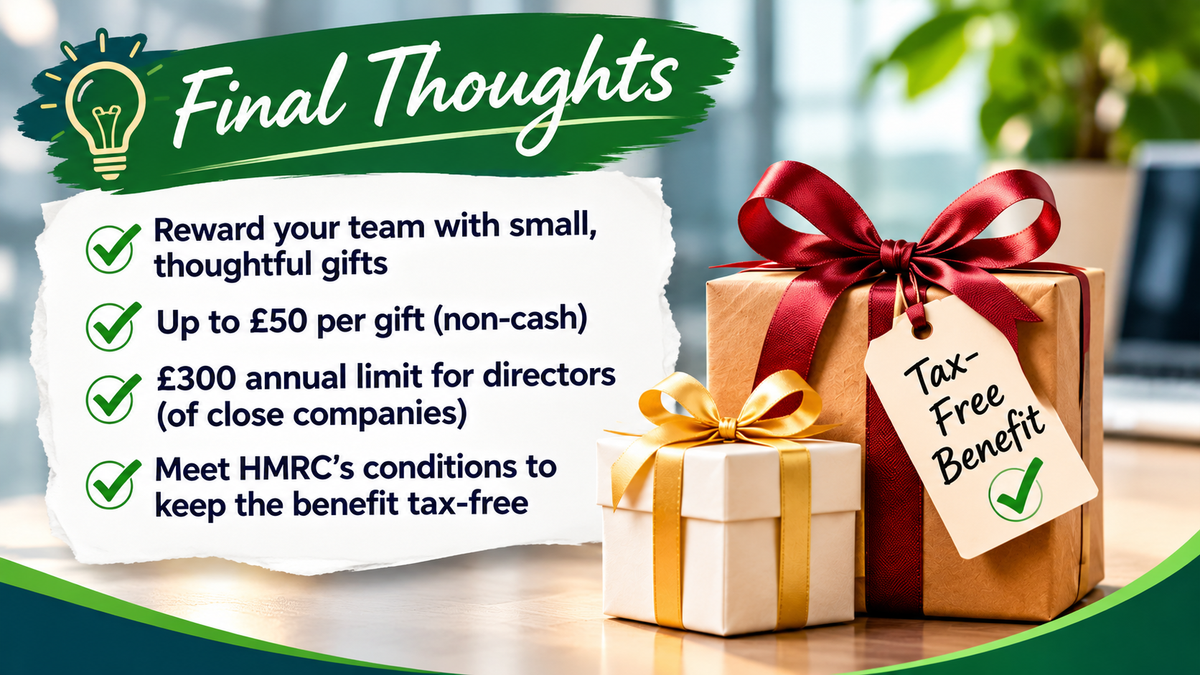
Trivial benefits offer UK employers a straightforward opportunity to provide small, thoughtful gifts without creating additional Income Tax or National Insurance liabilities.
For ordinary employees, there is no specific annual monetary cap, provided each benefit genuinely satisfies the qualifying conditions.
For directors of close companies, the £300 annual exemption provides a useful additional consideration when planning modest personal benefits.
However, businesses must remember that the £50 threshold, non-cash requirement, contractual restrictions and performance-related exclusions are fundamental.
A gift that fails even one of these tests may become taxable.
Maintaining records, reviewing the purpose of each gift and checking the full VAT-inclusive cost can help employers use the rules correctly.
When incorporated into sensible business practices, occasional gifts can support staff morale while offering legitimate tax advantages.
Need advice on tax-efficient employee benefits or limited company expenses?
📞 Call: 0161 710 1901
📧 Email: Tax@TaxesDoneRight.co.uk
Visit: www.taxesdoneright.co.uk
Get professional support to ensure your business expenses are recorded correctly and your tax position is managed efficiently.