
Jointly owned rental property: Who declares the income?
October 1, 2026
Uniform Tax Relief: Are You Missing Out on a Claim?
October 5, 2026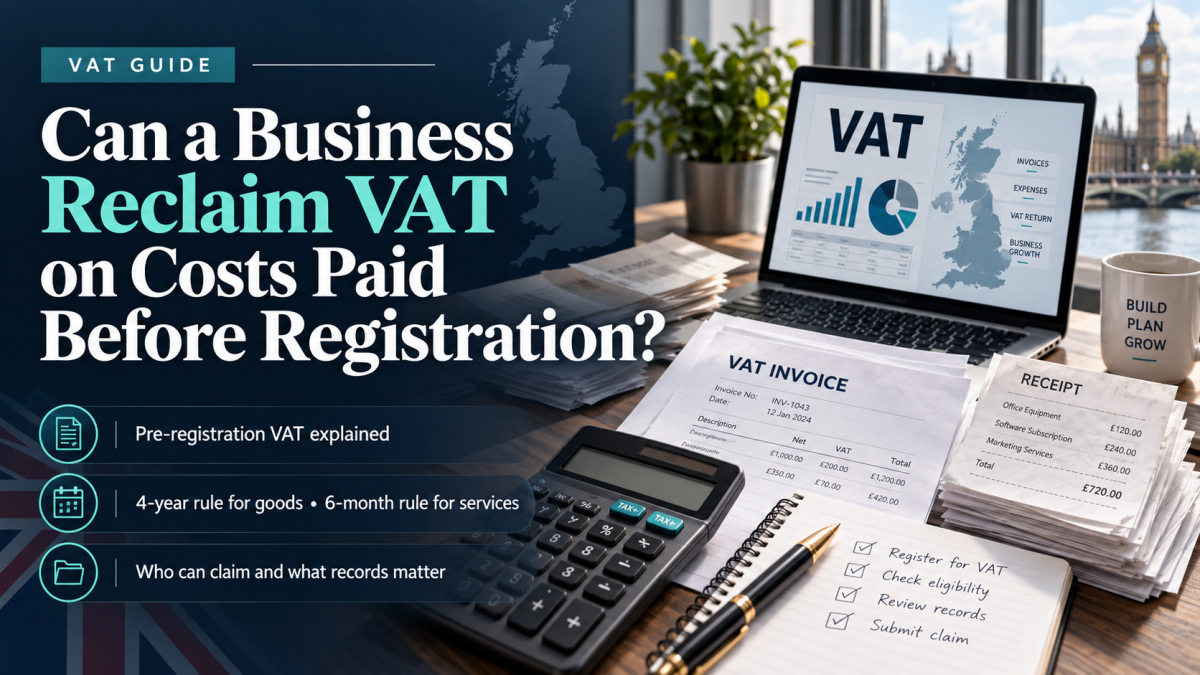
Can a business reclaim it VAT on costs paid before registration?
VAT on costs paid before registration can often be reclaimed once a business becomes VAT registered, but the rules are more specific than simply looking back through every old invoice and adding up the VAT. UK businesses need to consider what was purchased, when it was supplied, whether it was bought for the business that is now registered, whether it relates to taxable activities, and whether the goods or services still meet HMRC’s conditions at the effective date of registration.
For many growing businesses, VAT on costs paid before registration can represent a valuable first-return adjustment. A voluntarily registered business may have a similar history of expenditure. However, VAT on costs paid before registration is only recoverable where the statutory and HMRC conditions are satisfied.
This guide explains how VAT on costs paid before registration works, the important difference between goods and services, what happens with assets already used, how pre-incorporation expenditure can be treated, and what evidence should be retained. It also highlights situations where VAT on costs paid before registration may need to be restricted or may not be claimable at all.
Can you reclaim VAT on costs paid before registration?
The starting point for VAT on costs paid before registration is the effective date of VAT registration. The relevant look-back period is measured from that date. If HMRC backdates the registration, the backdated effective date becomes important when determining which purchases fall within the permitted time limits.
VAT on costs paid before registration must also relate to the business that is now VAT registered. An invoice being addressed to the owner does not by itself establish entitlement. The expenditure must have been incurred for the purposes of the relevant business and must relate to activities that give a right to recover input tax.
This means VAT on costs paid before registration will normally be considered alongside the standard input-tax rules. If VAT would ordinarily be blocked, restricted or irrecoverable after registration, becoming VAT registered does not magically turn it into recoverable VAT.
A key distinction is whether the expenditure relates to goods or services. VAT on costs paid before registration relating to qualifying goods can generally reach back further than qualifying services. Goods can fall within a four-year window, while services normally have a six-month window. The conditions for the two categories are also different.
Businesses should therefore avoid using one blanket calculation for VAT on costs paid before registration.
VAT on costs paid before registration: the four-year rule for goods
For goods, VAT on costs paid before registration can normally be recovered where the goods were supplied no more than four years before the effective date of registration and the goods are still held by the business at registration, or have been incorporated into other goods that are still held.
This can make VAT on costs paid before registration particularly important for businesses that bought machinery, office furniture, tools, computers, shelving, equipment or stock before registering.
To recover VAT on costs paid before registration, the goods must have been supplied to the person or entity that is now registered, subject to the separate rules for certain pre-incorporation expenditure. They must also have been obtained for the business covered by the registration and used, or intended to be used, for activities that support VAT recovery.
Another crucial condition is that the goods must still be on hand. VAT on costs paid before registration is not normally recoverable on goods that were completely consumed, sold or otherwise disposed of before the registration date. This is especially important for stock-based businesses.
Imagine a retailer bought £30,000 of stock plus VAT during the two years before VAT registration. By the registration date, £8,000 of that stock remains unsold. VAT on costs paid before registration cannot simply be calculated by reclaiming VAT on the entire £30,000 historical purchase value. The business needs to identify the qualifying stock that remains on hand and compile an appropriate stock account.
The position can be more favourable for fixed assets. VAT on costs paid before registration may be available on a qualifying asset that is still being used in the business at registration, even though it has already been used before registration. HMRC’s guidance specifically states that a business does not generally have to reduce the deduction on fixed assets merely to reflect taxable business use before registration, provided the asset is still in business use and other conditions are met.
If it was bought for the same taxable business and remains in use at registration, VAT on costs paid before registration may still be recoverable. The historical use does not automatically mean only the “unused” portion of the machine qualifies.
However, VAT on costs paid before registration can be restricted where there has been non-business use, private use or use connected with exempt activities. The exact treatment can also become more complex for high-value assets falling within the Capital Goods Scheme.
Businesses claiming VAT on costs paid before registration for goods should keep a detailed schedule. It should normally include the supplier, invoice date, description, net value, VAT amount, evidence that the item remains held, and any adjustment required for stock sold or for non-business or exempt use.
VAT on costs paid before registration: the six-month rule for services
Services are treated differently. VAT on costs paid before registration relating to services is normally limited to services supplied not more than six months before the effective date of VAT registration.
VAT on costs paid before registration for services must relate to the business now registered and to activities that provide a right to VAT recovery. Where the services relate partly to taxable activities and partly to other activities, an appropriate restriction may be needed.
HMRC also places importance on what the service relates to. VAT on costs paid before registration is not generally recoverable where a service related to goods that were disposed of before registration. For instance, if a business paid for repairs to a piece of equipment and then sold that equipment before becoming VAT registered, the related pre-registration service may fail the conditions.
The six-month window can produce surprising results. VAT on costs paid before registration on the older professional fee may fall outside the normal time limit, while the more recent advertising service may qualify.
The date that matters is generally the date the service was supplied for the purpose of applying the pre-registration rules, not simply when the business happens to pay the invoice. Businesses reviewing VAT on costs paid before registration should therefore use proper VAT invoices and supply dates rather than relying only on bank statements.
VAT on costs paid before registration for recurring services also needs careful review. A yearly software subscription, insurance-related service, professional contract or support package may straddle the registration date.
Where a service has been fully used up before registration, VAT on costs paid before registration may not be recoverable simply because the invoice happens to be less than six months old. HMRC’s internal guidance makes clear that recovery is linked to services supporting the taxable business and, where relevant, to taxable supplies after registration.
This is one reason VAT on costs paid before registration should not be handled as a mechanical six-month bank transaction search. The underlying purpose and use of each material service matters.
Why the effective date of registration matters
The effective date of registration, often called the EDR, anchors the calculation. VAT on costs paid before registration is measured by reference to the date from which the business is registered or was required to be registered.
This distinction matters where a registration is backdated. If a business expected its VAT registration to start on 1 October but HMRC registers it from 1 August, the look-back periods for VAT on costs paid before registration are measured from the August date.
The effective date also determines when the business becomes responsible for charging VAT on taxable supplies. A business should not look only at the potential benefit from VAT on costs paid before registration when choosing a voluntary registration date. An earlier registration date can also create output VAT obligations on sales made from that date.
HMRC currently allows voluntary registration to be backdated, subject to its rules, but an agreed registration date generally cannot simply be changed afterwards because another date later appears more attractive. The interaction between output VAT and VAT on costs paid before registration should therefore be considered before requesting a historic effective date.
For a compulsory registration, the date is not chosen merely to maximise VAT on costs paid before registration. It follows the statutory registration rules, including the historic turnover test and the forward-looking expectation test.
What cannot normally be reclaimed?
VAT on costs paid before registration is subject to the same broad principle that VAT recovery is linked to business activities carrying a right to deduct. Costs that are wholly private or non-business are not converted into business input tax because the owner later starts using an asset for the business.
HMRC gives the example of an asset originally bought wholly for private purposes and only later brought into the business. VAT on costs paid before registration may be unavailable because, at the time of purchase, the expenditure was not incurred for business purposes.
VAT on costs paid before registration may also be restricted or denied where expenditure relates to exempt supplies. Businesses in sectors such as finance, insurance, health, education and certain property activities should be particularly careful because their income may include exempt supplies.
The partial exemption rules can become technical. VAT on costs paid before registration attributable to exempt activity is not automatically recoverable simply because the amount might have fallen within the normal partial-exemption de minimis test. HMRC specifically states that the de minimis limits do not apply to pre-registration VAT in the same way.
Private use is another potential restriction. If a laptop, vehicle, phone or other asset has mixed business and personal use, VAT on costs paid before registration may need to reflect the normal input-tax rules and any relevant business/non-business apportionment.
There are also categories where input VAT is subject to special blocking or restriction rules. VAT on costs paid before registration cannot override those normal restrictions. Cars, business entertainment and certain other expenditure can therefore require separate analysis.
Pre-incorporation costs for a limited company
Many companies incur expenditure before Companies House incorporation or before the company opens its own bank account. VAT on costs paid before registration can, in some circumstances, include qualifying pre-incorporation expenditure.
This means a founder paying an incorporation-related adviser, buying equipment or incurring setup costs personally does not automatically prevent VAT on costs paid before registration from being considered. The audit trail, purpose of the cost and reimbursement arrangements need to support the claim.
HMRC’s rules allow qualifying pre-incorporation VAT to be considered where, among other conditions, the expenditure was incurred by someone who became a member, officer or employee of the company and the company reimburses the full cost.
Invoices should be reviewed carefully. VAT on costs paid before registration becomes harder to defend where the paperwork suggests the cost belonged to a separate business or individual rather than being genuinely incurred for the company being formed.
VAT on costs paid before registration should be capable of being explained transaction by transaction if HMRC asks how the first VAT return was prepared.
What records should the business keep?
Evidence is central to any input VAT claim. VAT on costs paid before registration should be supported by acceptable VAT evidence, normally valid VAT invoices or other evidence permitted by HMRC.
For goods, the business should maintain a schedule that identifies what is still held at the effective date. VAT on costs paid before registration for stock should be backed by a stock account showing quantities, acquisition dates and relevant disposals.
For services, the records should describe the service and when it was received. VAT on costs paid before registration for services should also show why the service relates to the registered business and, where necessary, how any taxable-use proportion was calculated.
Bank statements are useful supporting documents but do not necessarily replace VAT invoices. VAT on costs paid before registration should be reconciled to the accounting records so the same VAT is not claimed twice after registration.
This may appear detailed, but VAT on costs paid before registration is often scrutinised because a new registrant’s first return can produce an unusually large repayment. Clear records help demonstrate that the claim was calculated under the pre-registration rules rather than estimated from historic expenditure.
When is the VAT claimed?
HMRC’s published guidance says qualifying VAT on costs paid before registration should be included on the first VAT return.
VAT on costs paid before registration should be entered through the bookkeeping system in a way that creates a clear audit trail without changing the historic accounts incorrectly.
Nevertheless, deliberately postponing VAT on costs paid before registration is rarely good practice. Preparing the calculation before the first return reduces the chance of missing documents, duplicating VAT or applying the wrong registration date.
Businesses using the Cash Accounting Scheme also need to consider the scheme-specific timing provisions. VAT on costs paid before registration can interact with whether the qualifying purchase had already been paid by the registration date.
Common mistakes to avoid
One common error is assuming the four-year rule applies to every expense. It does not. VAT on costs paid before registration has a four-year look-back for qualifying goods, while qualifying services normally have a six-month limit.
Another mistake is reclaiming VAT on all historic stock purchases. VAT on costs paid before registration on goods generally depends on the goods still being held at registration or being incorporated into goods still held.
Businesses also sometimes use the payment date instead of properly checking the supply and VAT invoice details. VAT on costs paid before registration should be tested using the relevant VAT rules, not simply the date money left the bank.
A further problem is claiming costs that belong to a different legal person. VAT on costs paid before registration must be connected to the person or entity that becomes registered, unless a specific rule such as the pre-incorporation provision applies.
Another risk is overlooking exempt or non-business use. VAT on costs paid before registration may need to be apportioned where an expense supports activities that do not provide a full right to recover VAT.
Finally, businesses can forget that voluntary backdating has consequences for sales. An earlier registration date may increase VAT on costs paid before registration that falls within the permitted window, but it can also mean output VAT is due on taxable sales from that earlier date.
Final thoughts
VAT on costs paid before registration can provide a useful cash-flow benefit for a newly VAT-registered business, particularly where it has invested in equipment, stock and setup costs before registration. But the claim is governed by detailed conditions rather than a simple rule allowing all old VAT to be reclaimed.
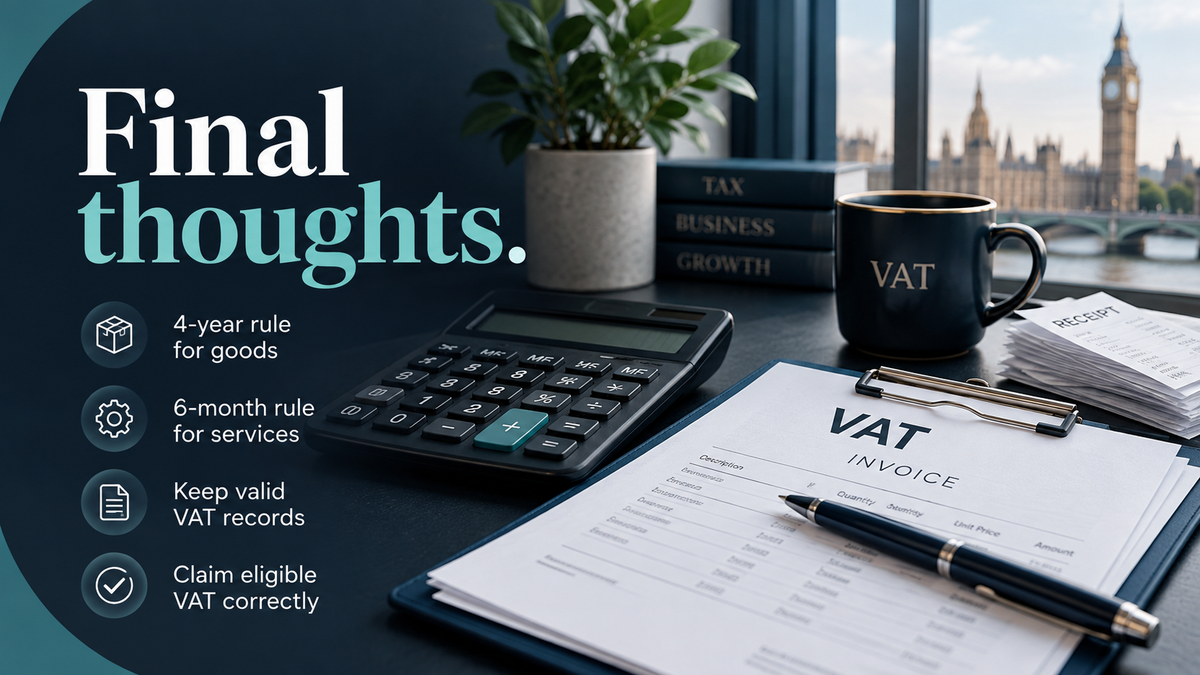
The key practical distinction is straightforward: VAT on costs paid before registration on qualifying goods can generally go back up to four years if the goods meet the conditions and remain on hand, while qualifying services normally have a six-month limit.
Every claim for VAT on costs paid before registration should be supported by good evidence, connected to the registered business and reviewed for taxable, exempt, private and non-business use. Stock already sold, goods used up and older services are common areas where a claim may fail.
For limited companies, VAT on costs paid before registration can also require a review of expenditure incurred before incorporation and whether the reimbursement conditions are met.
The safest approach is to prepare the VAT on costs paid before registration schedule before submitting the first return. Separate goods from services, confirm the effective date, check invoices, reconcile remaining stock and assets, identify any restrictions and retain a clear calculation.
Where the numbers are material or the business has exempt income, property transactions, mixed business/private use or high-value capital assets, VAT on costs paid before registration can become more technical. Professional advice can help ensure the first VAT return claims the relief available without overstating the business’s entitlement.
Need help deciding what’s best for your situation?
📞 Call 0161 710 1901
📧 Email Tax@TaxesDoneRight.co.uk
Visit www.taxesdoneright.co.uk