Tax Deductible Guide: When It’s a Repair or an Improvement
May 4, 2026
Can You Put Your Family on Payroll? (And Do It Properly)
May 6, 2026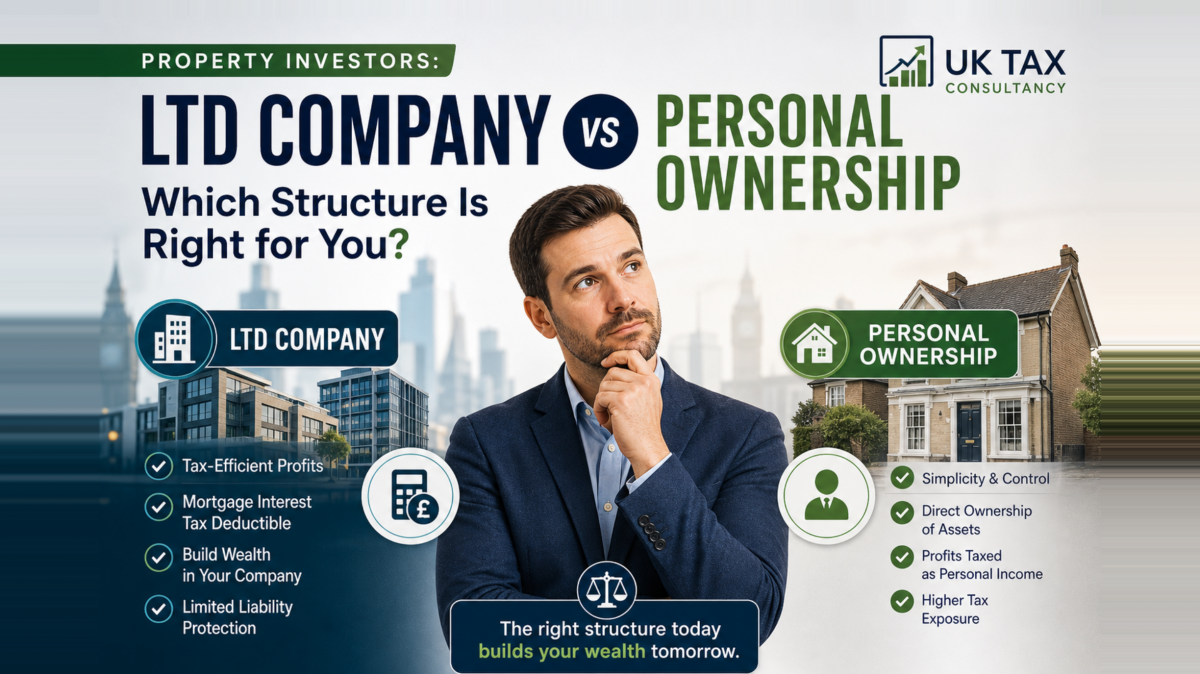
Property Investors in the UK are increasingly asking the same question: should you buy property in your personal name, or through a limited company? The answer is not one-size-fits-all. It depends on your income level, long-term plans, financing strategy, and tax position.
This guide breaks down the key differences so Property Investors can make informed decisions.
Why Property Investors Are Moving Towards Limited Companies
Over the last decade, tax changes introduced by HM Revenue and Customs have significantly impacted landlords. One of the biggest shifts was the restriction of mortgage interest relief for individuals.
For Property Investors, this means:
- Mortgage interest is no longer fully deductible against rental income
- Instead, a basic rate tax credit is applied
- Higher-rate taxpayers are hit the hardest
In contrast, limited companies can still deduct mortgage interest as a business expense. This is one of the main reasons many Property Investors now favour the company route.
Property Investors and Personal Ownership
Advantages of Personal Ownership
For Property Investors just starting out, owning property personally can be simpler and more cost-effective:
- No company setup or annual filing costs
- Simpler tax reporting via Self Assessment
- Access to personal CGT allowance
- Potentially easier mortgage approval
If you are a basic rate taxpayer with one or two properties, personal ownership may still work well.
Disadvantages for Property Investors
However, there are clear downsides:
- Rental income taxed at up to 45%
- Limited mortgage interest relief
- Less flexibility in tax planning
- Harder to scale a large portfolio
For higher earners, this can significantly reduce profits over time.
Property Investors Using a Limited Company
Advantages of a Limited Company
For growing portfolios, many Property Investors prefer a company structure due to tax efficiency and flexibility:
- Corporation tax (currently lower than higher income tax rates)
- Full mortgage interest deductibility
- Profits can be retained and reinvested
- Greater control over timing of income via dividends
This structure is especially attractive for Property Investors aiming to scale.
Disadvantages to Consider
Despite the benefits, there are trade-offs:
- Additional costs (accountant, filings, compliance)
- Dividend tax when extracting profits
- Mortgage rates can be higher for companies
- More complex administration
Property Investors must weigh these carefully before switching.
Tax Comparison for Property Investors
A simple example highlights the difference:
- Personal ownership: profits taxed at income tax rates (20%, 40%, 45%)
- Company ownership: profits taxed at corporation tax, then dividend tax when withdrawn
For Property Investors who do not need to withdraw all profits immediately, a company can offer significant tax deferral benefits.
Mortgage Considerations for Property Investors
Financing is another key factor:
- Personal mortgages often have lower interest rates
- Company mortgages may require larger deposits
- Lenders assess company structures differently
However, the tax savings for Property Investors can sometimes outweigh slightly higher mortgage costs.
Long-Term Strategy for Property Investors
The right structure depends heavily on your long-term goals:
Personal ownership may suit:
- First-time landlords
- Lower-income individuals
- Those planning to sell properties in the short term
Limited company may suit:
- Higher-rate taxpayers
- Portfolio landlords
- Property Investors focused on reinvestment and growth
Planning ahead is essential. Switching later can trigger capital gains tax and stamp duty, making it costly.
Should Property Investors Incorporate Existing Properties?
Transferring properties into a company is not straightforward. Property Investors may face:
- Capital Gains Tax on the transfer
- Stamp Duty Land Tax charges
- Legal and refinancing costs
There are reliefs available in some cases (such as incorporation relief), but these are complex and must be assessed carefully.
Final Thoughts for Property Investors

For Property Investors, choosing between a limited company and personal ownership is one of the most important decisions you will make. There is no universal answer, but the key is understanding how tax, finance, and long-term strategy align with your goals.
If you are building a portfolio or paying higher rates of tax, a limited company is often more efficient. However, for smaller portfolios or lower incomes, personal ownership may still be the simplest and most practical route.
Before making any decision, Property Investors should seek tailored advice to ensure the structure supports both current income and future growth.
Need help deciding what’s best for your situation?
Call 0161 710 1901
Email Tax@TaxesDoneRight.co.uk
Visit www.taxesdoneright.co.uk