Employment Allowance: Can Your Company Reduce Its NI Bill?
August 31, 2026
Undeclared Overseas Income? How the Worldwide Disclosure Facility Works
September 1, 2026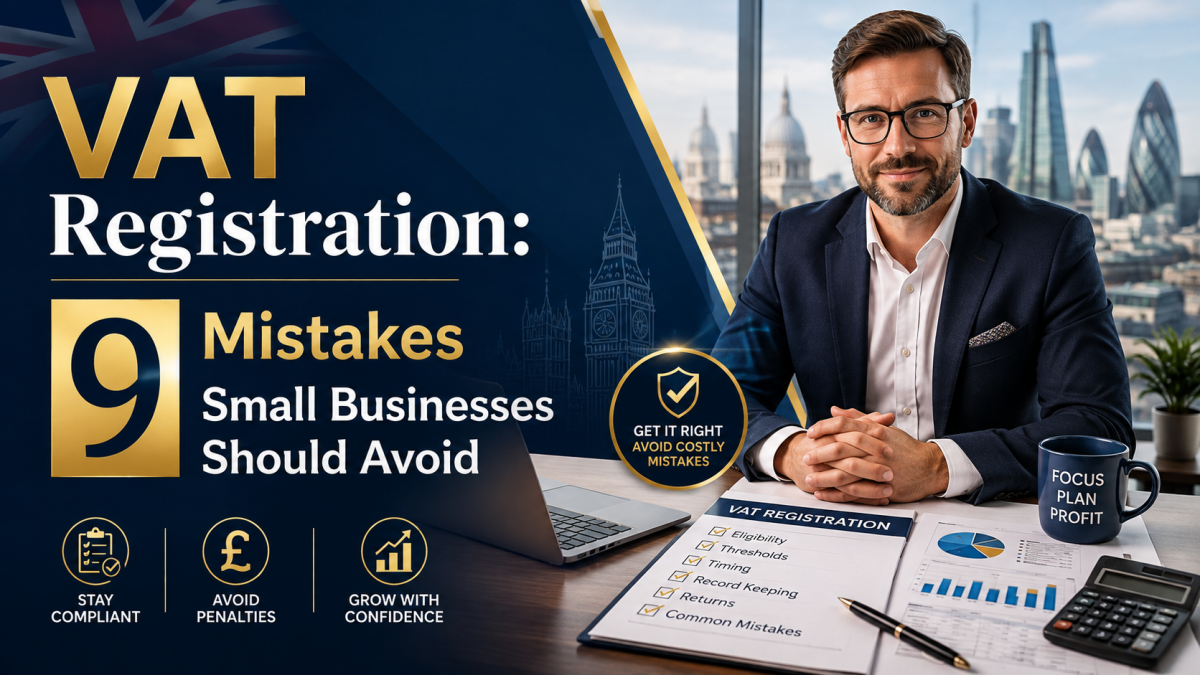
VAT Registration: 9 Mistakes Small Businesses Should Avoid
VAT Registration is an important compliance milestone for many UK businesses, but it is also an area where relatively small errors can become expensive. A growing business may be concentrating on customers, staffing, marketing and cash flow while this quietly becomes a legal obligation. If the business notices too late, the consequences can include backdated VAT, interest, penalties and the uncomfortable possibility of paying VAT out of money already collected from customers.
For that reason, It should not be treated as a one-off administrative form. It affects pricing, invoicing, bookkeeping, contracts, software and the way a business monitors turnover. A good VAT Registration process starts before the threshold is crossed and continues after HMRC confirms the VAT number.
The current compulsory VAT Registration threshold is £90,000 of taxable turnover. The important point is that the test looks at taxable turnover over a rolling 12-month period, rather than simply a tax year or company accounting period. A separate test can also require this if the business expects its taxable turnover to exceed £90,000 in the next 30 days alone.
Many small businesses assume that it only matters once annual accounts are prepared. That assumption can be costly. The obligation can arise during the year, and the business must identify the correct effective date. Businesses also need to understand what counts as taxable turnover, what VAT can be reclaimed and when VAT should begin appearing on invoices.
Good planning for this gives owners time to review prices before VAT starts. It also allows its procedures to be tested before the first return. When VAT Registration is handled early, the transition becomes easier for staff and customers.
Why VAT Registration Errors Can Become Expensive
VAT Registration changes the way a business deals with customers and HMRC. Once this becomes compulsory, the business cannot simply decide to delay because the timing is inconvenient. The effective date determines when output VAT becomes due, and missing that date can mean VAT has to be accounted for retrospectively.
The problem is particularly serious for businesses selling mainly to consumers. If a £1,000 price was agreed before VAT Registration and the business later discovers VAT should have been charged, it may not be commercially possible to ask the customer for extra money. The business could therefore have to treat part of the £1,000 already received as VAT and pay that amount to HMRC.
Businesses selling mainly to VAT-registered customers may find VAT Registration easier commercially because customers can often reclaim valid input VAT. Even then, delay in this creates administrative work. Invoices may need correction, accounting records may need rebuilding, and customers may need revised VAT documentation.
VAT Registration Mistake 1: Monitoring Turnover Only Once a Year
The first major mistake is checking turnover only at the end of the tax year or accounting year. VAT Registration does not normally operate on that basis. The historic test considers taxable turnover during the previous 12 months on a rolling basis.
For example, a company with a December year-end might assume it can be reviewed when December accounts are prepared. In reality, its rolling taxable turnover could exceed the threshold in May, August or any other month. Waiting until year-end could therefore make VAT Registration late by several months.
A better approach is to monitor taxable turnover every month. Businesses growing quickly may benefit from checking it more often. Accounting software can help, but the figures still need to be understood correctly because this depends on taxable turnover rather than simply the sales number shown in management accounts.
Once the rolling total goes above £90,000, the business generally has 30 days from the end of the month in which the threshold was exceeded to notify HMRC. The normal effective date is the first day of the second month after the threshold was exceeded.
Good planning for this, therefore requires a forward-looking system. Owners should know their current rolling total, their expected sales pipeline and how close the business is to compulsory VAT Registration. Waiting for the accountant to notice during annual accounts preparation is not a reliable control.
Mistake 2: Assuming All Turnover Is Treated the Same
Another common error is using total bank receipts as the VAT Registration figure without considering what those receipts represent. It is based on taxable turnover, and taxable turnover can include standard-rated, reduced-rated and zero-rated supplies. Zero-rated does not mean the sale is ignored for the threshold.
At the same time, genuinely exempt or out-of-scope supplies may be treated differently. This distinction is crucial because a business can have substantial income but still need a careful analysis before deciding whether it is compulsory. HMRC states that taxable turnover includes everything sold that is not VAT exempt or outside the scope, including zero-rated, reduced-rated and standard-rated supplies.
A business should therefore classify its income streams before reaching a VAT Registration conclusion. This is especially important where the business has several activities. One income source might be taxable while another may be exempt, and an incorrect classification could either trigger unnecessary VAT Registration or cause the business to register too late.
Businesses should also avoid assuming that money received equals turnover for this purposes. Loans, capital introduced by directors and certain other receipts are not customer sales simply because they appear in the bank account. The VAT treatment should follow the nature of the transaction.
Mistake 3: Ignoring the 30-Day Future Turnover Test
Many business owners know about the rolling 12-month threshold but overlook the separate forward-looking rule. VAT Registration can be required where the business expects taxable turnover to exceed £90,000 in the next 30 days alone.
This can happen when a business wins a large contract, completes a major project or expects an unusually large sale. VAT Registration may therefore become necessary even if historical turnover is well below £90,000.
HMRC explains that where the business realises its taxable turnover will exceed the threshold in the next 30 days, the effective date of this is normally the date the business first realised this would happen. The application deadline is the end of that 30-day period.
This rule makes forecasting essential. A business cannot safely manage this by looking backwards only. Signed contracts, accepted proposals, scheduled completions and confirmed orders can all be relevant when assessing whether a sudden increase in taxable turnover is expected.
Mistake 4: Getting the Effective Date Wrong
VAT Registration is not complete simply because an application has been submitted. The effective date is one of the most important details because it determines from when the business must account for VAT on taxable supplies.
If the effective date is earlier than the business expected, VAT may be due on sales invoices already issued. That can create a difficult situation where VAT Registration has to be reflected retrospectively. The business may need to issue corrected documents or calculate VAT from amounts already charged.
A business should therefore establish the correct VAT Registration date before changing its invoices or pricing. The rules differ depending on whether VAT Registration arises from the rolling 12-month test, the 30-day future test or voluntary registration.
Late VAT Registration does not usually make the underlying VAT liability disappear. HMRC can register a business from the date it should have been registered, leaving the business responsible for VAT from that date. That is why delaying VAT Registration to improve short-term cash flow can create a larger cash-flow problem later.
Mistake 5: Charging VAT Before the Business Is Entitled To
Some businesses start adding VAT to invoices as soon as they submit a VAT Registration application. That can create problems because an application being processed is not the same as having the VAT details needed to issue a normal VAT invoice.
The business should understand the position during the VAT Registration waiting period and ensure invoices are handled correctly. A business may need to adjust its invoicing process while waiting for HMRC confirmation rather than simply inventing a VAT number or presenting documents as though VAT Registration has already been finalised.
Equally, the business must not ignore taxable sales that fall after the effective VAT Registration date merely because the VAT number has not yet arrived. This is an area where bookkeeping and invoicing need to work together.
The safest approach is to plan the transition before VAT Registration takes effect. Update invoice templates, customer communications, accounting software and pricing procedures together. Staff responsible for sales should know exactly when VAT is to be reflected.
Mistake 6: Failing to Keep Proper Digital VAT Records
VAT Registration creates ongoing record-keeping responsibilities. A business that registers but continues using weak spreadsheets, incomplete sales records or disconnected systems can quickly create errors in its VAT returns.
This means VAT Registration should trigger a review of bookkeeping systems. Businesses should confirm that their software is suitable for Making Tax Digital for VAT, that transactions are coded correctly and that supporting invoices are retained.
The quality of records after VAT Registration directly affects the quality of the VAT return. If sales are missed, output VAT can be understated. If purchase invoices are incomplete, input VAT may be reclaimed incorrectly or not reclaimed at all.
Mistake 7: Forgetting About VAT on Pre-Registration Costs
A particularly expensive mistake is assuming that VAT paid before VAT Registration is automatically lost. In some circumstances, VAT on earlier business purchases can be reclaimed after registration, provided the conditions are met.
HMRC allows pre-registration VAT on qualifying goods bought within four years and services within six months, provided conditions are met.
This can make VAT Registration financially significant for a business that has invested heavily before reaching the threshold. Equipment, stock and professional services may contain recoverable VAT, subject to the detailed rules.
However, businesses should not simply reclaim every old VAT amount they can find. VAT Registration does not override restrictions on input tax. Personal expenditure, exempt activities and purchases without appropriate evidence may not qualify.
Mistake 8: Choosing a VAT Scheme Without Checking the Numbers
VAT Registration can bring choices about how VAT is accounted for. Depending on eligibility and circumstances, a business may consider options such as cash accounting, annual accounting or the Flat Rate Scheme.
The mistake is choosing a scheme simply because it sounds easier. VAT Registration should be followed by a comparison of the financial and administrative effects of each available method. A scheme that benefits one business may be unsuitable for another.
The Flat Rate Scheme can simplify calculations for some eligible businesses, but VAT Registration under that scheme does not mean the business simply keeps the difference between output VAT and the flat-rate payment. The commercial outcome depends on the applicable percentage, input VAT restrictions, spending pattern and whether the limited-cost business rules are relevant.
Mistake 9: Treating Every Sale as Standard-Rated
Once VAT Registration is complete, some businesses assume they should add 20% VAT to every invoice. That can be wrong. UK VAT includes standard-rated, reduced-rated, zero-rated, exempt and outside-the-scope treatments, and the correct treatment depends on the exact supply.
This matters because VAT Registration creates an obligation to apply the correct VAT treatment, not simply to charge the standard rate everywhere. Incorrectly charging VAT can cause customer disputes, overpayments to HMRC or incorrect input tax claims by customers.
Businesses operating in construction, property, food, education, health, international services or mixed activities may face particularly complex questions. VAT Registration should therefore be accompanied by a review of the products and services being sold.
International transactions deserve special attention. The place-of-supply rules, reverse charge and export rules can affect whether UK VAT appears on an invoice. VAT Registration does not automatically mean UK VAT must be charged to every overseas customer.
A Practical VAT Registration Checklist for Small Businesses
A strong VAT Registration process starts with accurate numbers. Each month, calculate the rolling 12-month taxable turnover and compare it with the current threshold. Separately consider whether confirmed work means taxable turnover is expected to exceed the threshold during the next 30 days.
Before VAT Registration becomes compulsory, review prices and contracts. Decide whether quoted amounts are VAT-inclusive or VAT-exclusive and assess how VAT Registration will affect customers. Businesses selling mainly to consumers may need more careful pricing decisions than businesses whose customers can recover VAT.
Next, identify the correct VAT Registration date and prepare the application using consistent business details. Make sure legal names, trading names, addresses, business activities and turnover figures agree with underlying records.
At the same time, prepare bookkeeping systems for VAT Registration. Confirm that accounting software uses the correct VAT codes, digital records are maintained and bank transactions are reconciled. Review whether the business will use standard VAT accounting or an alternative scheme.
The first VAT return deserves additional attention. VAT Registration may allow eligible pre-registration VAT to be reclaimed, so review qualifying goods and services and retain valid invoices. Check that sales from the effective date are included even where customers were invoiced before the VAT number was received.
After VAT Registration, continue monitoring the quality of records. VAT returns should be reconciled to sales, purchases, bank activity and accounting reports. Unusual or high-value transactions should be checked before submission.
Voluntary Registration: Is It Worth Considering?
A business below the compulsory threshold can choose voluntary VAT Registration. This can be useful where the business has significant VAT-bearing costs or mainly sells to VAT-registered customers that can normally recover the VAT charged.
Voluntary VAT Registration can also make sense where turnover is expected to rise above the threshold soon. Registering earlier may allow the business to introduce VAT-inclusive or VAT-exclusive pricing gradually instead of making an abrupt change later.
However, voluntary VAT Registration is not automatically beneficial. A business selling mainly to consumers may have to increase prices or absorb some of the VAT from its existing margin. VAT Registration also creates ongoing administrative obligations, including digital records and VAT returns.
Before choosing voluntary VAT Registration, calculate the likely annual output VAT, recoverable input VAT and compliance cost. Also consider whether customers are price-sensitive and whether competitors are VAT registered.
What Happens If You Register Late?
Late VAT Registration can result in VAT being due from the date the business should have registered rather than from the date the mistake was discovered. The business may therefore need to reconstruct historic transactions and calculate VAT retrospectively.
The cash-flow effect can be substantial. If customers cannot be charged extra, the business may have to fund the VAT from its existing income. This is why VAT Registration monitoring is particularly important for consumer-facing businesses with fixed prices.
Penalties may also apply depending on the circumstances, including how late the VAT Registration was and the behaviour that caused the failure. Businesses should therefore address a missed deadline promptly rather than allowing the exposure to increase.
Final Thoughts

VAT Registration is much easier to manage when it is treated as a business-planning issue rather than a last-minute tax form. The most important controls are regular turnover monitoring, correct classification of sales, accurate forecasting and reliable digital bookkeeping.
The nine mistakes above show that VAT Registration affects far more than the registration application itself. The effective date can affect historic sales, pricing decisions can affect margins, and poor records can create errors long after VAT Registration has been approved.
Small businesses approaching the threshold should review VAT Registration early. Check the rolling 12-month figure, consider the separate 30-day test and decide how customers will be charged once VAT applies. Review pre-registration purchases and make sure the bookkeeping system is ready.
The goal is not simply to complete VAT Registration. It is to make sure VAT Registration happens at the correct time, on the correct basis and with systems that allow the business to remain compliant afterwards. With regular monitoring and professional advice where the rules are unclear, VAT Registration can become a manageable part of growth rather than an expensive surprise.
Need help deciding what’s best for your situation?
📞 Call 0161 710 1901
📧 Email Tax@TaxesDoneRight.co.uk
Visit www.taxesdoneright.co.uk