How Much Can a Director Borrow From Their Limited Company? UK Guide for 2026/27
September 23, 2026
Do You Pay Tax on Savings Interest? Personal Savings
September 28, 2026
Do I Need to Complete a Self Assessment Tax Return? 10 Common Reasons
Self Assessment Tax Return obligations can apply to far more people than just the self-employed. You may be employed through PAYE and still need to report rental profits, investment income, capital gains, foreign income or other amounts that have not been taxed correctly at source.
The UK tax system collects much of its tax automatically through PAYE, pension deductions and withholding arrangements. However, HMRC cannot always know your complete financial position. A Self Assessment Tax Return allows you to report income and gains, claim relevant allowances and reliefs, calculate tax due and disclose information that HMRC needs to assess your tax position correctly.
For the 2025/26 tax year, which ran from 6 April 2025 to 5 April 2026, somebody who is newly required to file will normally need to notify HMRC by 5 October 2026. The usual paper filing deadline is 31 October 2026, while the online filing and payment deadline is 31 January 2027. If you are unsure whether a Self Assessment Tax Return is required, it is better to check early rather than discover the position after a deadline has passed.
This guide explains ten common reasons why you may need a Self Assessment Tax Return, together with practical considerations, filing deadlines and common mistakes.
What is a Self Assessment Tax Return?
A Self Assessment Tax Return is the method used by HMRC to collect information about income, gains, allowances and reliefs that are not always dealt with automatically through PAYE. It can include employment income, self-employment profits, rental income, dividends, savings income, foreign income, capital gains and other taxable receipts.
Submitting a Self Assessment Tax Return does not automatically mean that you will have tax to pay. In some cases, the return may show that tax has already been fully collected. In others, it may produce a repayment because too much tax was deducted or because you are entitled to additional relief.
The important point is that the requirement depends on your circumstances. Being employed does not automatically remove the need for a Self Assessment Tax Return, and having relatively modest additional income does not always mean that nothing needs to be reported.
1. You are self-employed and your gross trading income exceeds £1,000
One of the most common reasons for completing a Self Assessment Tax Return is self-employment. HMRC states that you must normally send a return if you were a sole trader and earned more than £1,000 before deducting expenses or tax reliefs.
This £1,000 figure relates to gross trading income, not profit. For example, if you received £4,000 from freelance work and incurred £3,200 of allowable expenses, your profit may only be £800, but your gross income is still above £1,000. A Self Assessment Tax Return may therefore be required.
Self-employment can include traditional businesses, freelance work, consultancy, online services, delivery work, content creation, tutoring, construction work, professional services and many other activities. However, a second source of trading income can still create a Self Assessment Tax Return obligation.
2. You receive income from property or land
Landlords are another major group who may need a Self Assessment Tax Return. Rental income can arise from residential property, commercial property, overseas property, land, garages or other letting arrangements.
A Self Assessment Tax Return normally includes the gross rent received and allowable property expenses. For individual landlords with residential property finance costs, mortgage interest is generally not deducted in the same way as ordinary property expenses. Instead, relief is normally given through the basic-rate finance cost tax reduction, subject to the relevant rules.
Jointly owned property can create additional considerations. The amount each owner reports can depend on legal ownership, beneficial ownership, marital status and any valid declaration or supporting documentation. It is important that the figures on the Self Assessment Tax Return reflect the correct beneficial entitlement rather than simply how rent happened to be paid into a bank account.
Landlords should keep clear records of rent received, management fees, repairs, insurance, service charges, professional fees and other property costs. Good records make the Self Assessment Tax Return easier to prepare and provide support if HMRC later asks questions.
3. You are a partner in a business partnership
If you are a partner in a business partnership, a Self Assessment Tax Return will normally be required. The partnership itself usually submits a partnership return, while each individual partner reports their share of the partnership’s taxable results on their own return.
Partnership taxation can be more complex than simply dividing cash withdrawals. Tax is generally based on the partner’s allocated share of taxable profit rather than the amount physically drawn from the business. This means you could have a Self Assessment Tax Return liability even where you leave some or all of your profit in the partnership bank account.
Partners should ensure that the figures on their Self Assessment Tax Return agree with the partnership return.
Changes in partners, accounting periods, profit-sharing ratios or business structure can also affect the figures reported. Where the partnership has more complex income, capital allowances or losses, professional advice may be worthwhile before the Self Assessment Tax Return is submitted.
4. You have Capital Gains Tax to report
Selling or disposing of an asset for more than its allowable cost can create a capital gain. Depending on the amount of the gain, the type of asset and your available exemptions or losses, you may need to complete a Self Assessment Tax Return.
A Self Assessment Tax Return may require you to report disposal proceeds, acquisition costs, eligible improvement expenditure, incidental buying and selling costs, losses and available reliefs.
UK residential property disposals can also have separate reporting and payment requirements, potentially before the annual Self Assessment Tax Return is due. Completing an in-year property return does not necessarily remove the need to include the relevant disposal in your annual tax filing where required.
5. You receive foreign income or foreign gains
UK residents with foreign income or gains often need a Self Assessment Tax Return. Foreign income can include overseas rent, foreign employment income, overseas pensions, bank interest, dividends and income from investments held outside the UK.
The fact that income has already been taxed overseas does not automatically mean it can be ignored in the UK. Depending on your residence status, treaty rules and the type of income, the amount may still need to be included on a Self Assessment Tax Return. Foreign Tax Credit Relief may then be available to reduce double taxation where the relevant conditions are satisfied.
From 6 April 2025, the UK introduced the Foreign Income and Gains regime for qualifying new residents. This can provide relief on eligible foreign income and gains during the relevant qualifying period, but claims may need to be made through the Self Assessment Tax Return and can have wider consequences for allowances and reliefs.
A Self Assessment Tax Return should therefore be prepared using complete overseas statements, translated where necessary, with foreign tax paid and exchange rates considered correctly.
When foreign income means a Self Assessment Tax Return may be needed
The key questions include where you are tax resident, what type of foreign income you received, whether any special relief applies and whether tax was already paid abroad. A Self Assessment Tax Return may be needed even where the eventual UK tax is reduced to nil by foreign tax credit or another relief.
6. You receive untaxed savings, dividends or other investment income
Banks and investment platforms do not always deduct the correct final amount of Income Tax. If you receive significant savings interest, dividends or other investment income, you may need a Self Assessment Tax Return depending on the amount and your wider circumstances.
Allowances may reduce or eliminate the tax payable, but an allowance does not necessarily mean that the underlying income should always be ignored. Whether a Self Assessment Tax Return is needed depends on the level and nature of the income and whether HMRC can collect any tax due through another method.
The dividend amount declared on the Self Assessment Tax Return should match the lawful dividend actually paid or credited, rather than an estimate based simply on withdrawals from the company.
7. You need to pay the High Income Child Benefit Charge
The High Income Child Benefit Charge can create a Self Assessment Tax Return requirement in some circumstances. The charge applies by reference to adjusted net income and Child Benefit received by you or your partner, subject to the current thresholds and rules.
HMRC now allows some taxpayers to deal with the charge through PAYE rather than filing solely for this reason. However, if you already need a Self Assessment Tax Return for another reason, or the relevant PAYE route is not available for your circumstances, the charge may need to be reported through Self Assessment.
A Self Assessment Tax Return can report the relevant Child Benefit details and calculate the charge due. Families should also consider whether pension planning or Gift Aid affects adjusted net income, although any action should be commercially and financially appropriate rather than undertaken solely for tax reasons.
8. You have income that has not been fully taxed through PAYE
Being an employee does not prevent you from needing a Self Assessment Tax Return. PAYE is designed to collect tax on employment income, but it may not capture every source of taxable income or every adjustment correctly.
You may have consultancy income, tips, commission, casual earnings, benefits, rental income, investment income or other receipts alongside your employment. If HMRC cannot collect the correct tax through your tax code, a Self Assessment Tax Return may be needed.
You should not assume that because tax has been deducted somewhere, your overall tax position must be correct. The purpose of a Self Assessment Tax Return is to assess your combined taxable position after all relevant income, reliefs and tax already deducted are considered.
9. You need to claim certain tax reliefs or repayments
Sometimes people complete a Self Assessment Tax Return not because HMRC is collecting additional tax, but because they need to claim relief.
A Self Assessment Tax Return can provide a structured way to claim relief while reporting your complete income. It may also generate a repayment if too much tax was deducted during the year.
Do not submit a Self Assessment Tax Return purely to claim a relief without first checking whether HMRC offers a simpler claim route. Equally, do not miss a valid claim simply because the tax was originally collected through PAYE.
10. HMRC has issued you with a notice to file
One of the most important rules is that if HMRC has formally required you to submit a Self Assessment Tax Return, you should not simply ignore the notice because you believe you have no tax to pay.
Once a notice to file has been issued, a return is generally expected unless HMRC agrees to withdraw the requirement. If your circumstances have changed and you no longer believe a Self Assessment Tax Return is necessary, contact HMRC and ask whether the filing requirement can be cancelled.
People sometimes stop self-employment, sell their rental property or move fully into PAYE employment and assume their Self Assessment Tax Return obligations automatically end. HMRC’s records may not update simply because your personal circumstances changed. You should notify HMRC and confirm whether future returns are still required.
Self Assessment Tax Return deadlines you should know
Deadlines are critical. For the tax year ending 5 April 2026, a taxpayer who is newly required to file will normally need to register or notify HMRC by 5 October 2026. A paper Self Assessment Tax Return is generally due by 31 October 2026.
An online Self Assessment Tax Return is generally due by 11:59pm on 31 January 2027. Tax due under Self Assessment is normally payable by the same 31 January deadline.
Some taxpayers also make payments on account. These are advance payments towards the next year’s Income Tax liability and are normally due on 31 January and 31 July. Your Self Assessment Tax Return calculation will show whether payments on account arise, subject to the relevant rules.
What happens if your Self Assessment Tax Return is late?
Submitting a Self Assessment Tax Return early reduces the risk of technical problems, missing documents and last-minute mistakes.
If you know that a Self Assessment Tax Return is overdue, dealing with it promptly is usually better than allowing the position to continue. Where several years are outstanding, each year should be reviewed separately because the filing requirement and available information may differ.
Common mistakes when completing a Self Assessment Tax Return
A Self Assessment Tax Return should reconcile to the underlying records. Common errors include omitting a bank account, forgetting dividends, reporting net rental income instead of gross rent and allowable expenses, claiming private expenditure as a business cost, entering mortgage capital repayments as an expense, or failing to report overseas income.
Another frequent mistake is using the wrong tax year. The UK tax year runs from 6 April to 5 April, so income should be allocated to the correct period. A Self Assessment Tax Return for 2025/26 should not simply use calendar-year figures unless those figures have been adjusted appropriately.
Taxpayers should also check tax already deducted under PAYE. Entering the correct gross pay but the wrong tax deducted can distort the Self Assessment Tax Return calculation.
What records should you keep?
The records needed depend on your circumstances. For a Self Assessment Tax Return, these may include P60s, P45s, P11Ds, invoices, expense receipts, bank statements, rental statements, mortgage interest certificates, dividend vouchers, savings statements, pension contribution records and documents supporting capital gains.
Do I still need a Self Assessment Tax Return if no tax is due?
Possibly. The filing requirement and the amount of tax payable are separate questions. You might need a Self Assessment Tax Return because of the type or amount of income received even if allowances, expenses, losses, foreign tax credits or tax already deducted ultimately reduce the liability to nil.
Likewise, if HMRC has issued a notice requiring a Self Assessment Tax Return, you should either file it or obtain confirmation that HMRC has withdrawn the requirement.
Can I complete the return myself?
Many straightforward taxpayers complete their own Self Assessment Tax Return using HMRC’s online service. If you have one employment and a small amount of simple additional income, the process may be manageable with good records.
Professional assistance can become more valuable where the Self Assessment Tax Return includes rental property, multiple businesses, partnership income, foreign income, capital gains, cryptocurrency, significant pension contributions, residence issues or several interacting allowances and reliefs.
Final thoughts
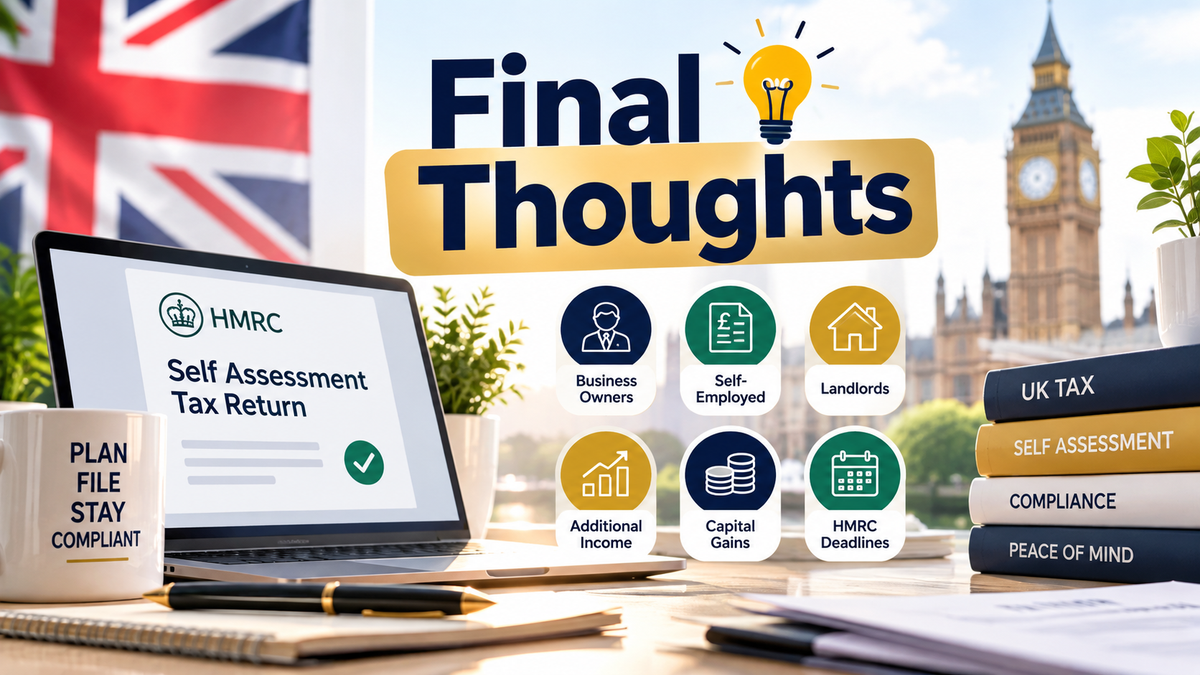
A Self Assessment Tax Return is not limited to sole traders. Landlords, business partners, investors, people with foreign income, individuals making capital disposals and employees with untaxed income can all fall within Self Assessment.
If you are newly required to complete a Self Assessment Tax Return, do not leave registration until the filing deadline. Check your obligation, register by the relevant date, gather your documents and prepare the figures in good time.
A correctly prepared Self Assessment Tax Return can help you avoid penalties, claim the reliefs to which you are entitled and give you certainty over your tax position. Where your affairs are more complex, seeking advice early can save time and reduce the risk of mistakes.
At Taxes Done Right Ltd, we help individuals, landlords, sole traders and business owners understand whether a Self Assessment Tax Return is required, prepare accurate calculations and submit returns to HMRC on time. If you are unsure about your position, a review before the deadline can provide clarity and help prevent unexpected tax issues.
Need help?
📞 Call 0161 710 1901
📧 Email Tax@TaxesDoneRight.co.uk
Visit www.taxesdoneright.co.uk