Do I Need to Complete a Self Assessment Tax Return? 10 Common Reasons
September 24, 2026
New to Self Assessment? Register by 5 October 2026 if you need to report income for 2025/26
September 28, 2026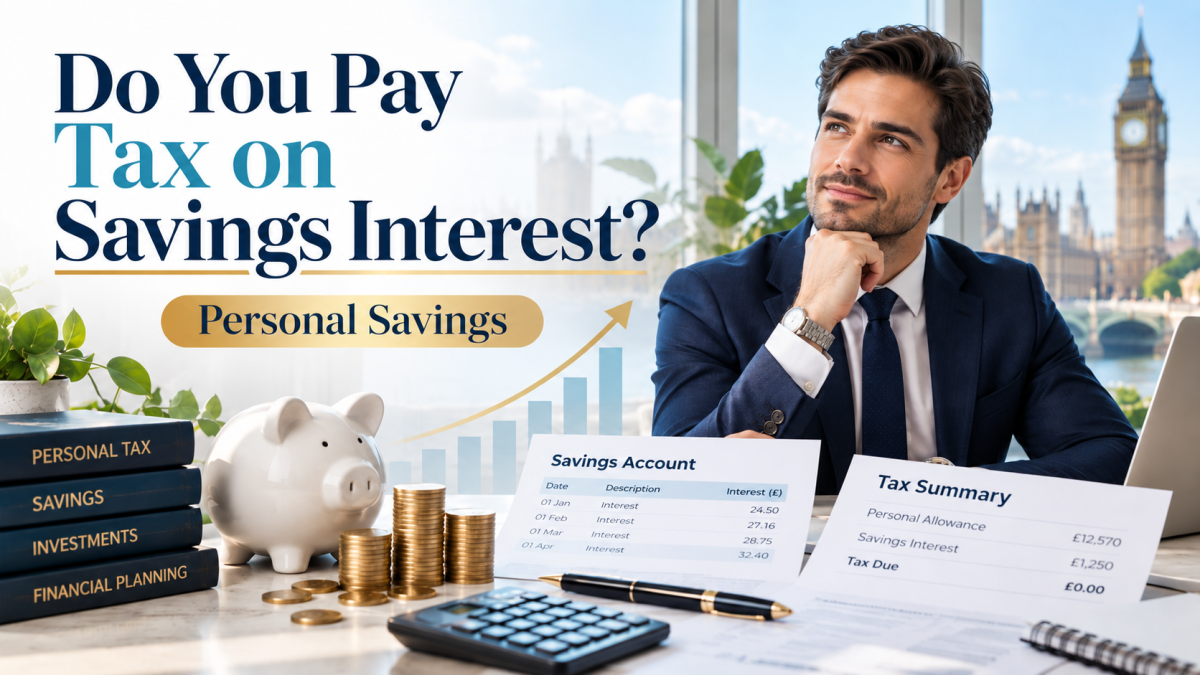
Do You Pay Tax on Savings Interest? Personal Savings
Tax on Savings Interest is increasingly relevant because stronger savings rates mean more people are earning enough interest to use their tax-free allowances. Earning bank interest does not automatically create a tax bill, but the amount you can receive tax-free depends on your total income and the allowances available to you.
The UK system can protect savings income through the Personal Allowance, the starting rate for savings and the Personal Savings Allowance. ISAs and certain other products can also provide tax-free returns.
However, Tax on Savings Interest depends on your Income Tax band, the type of account and the amount of interest received. This guide explains the 2026/27 rules, who may have to pay Tax on Savings Interest, how HMRC collects it and practical ways to manage Tax on Savings Interest efficiently.
What is Tax on Savings Interest?
Tax on Savings Interest is Income Tax charged on taxable interest arising from savings and certain investments. Banks and building societies generally pay interest without deducting Income Tax, so whether Tax on Savings Interest is ultimately due depends on your own position.
Savings income can include interest from current accounts, savings accounts, fixed-term deposits, credit union accounts and certain investments. Interest from government or company bonds, peer-to-peer lending and some investment funds may also fall within Tax on Savings Interest rules.
Tax on Savings Interest is calculated by considering your savings income alongside your other taxable income. This matters because your salary, pension, property income, self-employed profits and other taxable amounts may determine which tax band you fall into and, consequently, the size of your Personal Savings Allowance.
You should therefore avoid assuming that the same level of interest will produce the same Tax on Savings Interest for everyone. Two people earning £1,500 of bank interest could have very different Tax on Savings Interest outcomes if one is a basic-rate taxpayer and the other is an additional-rate taxpayer.
How much savings interest can you receive tax-free?
There are potentially three main tax-free layers that can reduce Tax on Savings Interest: your unused Personal Allowance, the starting rate for savings and the Personal Savings Allowance.
For 2026/27, the standard Personal Allowance is £12,570. If your wages, pension or other income do not use all of it, the unused amount can potentially cover savings interest before Tax on Savings Interest becomes payable.
The starting rate for savings can provide a further 0% band of up to £5,000. This is mainly relevant to people with relatively low non-savings income. If your other taxable income is £17,570 or more, you normally will not receive the starting rate for savings. Where other income exceeds the Personal Allowance, the £5,000 starting-rate band is reduced by £1 for every £1 of that other income above the allowance.
The final Tax on Savings Interest layer is the Personal Savings Allowance. This is often the most familiar allowance when discussing Tax on Savings Interest because it applies to many employed people, pensioners, landlords and business owners who already use their Personal Allowance against other income.
Tax on Savings Interest and the Personal Savings Allowance
For the 2026/27 tax year, the Personal Savings Allowance is:
- £1,000 for a basic-rate taxpayer
- £500 for a higher-rate taxpayer
- £0 for an additional-rate taxpayer
This means that a basic-rate taxpayer can generally receive up to £1,000 of qualifying savings interest without paying Tax on Savings Interest under the Personal Savings Allowance. A higher-rate taxpayer has a £500 allowance, while an additional-rate taxpayer does not receive a Personal Savings Allowance.
Your tax band is determined after taking account of your income as a whole, including the interest itself. This is important because Tax on Savings Interest can sometimes push part of your income into a higher tax band.
For example, suppose your other taxable income places you close to the higher-rate threshold and you then receive significant bank interest. Part of that interest may fall within the higher-rate band. This can change the amount of Personal Savings Allowance available and affect the final Tax on Savings Interest calculation.
Basic rate taxpayers
For many basic-rate taxpayers, Tax on Savings Interest only becomes payable once total taxable savings interest exceeds the £1,000 Personal Savings Allowance, assuming the interest is not already covered by unused Personal Allowance or the starting rate for savings.
Consider a basic-rate taxpayer who receives £1,300 of interest from ordinary savings accounts during 2026/27. If no other special allowance applies, the first £1,000 is covered by the Personal Savings Allowance. The remaining £300 is taxable at 20%, producing Tax on Savings Interest of £60.
If the same person receives only £800 of qualifying interest, the full amount is within the £1,000 allowance and there is normally no Tax on Savings Interest to pay.
Remember that HMRC looks at the total interest from relevant accounts. Opening several bank accounts does not provide several Personal Savings Allowances. Tax on Savings Interest is based on your combined savings income for the tax year.
Higher rate taxpayers
Higher-rate taxpayers normally have a Personal Savings Allowance of £500. As a result, Tax on Savings Interest can arise with a much lower savings balance than for a basic-rate taxpayer.
Suppose a higher-rate taxpayer receives £1,200 of taxable bank interest. The first £500 may be covered by the Personal Savings Allowance, leaving £700 subject to Tax on Savings Interest. If all of that taxable interest falls within the 40% savings rate, the Tax on Savings Interest would be £280.
Higher-rate taxpayers should pay particular attention to fixed-rate savings accounts, bonds and high-interest notice accounts. A large amount of interest credited in a single tax year can create an unexpected Tax on Savings Interest liability even if the saver does not withdraw the interest immediately.
The starting rate for savings
The starting rate for savings is sometimes overlooked because it mainly benefits people with lower levels of non-savings income. It can, however, eliminate Tax on Savings Interest for some pensioners, part-time workers and others whose earnings or pension income are relatively low.
For 2026/27, the maximum starting-rate band is £5,000 at 0%. If your non-savings income is no more than your £12,570 Personal Allowance, you may potentially have the full £5,000 starting-rate band available, subject to your circumstances.
If your non-savings income is £15,000, for example, £2,430 sits above the standard Personal Allowance. That amount reduces the £5,000 starting-rate band to £2,570. Savings interest falling within that remaining band can be taxed at 0%, which may substantially reduce Tax on Savings Interest.
If non-savings income reaches £17,570, the £5,000 starting-rate band has effectively been reduced to nil. The Personal Savings Allowance may still be available, so Tax on Savings Interest should always be calculated after considering each relevant allowance in the correct order.
Which savings are tax-free?
Some savings products are specifically tax-advantaged. Interest arising within a qualifying ISA is generally tax-free and does not use your Personal Savings Allowance. This means Tax on Savings Interest does not normally apply to interest earned inside a Cash ISA.
For 2026/27, the overall ISA subscription limit is £20,000. Depending on the ISA rules and the products chosen, this can allow savers to shelter a meaningful amount of money from Tax on Savings Interest over time.
Certain National Savings and Investments products are also tax-free. Premium Bond prizes are tax-free, while specific NS&I savings certificates have statutory exemptions. By contrast, interest on some other NS&I products can be taxable, so you should check the status of the particular product rather than assuming all NS&I returns are exempt from Tax on Savings Interest.
Tax-free savings can be especially useful when your ordinary accounts are already generating interest close to or above your Personal Savings Allowance. The objective should not simply be to avoid Tax on Savings Interest at any cost; the net return, access conditions, risk and savings goals should all be considered.
Do you pay Tax on Savings Interest from an ISA?
Normally, no. Interest earned within a qualifying Cash ISA is not subject to Tax on Savings Interest, and ISA interest does not need to be declared on a Self Assessment tax return.
This distinction is important. The £1,000 or £500 Personal Savings Allowance is not used up by ISA interest. Therefore, a saver may earn tax-free interest inside an ISA while still retaining their Personal Savings Allowance for taxable accounts outside the ISA.
For someone regularly exceeding their allowance, moving suitable cash savings into an ISA can reduce future Tax on Savings Interest. However, interest rates on ISA and non-ISA accounts can differ, so compare the after-tax return rather than assuming the ISA will always produce the better outcome.
Joint savings accounts
Where a savings account is held jointly, HMRC normally treats the interest as being split equally between the account holders. Each person then considers their share when working out their own Tax on Savings Interest.
For example, if a joint account held by two people earns £2,000 of interest, HMRC will normally attribute £1,000 to each holder. Whether either person owes Tax on Savings Interest then depends on that individual’s other income and available allowances.
For Tax on Savings Interest, the equal split may not always reflect the true beneficial ownership of the funds. HMRC guidance recognises that the presumption can potentially be rebutted where the underlying ownership is different. If substantial sums are involved, professional advice may be appropriate before reporting Tax on Savings Interest on a different basis.
Couples should also remember that tax planning should reflect genuine ownership of funds. Simply placing another person’s name on an account without understanding beneficial ownership may not produce the intended Tax on Savings Interest result.
How does HMRC collect Tax on Savings Interest?
Banks and building societies report interest information to HMRC after the end of the tax year. This means HMRC may already receive details of interest even where you do not complete a tax return.
If you are employed or receive a pension through PAYE, HMRC will often collect Tax on Savings Interest by changing your tax code. The code may be adjusted to collect tax due for an earlier year and may also contain an estimate of interest expected in the current year.
That estimate can be based on interest reported for the previous tax year. If interest rates fall, you move money, close an account or receive a one-off maturity payment, the estimate may be too high or too low. You should therefore review any adjustment for Tax on Savings Interest shown in your Personal Tax Account or tax code.
If HMRC cannot collect the amount through a tax code, it may issue a Simple Assessment showing the amount due and the payment instructions.
Tax on Savings Interest and Self Assessment
If you already complete a Self Assessment tax return, you should report the savings interest required on the return. Tax on Savings Interest is then included within your overall Income Tax calculation.
HMRC states that if your savings and investment income is over £10,000, you need to register for Self Assessment if you are not already within the system. If savings interest itself is more than £10,000, HMRC can also issue a notice requiring a return.
For Tax on Savings Interest, do not assume that interest below £10,000 is automatically tax-free. That figure relates to how Tax on Savings Interest may be reported and collected; it is not a £10,000 tax-free allowance. Tax on Savings Interest may arise at much lower levels where your Personal Savings Allowance has been exceeded.
If you have taxable interest but do not normally submit a return, HMRC may calculate the tax using information received from financial institutions. If you believe HMRC has used the wrong figure, compare the calculation with your annual bank statements and contact HMRC where necessary.
Example 1: basic-rate taxpayer
Amir earns £36,000 from employment and receives £1,600 of taxable bank interest in 2026/27. He has no other income and is a basic-rate taxpayer.
His Personal Savings Allowance is £1,000. That leaves £600 of interest taxable. At 20%, his Tax on Savings Interest is £120.
This example demonstrates why the tax is charged only on interest above the relevant allowance, not on the full savings balance and not automatically on all interest received.
Example 2: higher-rate taxpayer
Sara has employment income of £70,000 and earns £1,500 of taxable savings interest. Her Personal Savings Allowance is £500.
The remaining £1,000 is subject to Tax on Savings Interest. If it falls wholly within the higher savings rate, her Tax on Savings Interest is £400.
A saver in this position may wish to compare the net return on ordinary savings with the return available through tax-free accounts.
Example 3: low-income saver
David receives pension income of £14,000 and £2,000 of savings interest. His standard Personal Allowance covers the first £12,570 of pension income.
The £1,430 of pension income above the allowance reduces his £5,000 starting-rate band for savings to £3,570. His £2,000 interest is within that remaining 0% starting-rate band, so his Tax on Savings Interest may be nil.
The example shows why low-income savers should not look only at the Personal Savings Allowance. The starting rate for savings can provide valuable additional protection from Tax on Savings Interest.
Practical ways to reduce Tax on Savings Interest
Good planning normally starts by estimating the interest likely to arise across all accounts before the end of the tax year. Once you know whether you are approaching your allowance, you can consider whether tax-free products or changes in ownership are appropriate.
Using an ISA can protect future interest from Tax on Savings Interest. Couples may also review whose name genuine savings are held in, because each individual has their own allowances and tax band. Transfers between spouses or civil partners can sometimes support tax-efficient ownership, but ownership must be genuine and the wider circumstances should be considered.
You can also compare accounts using the net interest after Tax on Savings Interest rather than the advertised gross rate. A taxable account with a higher headline rate may still beat an ISA for someone whose interest remains fully within their allowance. Conversely, once the allowance is exceeded, the ISA may become more attractive.
Timing may matter as well. If a fixed-term product allows a choice over how interest is paid, understanding the tax year in which the interest arises can help you anticipate Tax on Savings Interest. Product terms should be checked carefully before making decisions.
Final thoughts
Tax on Savings Interest does not mean every saver will pay tax on their bank interest. Many people remain fully protected by the Personal Allowance, the starting rate for savings, the Personal Savings Allowance or tax-free savings products.
For 2026/27, basic-rate taxpayers generally have a £1,000 Personal Savings Allowance, higher-rate taxpayers have £500 and additional-rate taxpayers have no Personal Savings Allowance. Low-income savers may also benefit from a starting rate for savings of up to £5,000.
The key is to review all relevant interest together and consider it alongside your other taxable income. As savings balances and interest rates increase, Tax on Savings Interest can arise sooner than many people expect.
Keeping good records, checking HMRC calculations and making sensible use of tax-free savings can help you manage Tax on Savings Interest efficiently. If your income is more complex, obtaining advice before the tax year ends can provide more options than trying to correct the position afterwards.
If you need help reviewing your savings income, allowances or Self Assessment position, Taxes Done Right can help you understand your Tax on Savings Interest obligations and ensure the correct figures are reported to HMRC.
Need help deciding what’s best for your situation?
📞 Call 0161 710 1901
📧 Email Tax@TaxesDoneRight.co.uk
Visit www.taxesdoneright.co.uk