Common Self Assessment Mistakes and How to Avoid Them
October 21, 2026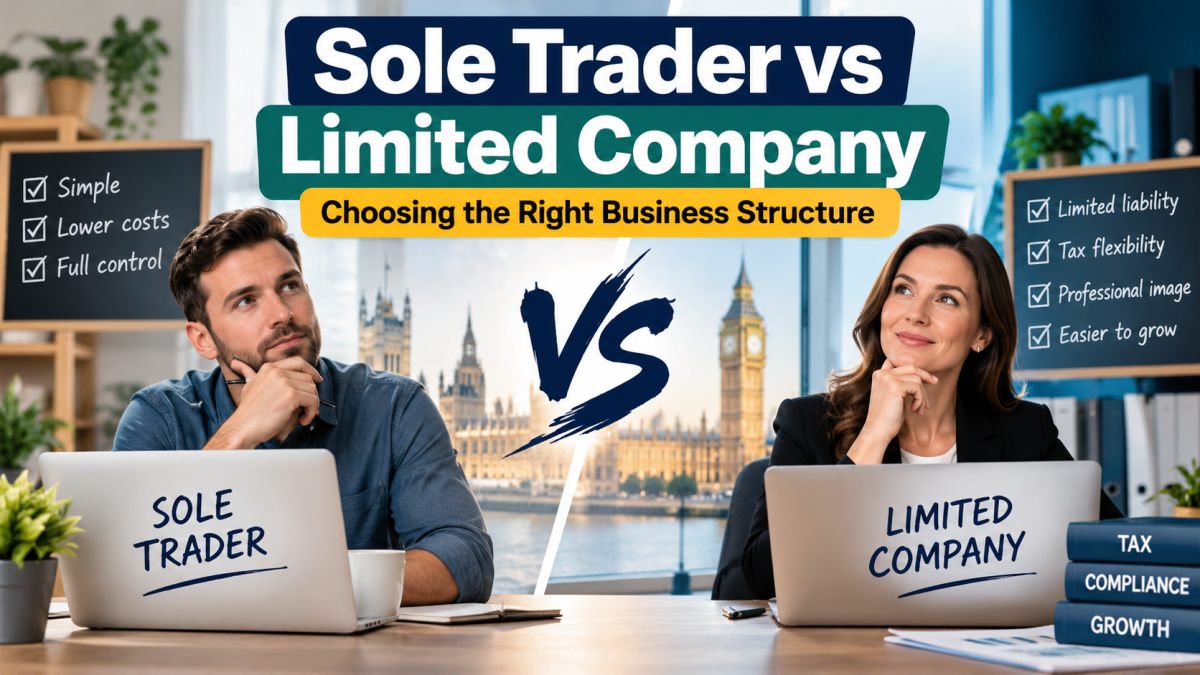
Sole Trader vs Limited Company: The Ultimate Guide to Choosing the Right Business Structure
Starting a business is an exciting journey, but one of the most important decisions you will face is choosing the right legal structure. For entrepreneurs across the UK, the Sole Trader vs Limited Company debate often comes down to taxation, financial protection, administration and future business ambitions.
Whether you are launching a consultancy, opening an online shop, working as a freelancer or expanding an established business, your chosen structure can significantly influence how much tax you pay, how you manage your finances and how your business grows.
Some entrepreneurs prefer the simplicity and independence of sole trader status. Others choose a limited company because of its separate legal identity, potential tax planning opportunities and greater flexibility for investment.
However, there is no universal answer. The most suitable structure depends on your profits, personal circumstances, business risks and long-term objectives.
This guide explores the key differences between sole traders and limited companies, helping you make an informed decision under current UK regulations.
What Is a Sole Trader?
A sole trader is an individual who owns and operates a business in their own name or under a trading name.
It is one of the simplest ways to establish a business in the UK because there is no requirement to incorporate a separate legal entity.
As a sole trader, you control business decisions, manage day-to-day operations and retain profits after paying applicable taxes.
You can employ staff, work with contractors, register for VAT and operate a substantial business while remaining a sole trader.
However, you and your business are legally the same person. This means you are personally responsible for business debts and certain legal liabilities.
How to Become a Sole Trader
Setting up generally involves relatively few formalities.
You can begin trading immediately, although you must register for Self Assessment if your gross self-employment income exceeds £1,000 during a tax year, subject to the applicable registration rules.
You should also maintain accurate financial records, monitor your taxable profits and check whether additional registrations are required.
Although a separate business bank account is not generally compulsory, using one can simplify bookkeeping and improve financial organisation.
For individuals testing a new business idea, this straightforward structure can be particularly appealing.
What Is a Limited Company?
A limited company is a legally separate business entity registered with Companies House.
Unlike a sole trader, the company can own assets, enter contracts, employ staff and incur liabilities in its own name.
The company is managed by directors and owned by shareholders. In many small businesses, one person acts as both the sole director and shareholder.
A limited company pays Corporation Tax on taxable profits, while directors and shareholders may pay personal taxes on money received from the company.
Importantly, company funds do not automatically belong to the director.
Money must be withdrawn through legitimate arrangements, including salaries, dividends, expense reimbursements or properly recorded director’s loan transactions.
How to Register a Limited Company
To establish a company, you must complete company incorporation with Companies House.
This involves selecting an acceptable name, appointing directors, identifying shareholders and providing a registered office address.
You must also establish appropriate constitutional documents and comply with identity verification requirements.
As of October 2026, standard online incorporation costs £100.
Once established, the company must meet ongoing reporting, accounting and statutory obligations.
For growing businesses, these additional responsibilities may be worthwhile because of the commercial and organisational benefits.
Sole Trader vs Limited Company: Key Differences
Understanding the practical differences helps identify which structure aligns with your objectives.
| Feature | Sole Trader | Limited Company |
|---|---|---|
| Legal identity | Owner and business are legally the same | Separate legal entity |
| Personal liability | Generally unlimited | Generally limited |
| Business taxation | Income Tax and National Insurance | Corporation Tax |
| Taking profits | Owner can withdraw funds | Formal withdrawal methods |
| Formation | Simple registration | Companies House incorporation |
| Annual reporting | Personal tax reporting | Company accounts and tax reporting |
| Administration | Generally lower | Generally higher |
| Financial privacy | Greater privacy | Public company records |
| Raising investment | More limited options | Can issue shares |
| Business continuity | Closely linked to owner | Company can continue independently |
Neither structure is automatically superior.
A sole trader may save considerable administration costs, whereas a limited company may offer advantages for businesses seeking investment, reinvestment opportunities or liability protection.
The key is understanding which differences have the greatest financial and practical impact on your circumstances.
Tax Differences Between Sole Traders and Limited Companies
Taxation is frequently the deciding factor when comparing business structures.
However, comparing Income Tax directly with Corporation Tax can produce misleading conclusions.
Limited company profits may be taxed twice in economic terms: first within the company and then personally when distributed as dividends.
A proper comparison must consider the complete tax position.
Sole Trader Income Tax
Sole traders normally pay Income Tax on taxable business profits, alongside any applicable National Insurance contributions.
For the 2026/27 tax year, the standard Personal Allowance is £12,570.
For taxpayers in England, Wales and Northern Ireland, the principal non-savings Income Tax rates are:
- Basic rate: 20%
- Higher rate: 40%
- Additional rate: 45%
Scotland applies different rates and bands to non-savings income.
The Personal Allowance also reduces when adjusted net income exceeds £100,000.
One important consideration is that sole traders are generally taxed on profits, not simply on the money they withdraw.
Leaving money in the business bank account does not automatically defer personal taxation.
Sole Trader National Insurance
Self-employed individuals may also pay Class 4 National Insurance.
For 2026/27, the main rates are:
- 6% on profits between £12,570 and £50,270.
- 2% on profits above £50,270.
Separate Class 2 rules determine whether contributions are treated as paid or can be paid voluntarily.
These additional costs should be included when calculating the overall tax burden of self-employment.
Limited Company Corporation Tax
Limited companies pay Corporation Tax on taxable company profits.
The standard rates are:
- 19% for profits up to £50,000.
- 25% for profits above £250,000.
- Marginal Relief may apply between these thresholds.
These thresholds can be reduced where companies have associated companies or shorter accounting periods.
Corporation Tax is not necessarily the final tax charge experienced by the business owner.
For example, if a company makes £40,000 in taxable profits and qualifies for the 19% rate, its Corporation Tax would be £7,600.
That leaves £32,400 in post-tax profits.
However, additional personal tax may arise if those profits are distributed to shareholders.
Dividend Tax for Company Directors
Many owner-managed companies use a combination of salary and dividends to remunerate directors.
Dividends are normally paid from legally available distributable profits and are not deductible expenses for Corporation Tax purposes.
For 2026/27, the dividend allowance is £500.
The applicable dividend tax rates are:
- Basic rate: 10.75%.
- Higher rate: 35.75%.
- Additional rate: 39.35%.
Dividend tax depends on the shareholder’s total taxable income and available allowances.
Therefore, incorporating a business does not automatically guarantee lower overall taxation.
Which Structure Is More Tax-Efficient?
The answer depends on profits, other income, pension contributions, employment arrangements and how much money the owner needs personally.
A sole trader earning modest profits may find that the potential tax benefits of incorporation are outweighed by additional accounting expenses.
Conversely, a profitable company owner who does not need to withdraw all available profits may benefit from retaining funds for future investment.
For example, retained company profits could finance equipment, recruitment, expansion or working capital.
The shareholder generally does not incur dividend tax merely because the company retains its profits.
However, extracting those funds later may create a personal tax liability.
The most reliable approach is to calculate both scenarios using the same projected business profits and personal withdrawal requirements.
Personal Liability and Financial Protection
One significant advantage of a limited company is its separate legal identity.
As a sole trader, business debts are generally your personal responsibility.
If the business cannot meet its financial obligations, creditors may pursue your personal assets, subject to applicable legal protections.
This creates greater personal financial exposure, especially in businesses involving substantial borrowing, stock, employees or contractual commitments.
Limited company shareholders normally benefit from limited liability, meaning their financial exposure as shareholders is generally restricted to their investment and unpaid share capital.
However, limited liability is not absolute.
Directors may still face personal responsibility where they provide personal guarantees, breach legal duties or engage in wrongful or fraudulent conduct.
Insurance also remains important.
Businesses should assess their exposure to professional negligence, public liability, employer responsibilities and industry-specific risks.
For higher-risk activities, incorporation may offer meaningful protection, but it should never replace proper risk management.
Accounting and Administrative Responsibilities
Administration is another major difference in the Sole Trader vs Limited Company comparison.
Sole traders generally have simpler bookkeeping and reporting requirements.
They must record business income and allowable expenditure, calculate taxable profits and submit required tax information.
Limited companies have additional legal and financial responsibilities.
These include preparing statutory accounts, maintaining company records, calculating Corporation Tax and filing the relevant returns.
Directors must also ensure company money is properly distinguished from personal funds.
Companies House Filing Requirements
Most active limited companies must submit annual accounts and a confirmation statement.
The confirmation statement confirms key company information held on the public register.
As of October 2026, its standard online filing fee is £50.
Late accounts may result in financial penalties, while other compliance failures can expose directors to enforcement action.
These requirements make professional accounting support particularly valuable for limited companies.
Making Tax Digital: Does Business Structure Matter?
Digital tax reporting is becoming increasingly important for UK businesses.
Making Tax Digital for Income Tax applies to qualifying sole traders and landlords in stages.
The scheduled thresholds are:
- From 6 April 2026: qualifying income exceeding £50,000.
- From 6 April 2027: qualifying income exceeding £30,000.
- From 6 April 2028: qualifying income exceeding £20,000.
Qualifying income generally considers gross self-employment and property income before expenses, rather than net profit.
Affected individuals must maintain digital records and submit quarterly updates using compatible software, subject to exemptions.
Limited companies are not brought into this Income Tax regime merely because they are incorporated, although company directors may have separate personal reporting obligations.
Companies must still comply with their own corporation tax and VAT reporting requirements.
Therefore, digital compliance should be considered when deciding which structure is appropriate.
VAT Registration: Sole Trader vs Limited Company
VAT obligations are not determined simply by whether you operate as a sole trader or limited company.
Both structures can register voluntarily or become required to register when the relevant conditions are met.
The current compulsory UK VAT registration threshold is £90,000 of taxable turnover, assessed under the applicable rolling and forward-looking tests.
Businesses approaching this threshold should monitor their turnover carefully.
VAT registration can affect pricing, cash flow and administrative responsibilities.
For businesses supplying VAT-registered customers, charging VAT may have less commercial impact because eligible customers can often recover it.
However, businesses selling mainly to consumers may need to consider how VAT affects competitiveness.
Choosing incorporation solely to avoid VAT is generally ineffective because the same broad registration principles apply, and artificial business separation can be challenged.
Business Expenses and Tax Relief
Both structures can claim appropriate business expenses, but the treatment of certain payments differs.
Common deductible costs may include professional fees, business insurance, qualifying travel, advertising, software subscriptions and relevant equipment.
Expenses must satisfy the rules applicable to the particular tax and business structure.
Sole traders generally claim qualifying business expenditure against trading profits.
Limited companies claim eligible company expenditure, subject to Corporation Tax rules and restrictions.
Some expenses involving directors may also create personal tax or benefit-in-kind consequences.
Working-from-home costs, company vehicles, entertaining and pension contributions require particular care.
For example, a company-funded asset available for private use may produce a taxable employee benefit even where the company qualifies for some tax relief.
Accurate categorisation and supporting records are essential under either structure.
Salary, Dividends and Pension Contributions
A limited company can provide additional flexibility over how its director-shareholder receives remuneration.
A properly structured combination of salary, dividends and employer pension contributions may be appropriate.
However, the most efficient arrangement depends on employment status, National Insurance thresholds, other earnings and individual circumstances.
Employer pension contributions can sometimes be particularly attractive because qualifying contributions may receive Corporation Tax relief without being treated as ordinary salary.
Nevertheless, pension annual allowance rules and commercial deductibility requirements must be reviewed.
Sole traders can also make personal pension contributions and obtain applicable tax relief.
The important distinction is that sole traders cannot employ themselves or deduct their own salary as a business expense.
Company directors should obtain tailored advice before adopting a remuneration strategy.
Professional Image and Business Credibility
A limited company can create a more established commercial image, especially when dealing with larger organisations.
Some clients, procurement departments and commercial lenders prefer contracting with incorporated businesses.
Companies House registration also provides a publicly accessible record of the company’s existence and certain financial information.
However, this does not mean sole traders are less professional.
Experienced freelancers, consultants, tradespeople and creative professionals frequently operate successfully as sole traders.
Customer confidence often depends more heavily on service quality, qualifications, insurance, reputation and reliable communication.
Incorporation may support branding and credibility, but it cannot compensate for poor business practices.
Funding, Investment and Business Growth
Your long-term plans should strongly influence your choice.
Sole traders can obtain business finance, employ workers and expand their operations.
However, raising equity investment is more difficult because there are no company shares to issue.
A limited company can introduce new shareholders, create different share classes where appropriate and establish formal ownership arrangements.
This may be useful when bringing in investors, business partners or future management teams.
A company can also provide a clearer framework for succession and ownership transfers.
Nevertheless, incorporation does not guarantee access to funding.
Lenders may still assess trading history, profitability, security and the director’s personal financial circumstances.
For ambitious businesses expecting external investment, the company structure often provides greater flexibility.
Costs of Running Each Structure
Sole traders generally benefit from lower initial and ongoing costs.
There is no Companies House incorporation fee, and straightforward businesses may have relatively modest accounting requirements.
However, professional support, software, insurance and regulatory costs can still arise.
Limited companies incur incorporation fees and additional recurring compliance expenses.
Typical costs may include accountancy services, payroll administration, bookkeeping software, registered office services and statutory filing fees.
These expenses vary considerably depending on transaction volume, employee numbers, VAT obligations and accounting complexity.
Consequently, the cheapest legal structure to establish is not necessarily the most cost-effective structure over several years.
Business owners should compare the total ongoing financial impact, not merely the registration fee.
Can You Change from Sole Trader to Limited Company?
Yes. Many successful businesses begin as sole traders before incorporating when profitability, risks or expansion plans change.
However, incorporation is not simply a change of trading name.
The process may involve transferring business assets, customer contracts, stock, goodwill and operational arrangements into a new legal entity.
Existing liabilities, VAT registrations, finance agreements and employment contracts may also need attention.
Potential tax consequences should be examined before transferring assets.
Depending on the circumstances, reliefs may be available, but they are not automatic.
It is therefore sensible to review incorporation before significant contracts, asset acquisitions or ownership changes take place.
When Might Sole Trader Status Be Better?
Sole trader status may be particularly appropriate where:
- You are starting a small business with uncertain profits.
- You want straightforward accounting and administration.
- Your business carries relatively limited financial risk.
- You need regular access to most of your earnings.
- You do not currently require outside shareholders.
This structure can be an excellent starting point for freelancers, tutors, consultants and small service providers.
Importantly, choosing sole trader status today does not prevent incorporation later.
When Might a Limited Company Be Better?
A limited company may be more suitable when:
- Your business faces significant contractual or financial risks.
- You expect substantial profits and want to reinvest earnings.
- You intend to introduce investors or shareholders.
- You want a formal structure for future business succession.
- Your projected tax position justifies the additional compliance costs.
Limited companies can be particularly useful for established businesses planning sustained growth.
However, the benefits must be considered alongside director responsibilities and the costs of operating a separate legal entity.
Common Mistakes to Avoid
One common mistake is assuming that limited companies always pay less tax.
Another is believing that company directors can freely withdraw money without recording it.
Business owners should also avoid choosing structures based solely on turnover, rather than assessing actual profit and cash requirements.
Failing to consider personal guarantees, insurance, dividend availability or filing deadlines can create unexpected problems.
Similarly, delaying professional advice until after major financial decisions may reduce available planning options.
A considered decision made before trading or expansion can prevent costly restructuring later.
How to Choose the Right Business Structure
Before deciding, consider the following questions:
- How much profit do you realistically expect to make?
- How much income will you need for personal living expenses?
- What financial and legal risks does your business face?
- Will you need external investment or additional owners?
- Can your business manage higher accounting and compliance costs?
- Do you plan to retain profits for future growth?
- Could your circumstances change significantly in the next few years?
Answering these questions creates a clearer picture of your requirements.
A qualified accountant can then compare projected Income Tax, National Insurance, Corporation Tax and dividend liabilities, while considering practical business requirements.
Final Thoughts
The Sole Trader vs Limited Company decision is about much more than choosing the lowest apparent tax rate.
It affects personal liability, financial control, administration, investment opportunities and the future direction of your business.
For smaller businesses prioritising simplicity, sole trader status can be an effective and economical solution.
For businesses expecting growth, additional financial exposure or external investment, a limited company may offer important advantages.
Ultimately, the best structure is the one that supports your personal financial circumstances and commercial objectives.
At Taxes Done Right, we help UK entrepreneurs understand their business tax obligations and make informed decisions about their business structure.
Whether you are starting a new venture or considering incorporation, professional advice can help you evaluate your options and avoid unnecessary costs.
Choosing the right structure from the beginning can create a stronger foundation for long-term business success.
Need help deciding what’s best for your situation?
📞 Call: 0161 710 1901
📧 Email: Tax@TaxesDoneRight.co.uk
Visit: www.taxesdoneright.co.uk