Pension Contributions: Tax Considerations and Savings for Business Owners in 2026/27
October 20, 2026
Sole Trader vs Limited Company: The Ultimate Guide to Choosing the Right Business Structure
October 22, 2026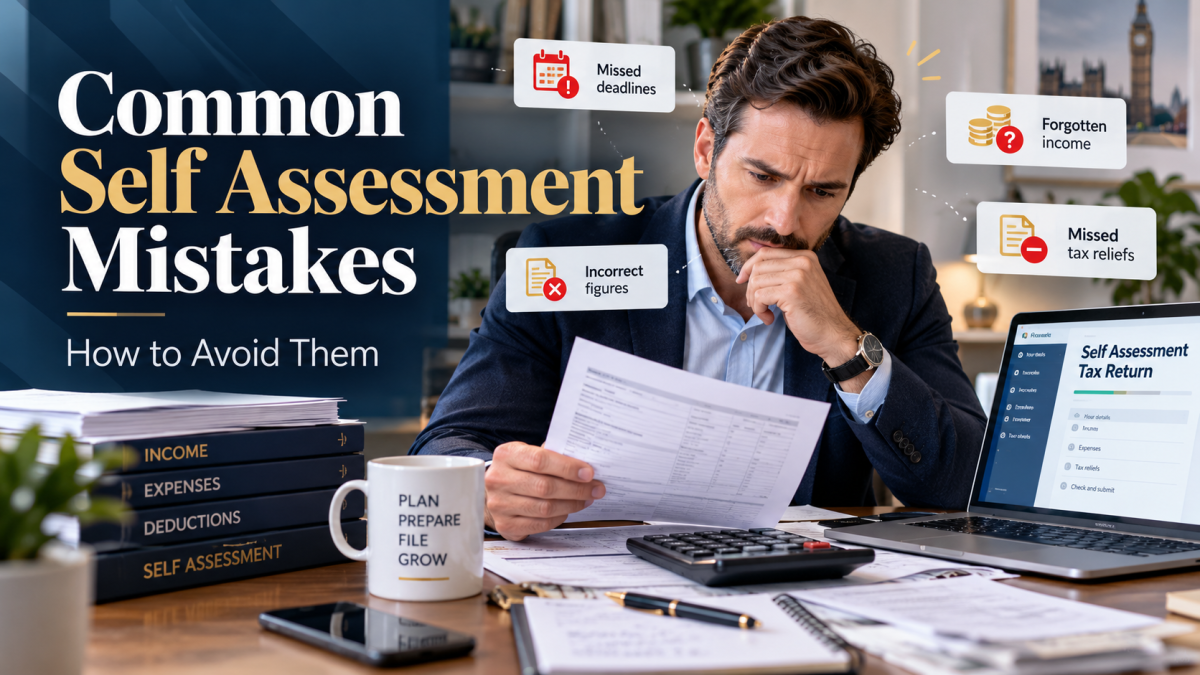
Common Self Assessment Mistakes and How to Avoid Them
Completing a Self Assessment tax return is an important responsibility for millions of UK taxpayers. Whether you are self-employed, a landlord, a company director or someone receiving additional income, understanding your tax obligations can help you avoid unnecessary penalties and unexpected tax bills.
Unfortunately, Self Assessment mistakes are surprisingly easy to make. Missing income, overlooking allowable expenses, misunderstanding HMRC deadlines or entering incorrect figures can result in paying too much tax, paying too little or facing enquiries from HM Revenue & Customs (HMRC).
Even small errors can create complications, particularly when they affect previous tax returns or result in inaccurate payments on account.
The good news is that most mistakes are preventable with effective record-keeping, careful preparation and a clear understanding of UK tax rules.
In this comprehensive guide, we explore 16 common Self Assessment mistakes, explain their potential consequences and provide practical advice to help individuals and business owners complete their tax returns accurately.
Whether you are preparing your first tax return or have been submitting returns for years, these tips will help make the process more manageable.
1. Missing the Self Assessment Deadline
One of the most common and costly mistakes is failing to submit a tax return before the relevant deadline.
HMRC operates strict filing deadlines, and missing them can trigger automatic penalties even when you have no additional tax to pay.
For the 2025/26 tax year, the key dates are:
- 5 October 2026: Normal deadline to register for Self Assessment if you are newly required to notify HMRC.
- 31 October 2026: Deadline for HMRC to receive paper tax returns.
- 30 December 2026: Deadline for eligible online returns where you want tax collected through PAYE.
- 31 January 2027: Deadline for filing online tax returns and paying the balancing tax liability.
- 31 July 2027: Deadline for the second payment on account, where applicable.
Different deadlines can apply if HMRC issues a notice to file late.
How to avoid this mistake
Check the official Self Assessment deadlines and mark the relevant dates in your calendar.
Begin gathering information several months before January. Filing early gives you more time to correct errors, calculate liabilities and arrange payment.
2. Forgetting to Register for Self Assessment
Some taxpayers assume that HMRC will automatically notify them when they need to submit a tax return.
However, individuals are generally responsible for determining whether they need to register.
You might need to complete a return if you receive self-employment income, taxable property income, certain investment income or other income that has not been taxed appropriately.
For example, a sole trader with gross trading income exceeding £1,000 will normally need to consider registering, even if their business expenses mean they have little taxable profit.
Importantly, receiving a salary through PAYE does not automatically remove your Self Assessment obligations.
How to avoid this mistake
Use HMRC’s tax return checker when your circumstances change.
Review your income sources annually, particularly if you begin freelancing, renting out property or receiving additional earnings.
If HMRC has issued a notice requiring a return, do not ignore it simply because you believe no tax is due.
3. Failing to Declare All Sources of Income
Another frequent Self Assessment mistake involves reporting only the taxpayer’s main income.
HMRC generally requires relevant taxable income from different sources to be reported, even where some tax has already been deducted.
Income that taxpayers sometimes overlook includes:
- Employment income and taxable benefits.
- Self-employment and freelance earnings.
- Rental income from UK or overseas properties.
- Dividends and taxable savings interest.
- Foreign income and certain pension payments.
- Commission, bonuses and additional consultancy income.
For example, someone working full-time who also provides freelance services may need to declare both their employment income and self-employment profits.
How to avoid this mistake
Prepare an annual summary of every income source before completing your return.
Check bank statements, payslips, P60s, P11Ds, dividend vouchers and investment statements.
Do not assume information already held by HMRC has automatically been included correctly in your tax return.
4. Claiming Incorrect or Ineligible Business Expenses
Claiming expenses incorrectly can lead to an inaccurate tax calculation and potentially an HMRC enquiry.
Self-employed individuals can generally deduct legitimate business expenses incurred for business purposes, subject to the relevant tax rules.
Examples include appropriate business travel, professional subscriptions, advertising, insurance and office costs.
However, everyday personal expenditure is not deductible merely because a business owner pays for it using a business bank account.
Where costs have both personal and business purposes, only the qualifying business proportion may be claimed.
How to avoid this mistake
Review HMRC’s guidance on allowable business expenses before submitting your figures.
Keep invoices and receipts and document how mixed-use expenses have been apportioned.
Be particularly careful with clothing, entertaining clients, commuting and personal purchases, as these are frequently misunderstood.
Remember that equipment purchases may also require different tax treatment depending on your accounting method.
5. Overlooking Legitimate Tax Reliefs
While some taxpayers claim expenses incorrectly, others fail to claim reliefs they are genuinely entitled to receive.
This can result in unnecessarily high tax bills.
Potentially relevant reliefs include qualifying business expenses, professional subscriptions, charitable donations and certain pension contributions.
Higher-rate and additional-rate taxpayers may also be entitled to further relief on personal pension contributions made under relief-at-source arrangements.
However, tax relief depends on individual circumstances, applicable limits and how contributions were made.
For example, contributions deducted from employment income before tax under a net pay pension arrangement are treated differently from relief-at-source contributions.
How to avoid this mistake
Review available reliefs before finalising your tax calculation.
Check the rules on pension contribution tax relief and ensure you have entered eligible contributions correctly.
Seeking professional advice can be particularly valuable if you have several income sources or make substantial pension contributions.
6. Poor Record-Keeping Throughout the Year
Poor bookkeeping is one of the main reasons taxpayers struggle with Self Assessment.
Missing receipts, incomplete sales records and unexplained bank transactions make it difficult to calculate taxable profits accurately.
Relying on memory when preparing a tax return increases the likelihood of overlooking income or claiming an expense twice.
Inadequate records can also create difficulties if HMRC asks for supporting information.
Self-employed taxpayers generally need to retain appropriate records for at least five years after the relevant 31 January submission deadline, although different rules can apply in certain circumstances.
How to avoid this mistake
Maintain organised financial records throughout the year rather than gathering everything at the last minute.
Reconcile business bank accounts regularly, keep copies of invoices and categorise transactions correctly.
Accounting software can simplify this process by helping monitor income, expenditure and outstanding invoices.
Good records also make it easier to identify unexpected costs and improve business profitability.
7. Mixing Personal and Business Transactions
Using one bank account for both personal and business activity is not necessarily prohibited for sole traders, but it can make bookkeeping unnecessarily complicated.
Personal spending may accidentally be recorded as business expenditure, while legitimate business payments could be missed.
For example, a supermarket transaction containing both business supplies and personal groceries should not automatically be treated as fully deductible.
Likewise, withdrawing money from a sole trader’s business account does not create an allowable business expense.
How to avoid this mistake
Consider maintaining a dedicated business bank account.
Clearly distinguish personal expenditure from business transactions and regularly review transfers between accounts.
Keep explanations and receipts for unusual payments, particularly when the same supplier provides both personal and business goods.
Separating finances improves accuracy and saves time when preparing your Self Assessment tax return.
It also makes it easier for your accountant to identify discrepancies before submission.
8. Misunderstanding the £1,000 Trading Allowance
The trading allowance is frequently misunderstood by taxpayers who earn relatively small amounts from self-employment.
Eligible individuals may receive up to £1,000 of trading income relief annually.
Where qualifying gross trading income does not exceed £1,000, the income may be exempt, although exceptions and reporting requirements can apply.
Where income exceeds £1,000, taxpayers may be able to deduct the £1,000 allowance instead of actual allowable expenses.
However, they cannot normally claim both against the same trading income.
How to avoid this mistake
Compare the trading allowance with your actual deductible business costs.
For example, if your qualifying trading income is £5,000 and allowable expenses total £600, using the £1,000 allowance could produce a lower taxable profit.
If allowable expenses total £2,000, claiming actual expenses may be preferable.
Also consider whether claiming a trading loss would be more beneficial than using the allowance.
9. Making Mistakes with Rental Income
Landlords face specific Self Assessment requirements that differ from those applying to ordinary trading businesses.
A frequent mistake involves treating the entire mortgage payment as a deductible rental expense.
For individual residential landlords, mortgage capital repayments are not deductible, and qualifying finance costs are generally subject to basic-rate tax reduction rules rather than a deduction from rental profits.
Other common errors include confusing property improvements with repairs, overlooking rental receipts and misunderstanding jointly owned property income.
For example, replacing a damaged component may be treated differently from substantially improving a property.
How to avoid this mistake
Maintain separate property records showing rental income, repairs, insurance, agent fees and financing costs.
Review HMRC’s rental income guidance before calculating taxable profits.
If you own multiple properties, ensure relevant income and expenses are allocated correctly.
Landlords should also review whether property losses brought forward affect their current tax position.
10. Reporting Income in the Wrong Tax Year
The UK tax year runs from 6 April to 5 April of the following year.
Confusing tax years can result in income or expenditure being reported in the wrong period.
For example, income received on 4 April 2026 falls within the 2025/26 tax year, whereas income received on 7 April 2026 falls within 2026/27.
However, when income is recognised for tax purposes depends on the applicable accounting rules, including whether cash basis or traditional accounting applies.
Not every transaction should simply be allocated according to the bank payment date.
How to avoid this mistake
Identify the relevant accounting method before preparing your figures.
Check transactions close to 5 April carefully and reconcile year-end balances.
Keep consistent accounting records and ensure business income is not accidentally omitted or duplicated when moving between tax years.
If you change accounting methods, consider obtaining advice on the transitional adjustments that may be required.
11. Forgetting Payments on Account
Payments on account can surprise taxpayers who complete their Self Assessment return and assume the amount calculated is their entire January payment.
These advance payments usually apply when the previous year’s relevant liability is at least £1,000 and less than 80% of the tax liability was collected at source.
They are generally split into two instalments, due in January and July.
Consequently, a taxpayer may need to pay their outstanding tax for the previous year alongside an advance payment towards the following year.
How to avoid this mistake
Review your calculation and understand payments on account before the payment deadline.
Budget throughout the year rather than relying on funds remaining in your bank account.
If you genuinely expect a lower future liability, you may request reduced payments.
However, reducing them excessively can result in interest charges.
12. Entering Incorrect PAYE Information
People who receive employment income alongside self-employment or rental income sometimes enter incorrect employment figures.
Common errors include reporting take-home pay instead of taxable employment income, entering the wrong tax deducted or overlooking taxable benefits.
These mistakes can affect the total liability and may result in tax already paid not being credited correctly.
Another frequent issue involves entering employment income twice when figures have already been imported into the return.
How to avoid this mistake
Use your P60 and relevant P45 information to confirm employment income and PAYE tax deducted.
Check your P11D or other benefit information where applicable.
Compare any pre-populated figures with your own documents rather than assuming they are correct.
If you changed jobs during the year, ensure all relevant employment details are included.
Review the final tax calculation for inconsistencies before submission.
13. Forgetting the High Income Child Benefit Charge
The High Income Child Benefit Charge is another area where mistakes can arise.
For the 2025/26 tax year, the charge may apply where an individual’s adjusted net income exceeds £60,000 and relevant Child Benefit has been received.
The charge increases as income rises and can equal the full Child Benefit amount when adjusted net income reaches £80,000.
Importantly, the calculation considers adjusted net income rather than simply gross salary.
Pension contributions and certain charitable donations may affect this calculation.
How to avoid this mistake
Check your adjusted net income and whether the charge applies to your household circumstances.
Read HMRC’s High Income Child Benefit Charge guidance.
Depending on your circumstances, the charge may be paid through Self Assessment or PAYE.
Do not assume that the person receiving Child Benefit must always be the person responsible for the charge.
14. Ignoring Foreign Income and Capital Gains
Taxpayers sometimes assume that foreign income does not need declaring because it was earned or taxed overseas.
However, UK tax residents may have reporting obligations for foreign income and gains, depending on their circumstances and the applicable rules.
Similarly, profits from selling assets such as shares, investment properties or certain other investments may create Capital Gains Tax obligations.
Different reporting deadlines can apply, particularly to disposals of UK residential property.
A common mistake is assuming that having no immediate tax payment means there is no reporting requirement.
How to avoid this mistake
Review all overseas income, investment activity and significant asset disposals.
Consider tax residence, available reliefs, foreign tax credits and any applicable double taxation agreements.
Keep records of purchase costs, sale proceeds and associated allowable expenditure.
Obtain specialist advice where overseas tax rules, property disposals or complex investment transactions are involved.
15. Failing to Check the Return Before Submission
Submitting a tax return without reviewing the final figures is an avoidable mistake.
Errors can arise from typing incorrect amounts, selecting the wrong income category or overlooking important information.
Even a small error can change the tax calculation or create inconsistencies between the return and supporting records.
Tax software may identify missing fields, but it cannot always determine whether the financial information entered is correct.
How to avoid this mistake
Review your completed tax return alongside your accounting records and supporting documents.
Pay particular attention to income totals, expenses, tax deductions, relief claims and previous payments.
Compare figures with earlier tax years and investigate unusual movements.
Before submission, read the tax calculation carefully to understand how the liability has been determined.
Once filed, retain a copy of your return, tax calculation and submission acknowledgement for future reference.
16. Assuming Filing the Return Means the Tax Has Been Paid
Filing and paying are separate obligations.
Submitting a tax return successfully does not automatically mean that HMRC has received the money owed.
Taxpayers may accidentally miss the payment deadline because they believe filing completes the process.
Late payment can result in interest and additional penalties, depending on the circumstances and duration of the delay.
The standard Self Assessment late filing penalty starts at £100, with further charges potentially applying if the return remains outstanding.
How to avoid this mistake
Check your HMRC account after filing and confirm the amount payable and relevant due dates.
Use an approved payment method and allow enough time for the payment to reach HMRC.
If you cannot pay in full, investigate whether an HMRC Time to Pay arrangement is available.
Contact HMRC promptly rather than ignoring an outstanding balance.
What Happens If You Make a Self Assessment Mistake?
Making a genuine mistake does not necessarily mean you will receive a penalty.
The consequences depend on the type of error, whether tax has been underpaid and whether reasonable care was taken.
HMRC distinguishes between different behaviours, including careless inaccuracies and deliberate errors.
Where an error has led to insufficient tax being paid, HMRC may seek the outstanding amount and applicable interest.
Penalties can also apply, depending on the circumstances.
If you discover an error after submitting your return, correcting it promptly is generally advisable.
Taxpayers can normally amend a Self Assessment return within 12 months of the normal online filing deadline.
For example, the usual amendment deadline for the 2025/26 return is 31 January 2028.
If the amendment deadline has passed, different procedures may apply, and you may need to contact HMRC directly.
Voluntarily correcting errors can help demonstrate responsible tax compliance.
How Making Tax Digital Affects Self Assessment
Making Tax Digital for Income Tax is changing how eligible sole traders and landlords maintain records and report information to HMRC.
The system introduces digital record-keeping and quarterly updates for qualifying taxpayers.
The introduction is being phased in:
- 6 April 2026: Qualifying income exceeding £50,000, assessed using the 2024/25 tax year.
- 6 April 2027: Qualifying income exceeding £30,000, assessed using the 2025/26 tax year.
- 6 April 2028: Qualifying income exceeding £20,000, assessed using the 2026/27 tax year.
Qualifying income generally refers to combined gross self-employment and property income before expenses, rather than taxable profit.
Individuals within the rules must normally use compatible software, subject to relevant exemptions.
The annual tax return and payment obligations continue, although the reporting process changes.
You can review HMRC’s guidance on Making Tax Digital for Income Tax.
Practical Self Assessment Checklist
Before submitting your return, complete the following checks:
- Confirm whether you need to submit a return and identify the correct deadline.
- Gather records covering the full tax year.
- Reconcile bank accounts and business transactions.
- Include all relevant taxable income.
- Review expenses and applicable tax reliefs.
- Confirm employment income and tax already deducted.
- Check rental income, investments and other additional earnings.
- Review payments on account and previous tax payments.
- Examine the final calculation for unusual figures.
- Submit your return and retain confirmation of successful filing.
Allow enough time to obtain missing information and resolve discrepancies.
Completing these checks before January can significantly reduce the risk of unexpected problems.
Frequently Asked Questions
Can HMRC fine me for an honest mistake?
An honest error does not automatically result in a penalty. HMRC considers the nature of the inaccuracy, whether reasonable care was taken and how the error was corrected. However, outstanding tax and interest may still be payable.
Can I correct a Self Assessment return after submitting it?
Yes. In most circumstances, you can amend your return within the normal amendment period. If the deadline has passed, you may need to contact HMRC or follow another applicable correction procedure.
Is it worth using an accountant for Self Assessment?
An accountant can help identify errors, review allowable deductions, calculate tax liabilities and ensure applicable reporting requirements are met.
Professional assistance can be particularly useful for landlords, company directors, business owners and individuals with multiple income sources.
Final Thoughts

Avoiding common Self Assessment mistakes is about more than meeting deadlines. Accurate tax reporting helps protect your finances, ensures you claim legitimate reliefs and reduces the risk of HMRC enquiries.
The most effective approach is to maintain reliable records, understand your tax obligations and review your return carefully before submission.
Do not wait until the final days of January to organise financial information or calculate your tax liability.
Early preparation provides opportunities to correct discrepancies, plan payments and obtain advice where necessary.
As the UK tax system continues to evolve, particularly with Making Tax Digital, staying informed is increasingly important.
Need help with your Self Assessment tax return?
At Taxes Done Right Ltd, we help individuals, sole traders, landlords and business owners manage their tax obligations with confidence.
Whether you need assistance preparing a return, identifying allowable expenses, reviewing tax reliefs or planning future liabilities, professional advice can make the process simpler.
Get in touch with Taxes Done Right Ltd to discuss your Self Assessment requirements and avoid unnecessary tax complications.
Need help deciding what’s best for your situation?
📞 Call: 0161 710 1901
📧 Email: Tax@TaxesDoneRight.co.uk
Visit: www.taxesdoneright.co.uk