Mortgage Payments vs Mortgage Interest: What Tax Relief Can Landlords Claim?
October 26, 2026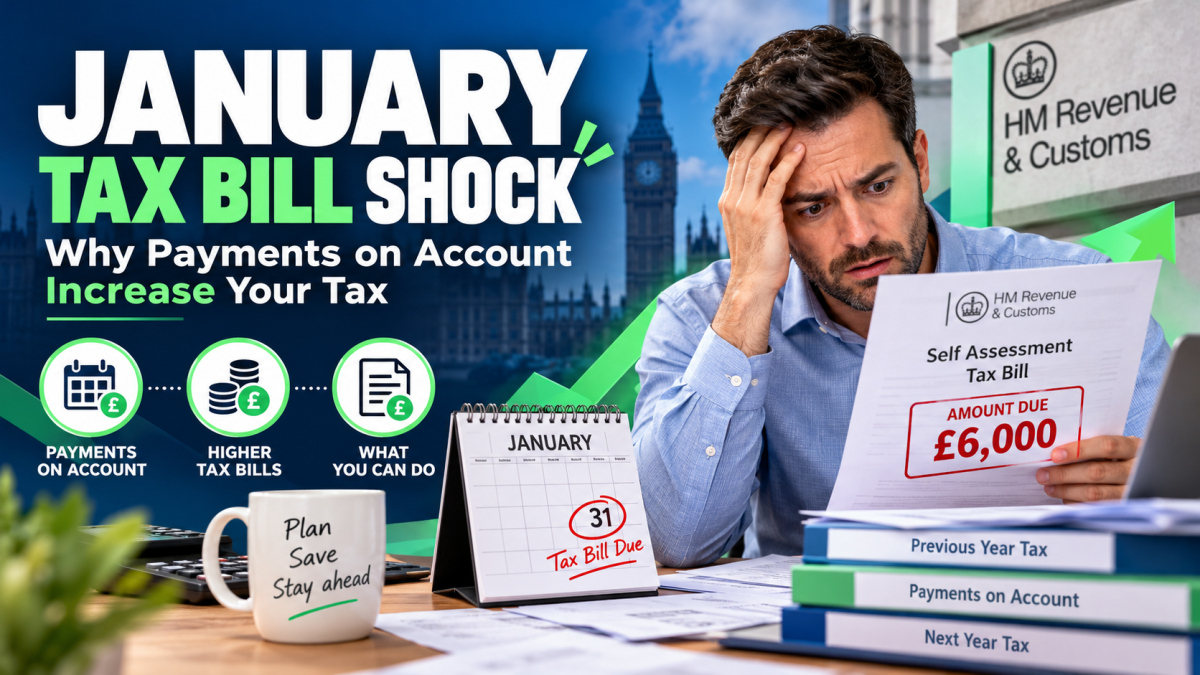
January Tax Bill Shock: Why Payments on Account Increase Your Tax
For many self-employed individuals, landlords and small business owners, January brings more than the usual post-Christmas financial pressure. It also brings the deadline for paying their Self Assessment tax bill. However, what often surprises taxpayers is discovering that the amount HMRC expects them to pay is significantly higher than the tax calculated on their earnings.
The reason is frequently something called payments on account.
You might have calculated an income tax liability of £4,000, only to discover that HMRC wants £6,000 by the end of January. Understandably, this can create confusion, particularly if you have already budgeted for the tax shown on your Self Assessment calculation.
The additional amount is not necessarily an error, an unexpected tax rate increase or a penalty. Instead, HMRC may be requesting an advance payment towards your next tax year’s liability.
Understanding how payments on account work is essential for effective financial planning. Whether you operate as a sole trader, receive rental income or have other untaxed earnings, knowing what your January tax bill includes can help prevent unpleasant financial surprises.
In this guide, we explain how payments on account are calculated, who must pay them, when the deadlines fall and what you can do if the amount requested seems unreasonable.
What Are Payments on Account?
Payments on account are advance payments collected by HM Revenue & Customs (HMRC) towards your next Self Assessment tax liability.
Unlike employees whose income tax is generally deducted automatically through PAYE, self-employed individuals and other taxpayers with untaxed income normally pay their tax after the relevant tax year has ended.
This creates a delay between earning the income and paying the associated tax.
To reduce that gap, HMRC operates a system requiring qualifying taxpayers to make advance payments based on their previous year’s tax liability.
These advance payments are generally divided into two equal instalments:
- First payment on account: 31 January
- Second payment on account: 31 July
Each instalment normally represents 50% of the previous year’s relevant Self Assessment liability.
Importantly, these amounts are not additional taxes. They are advance contributions towards an existing future tax obligation.
According to HMRC guidance on payments on account, the system is intended to spread tax payments across the year rather than requiring the entire liability to be paid after the tax year ends.
Nevertheless, the system can create significant cash-flow challenges, especially for taxpayers making payments on account for the first time.
Why Your January Tax Bill Can Be Higher Than Expected
The main reason a January tax bill feels unexpectedly high is that HMRC may collect two different amounts at the same time.
These are:
- A balancing payment for the tax year that has already ended.
- The first payment on account towards the following tax year.
For example, suppose your Self Assessment tax liability for 2025/26 is £4,000.
Assume you have not already made any payments on account towards that year.
You might reasonably expect to pay £4,000 by 31 January 2027.
However, HMRC may also require your first advance payment towards 2026/27.
Because the previous year’s relevant liability was £4,000, the first payment on account would normally be £2,000.
Your total January payment would therefore be:
| Description | Amount |
|---|---|
| 2025/26 tax liability | £4,000 |
| First 2026/27 payment on account | £2,000 |
| Total due 31 January 2027 | £6,000 |
| Second payment due 31 July 2027 | £2,000 |
Although your actual tax liability was £4,000, the immediate payment requirement increases to £6,000.
This effectively means paying 150% of the previous year’s relevant tax liability in January, where no advance payments have already been made.
For taxpayers unaware of the system, the resulting difference can be financially uncomfortable.
Who Needs to Make Payments on Account?
Not everyone completing a Self Assessment tax return must make payments on account.
Generally, they are required when your previous year’s relevant Self Assessment liability was at least £1,000 and less than 80% of the relevant tax liability was collected outside Self Assessment.
You may therefore need to make advance payments if you receive:
- Self-employment income from a sole trader business.
- Rental profits from residential or commercial property.
- Income from freelance or consultancy activities.
- Certain partnership profits.
- Significant untaxed savings or investment income.
- Other income generating a substantial Self Assessment liability.
However, simply submitting a Self Assessment return does not automatically mean advance payments are necessary.
For example, someone employed full-time who has already paid most of their income tax through PAYE might not be required to make payments on account.
Similarly, a taxpayer whose relevant liability is below £1,000 would generally be excluded.
It is important to distinguish between the total amount payable under Self Assessment and the specific amounts included when calculating payments on account.
Certain liabilities, including Capital Gains Tax and student loan repayments, do not normally form part of the advance payment calculation.
Understanding the £1,000 Threshold and 80% Rule
Two important conditions determine whether HMRC normally requires payments on account.
The £1,000 threshold
If your relevant previous-year Self Assessment liability is less than £1,000, payments on account are generally not required.
For example, if your relevant liability is £850, you would ordinarily pay that amount by the January deadline without having to make advance payments for the following year.
However, if the liability reaches £1,000, payments on account may become necessary.
The 80% tax collection rule
Advance payments are also generally unnecessary where more than 80% of the relevant tax liability has already been collected outside Self Assessment.
This commonly benefits employed individuals whose income tax is largely deducted through payroll.
Consider an employee with a small amount of additional rental income.
If most of their overall income tax has already been collected through PAYE, they might not need to make payments on account even where an additional balancing payment arises.
The outcome depends on the individual’s complete tax position rather than simply their employment status or rental profit.
An accountant can review the calculation and explain whether these exclusions apply.
Important Self Assessment Payment Deadlines for 2026/27
Understanding payment dates is just as important as understanding the amounts involved.
For taxpayers submitting their 2025/26 Self Assessment tax return, the key deadlines are:
| Deadline | Payment required |
|---|---|
| 31 January 2027 | Any outstanding 2025/26 balancing payment |
| 31 January 2027 | First payment on account for 2026/27 |
| 31 July 2027 | Second payment on account for 2026/27 |
| 31 January 2028 | Any remaining 2026/27 balancing payment and first 2027/28 advance payment |
The online tax return submission deadline for 2025/26 is also 31 January 2027.
However, taxpayers do not have to wait until January to prepare or submit their returns.
Filing early can make a substantial difference to financial planning.
For further information, consult the official Self Assessment deadlines.
What Happens If You Already Made Payments on Account?
Once you enter the payments on account system, future January bills are calculated differently.
Instead of necessarily paying the entire previous year’s tax liability again, HMRC deducts the advance payments already made.
Consider a self-employed consultant whose relevant 2025/26 tax liability is £8,000.
During that tax year, they made two payments on account of £3,000 each, totalling £6,000.
When the final 2025/26 tax calculation is prepared, the position becomes:
| Description | Amount |
|---|---|
| Actual 2025/26 liability | £8,000 |
| Payments already made | (£6,000) |
| Outstanding balancing payment | £2,000 |
| First 2026/27 payment on account | £4,000 |
| Total due January 2027 | £6,000 |
The second 2026/27 payment of £4,000 would then normally fall due in July 2027.
This demonstrates why January bills can fluctuate considerably between years.
If business profits increase, your payments on account might not fully cover the final liability.
Conversely, where profits decrease, advance payments may exceed the actual tax owed.
The difference is reconciled when the relevant tax return is completed.
Why First-Time Self Assessment Taxpayers Are Often Surprised
The first year in which payments on account become due can be particularly challenging.
Imagine someone leaving employment to establish a consultancy business.
During their first trading year, they earn sufficient profits to generate a £10,000 income tax and relevant National Insurance liability.
Because they have never previously operated under the payments on account system, they may not have made any advance payments.
When their first tax return is submitted, HMRC may require:
- £10,000 for the completed tax year.
- £5,000 as the first payment towards the following year.
- Another £5,000 by the next July deadline.
This creates an initial January requirement of £15,000.
For someone who has only reserved £10,000, the additional £5,000 can place considerable pressure on business finances.
The difficulty often arises because individuals budget for the tax attributable to their profits without considering advance payments.
Planning for both liabilities from the beginning of self-employment helps avoid this problem.
How Payments on Account Affect Landlords
Landlords can face similar issues, especially where rental income represents a substantial addition to employment earnings.
Suppose a landlord owns two buy-to-let properties generating taxable rental profits of £20,000 annually.
After considering their other income, the rental profits might generate a significant additional income tax liability.
If this creates a qualifying Self Assessment liability, HMRC may require payments on account.
The landlord could therefore be paying both the remaining tax on their previous rental profits and an advance amount towards future rental income.
This can become particularly challenging where mortgage interest, repairs, insurance and other property expenses already reduce available cash.
Residential landlords should also remember that mortgage capital repayments are not deductible expenses, while mortgage finance costs for individual residential landlords are generally subject to specific tax relief restrictions.
Consequently, cash flow and taxable rental profit can differ substantially.
Landlords should calculate their anticipated tax position before assuming that rental income remaining in their bank account represents disposable profit.
Can You Reduce Your Payments on Account?
Yes. HMRC allows taxpayers to request reduced payments on account where they reasonably expect their relevant tax liability to decrease.
This may be appropriate where:
- Self-employment profits have fallen.
- A business has ceased trading.
- Rental income has reduced following a vacancy.
- Allowable business expenses have increased.
- Income is now being taxed through PAYE.
- Additional legitimate tax reliefs reduce the expected liability.
For example, suppose your previous relevant tax liability was £8,000.
HMRC would normally request two advance payments of £4,000.
However, you reasonably expect the following year’s liability to be £4,000 because business profits have declined.
You may be able to reduce each payment on account to £2,000.
Instead of paying £8,000 in advance across January and July, you would pay £4,000.
Requests can be submitted online or through form SA303.
However, reductions should always be supported by realistic financial estimates.
The Risks of Reducing Payments Too Much
Although reducing payments on account can improve short-term cash flow, requesting an excessive reduction carries risks.
HMRC can charge interest where the advance payments made were insufficient compared with the amount that should have been paid.
Imagine your original payments on account totalled £10,000.
You reduced them to £4,000 because you expected substantially lower profits.
However, your final relevant tax liability was £9,000.
The £5,000 shortfall in advance payments could give rise to interest calculated from the original payment deadlines.
An excessive reduction does not automatically mean a penalty will arise, but deliberately or carelessly providing inaccurate information can create further compliance concerns.
The safest approach is to prepare a reasonable tax forecast before requesting any reduction.
If circumstances change again, review the estimate rather than leaving an outdated figure in place.
Reducing payments on account should be a legitimate financial adjustment, not simply a way of postponing tax that you already know will be payable.
What If Your Business Profits Increase?
Increasing profits can create the opposite problem.
Because payments on account are generally based on the previous year’s relevant liability, they may be insufficient where profits rise substantially.
For example, your advance payments might total £5,000, while your final relevant tax liability increases to £12,000.
You would then face a £7,000 balancing payment in January.
At the same time, HMRC could request the first advance payment towards the next tax year, calculated at £6,000.
Consequently, your January payment could total £13,000.
This is particularly relevant for growing businesses, successful freelancers and landlords acquiring additional properties.
As profits rise, the amounts already collected through payments on account may no longer reflect the eventual liability.
Regularly forecasting taxable profits helps identify these potential shortfalls before the payment deadline approaches.
Do Payments on Account Include National Insurance?
For self-employed individuals, payments on account generally include relevant Class 4 National Insurance contributions alongside income tax.
This is important because some taxpayers calculate their expected payments using income tax alone.
However, the Self Assessment liability can contain additional amounts that affect the final balancing payment.
Class 2 National Insurance is not normally included in the payments on account calculation.
Capital Gains Tax and student loan repayments are also normally excluded from advance payment calculations, even though they may be payable through Self Assessment.
For example, a taxpayer who sells an investment property might have a significant Capital Gains Tax liability in addition to income tax.
That capital gains liability does not automatically increase the calculation of their next year’s payments on account.
Understanding the distinction between amounts payable immediately and those used to calculate future advance payments is essential when checking HMRC statements.
How to Check Whether Your January Tax Bill Is Correct
If the amount HMRC requests seems unexpectedly high, review the detailed Self Assessment calculation before making assumptions.
Start by identifying the tax liability for the completed tax year.
Next, check whether any payments on account have already been credited against that liability.
Then identify whether the January amount includes a balancing payment and an advance payment towards the following year.
Your online tax account should provide a breakdown of the amounts outstanding.
You can find further information in HMRC’s guide to understanding your Self Assessment tax bill.
It is also important to check that all previous payments have been allocated correctly.
Where payments were made close to the deadline, allow for processing time and confirm that the transaction appears against the correct tax account.
If the calculation still appears incorrect, ask your accountant to reconcile the tax computation against the Self Assessment statement.
What Happens If You Cannot Afford Your January Tax Bill?
Discovering an unexpectedly high liability does not necessarily mean you have to ignore the deadline or wait for enforcement action.
HMRC offers payment support for taxpayers experiencing genuine financial difficulties.
Depending on your circumstances, you may be able to arrange a Time to Pay agreement.
Such arrangements allow qualifying taxpayers to settle outstanding liabilities through instalments rather than paying the entire amount immediately.
However, interest can still apply, and HMRC will assess whether the proposed repayment arrangement is affordable and appropriate.
If you anticipate difficulties, contact HMRC before the payment deadline wherever possible.
Guidance is available through HMRC’s Self Assessment payment service.
Remember that submitting your tax return and paying your tax are separate obligations.
Even where you cannot afford the balance, filing the return on time remains important.
Ignoring both requirements can result in unnecessary penalties and additional financial pressure.
Practical Ways to Avoid an Unexpected January Tax Bill
The most effective solution to January payment surprises is proactive tax planning throughout the year.
Set money aside regularly
Transfer a proportion of business or rental income into a dedicated tax savings account.
The appropriate percentage depends on your income, tax band, other earnings and available allowances.
Prepare accounts before the deadline
Completing bookkeeping promptly helps estimate taxable profits without waiting until January.
Review your payments on account
Check whether previous advance payments are sufficient, excessive or likely to require adjustment.
Forecast changes in income
Business expansion, additional rental properties, increased employment earnings and changes in tax relief can materially affect future liabilities.
Submit your tax return early
Filing earlier gives you more time to arrange funds, examine the calculation and address any discrepancies.
HMRC also offers a Budget Payment Plan, allowing eligible taxpayers to make regular payments towards their next Self Assessment liability.
These contributions can make major tax deadlines easier to manage.
Common Mistakes Taxpayers Make With Payments on Account
Several misunderstandings repeatedly create problems for individuals completing Self Assessment returns.
The first is assuming the January payment represents only the tax due for the previous year.
Another is treating payments on account as additional taxation rather than advance payments credited against a future liability.
Some taxpayers also forget the July instalment, creating unexpected financial pressure during the summer.
Others reduce payments on account without properly estimating their current year’s earnings.
A further mistake is assuming that filing a return early means the tax becomes immediately payable. Generally, early submission does not bring forward the normal payment deadline.
Finally, taxpayers sometimes overlook the difference between their tax computation and their outstanding HMRC account balance.
Checking both documents is essential to understanding exactly what must be paid.
How Taxes Done Right Ltd Can Help
Understanding Self Assessment payments can be complicated when you have multiple income sources, changing profits or substantial rental earnings.
At Taxes Done Right Ltd, we help self-employed individuals, landlords, freelancers and business owners understand their tax liabilities and plan for upcoming payment deadlines.
Our services include Self Assessment tax return preparation, reviewing payments on account, calculating balancing payments, considering legitimate reductions and providing personalised tax planning advice.
We aim to ensure clients understand not only how much tax they owe but also when it must be paid and why.
Early planning can provide greater certainty and reduce the financial pressure associated with January and July deadlines.
For professional support, visit Taxes Done Right Ltd or contact our team on 0161 710 1901.
Frequently Asked Questions
Why is my January tax bill 50% higher than expected?
Where you have not already made advance payments, HMRC may require your full previous-year liability plus a first payment on account equal to 50% of the relevant liability. This can create an initial January payment equivalent to 150%.
Can I avoid payments on account altogether?
Payments on account are generally mandatory where the qualifying conditions apply. However, you may not need them if your relevant liability is below £1,000 or the 80% tax collection exception applies. Legitimate reductions are also possible.
Will I get a refund if I overpay?
Yes. If your advance payments exceed your final tax liability, the excess can generally be refunded or credited against other outstanding tax amounts.
Do payments on account apply every year?
They normally continue while the qualifying conditions remain satisfied. The amounts may increase or decrease depending on the previous year’s relevant tax liability.
What happens if I miss the July payment?
HMRC can charge interest on overdue payments on account. It is therefore important to make payments by the deadline or contact HMRC if you are experiencing financial difficulties.
Final Thoughts
An unexpectedly high January tax bill can be worrying, but payments on account are a normal part of the UK Self Assessment system.
The key is recognising that your January payment may include both outstanding tax for the previous year and an advance contribution towards the next.
For sole traders, landlords and growing businesses, understanding this distinction can make a substantial difference to financial planning.
By maintaining accurate records, monitoring profits, reviewing advance payments and filing returns early, you can reduce the likelihood of unpleasant surprises.
Need help understanding your January tax bill? Contact Taxes Done Right Ltd for professional Self Assessment support and practical tax planning advice.
Need help deciding what’s best for your situation?
📞 Call: 0161 710 1901
📧 Email: Tax@TaxesDoneRight.co.uk
Visit: www.taxesdoneright.co.uk