Closing Your Limited Company: What Happens to the Money Left Inside?
October 9, 2026
Off-Payroll Working: Will Your Company’s Responsibilities Change?
October 13, 2026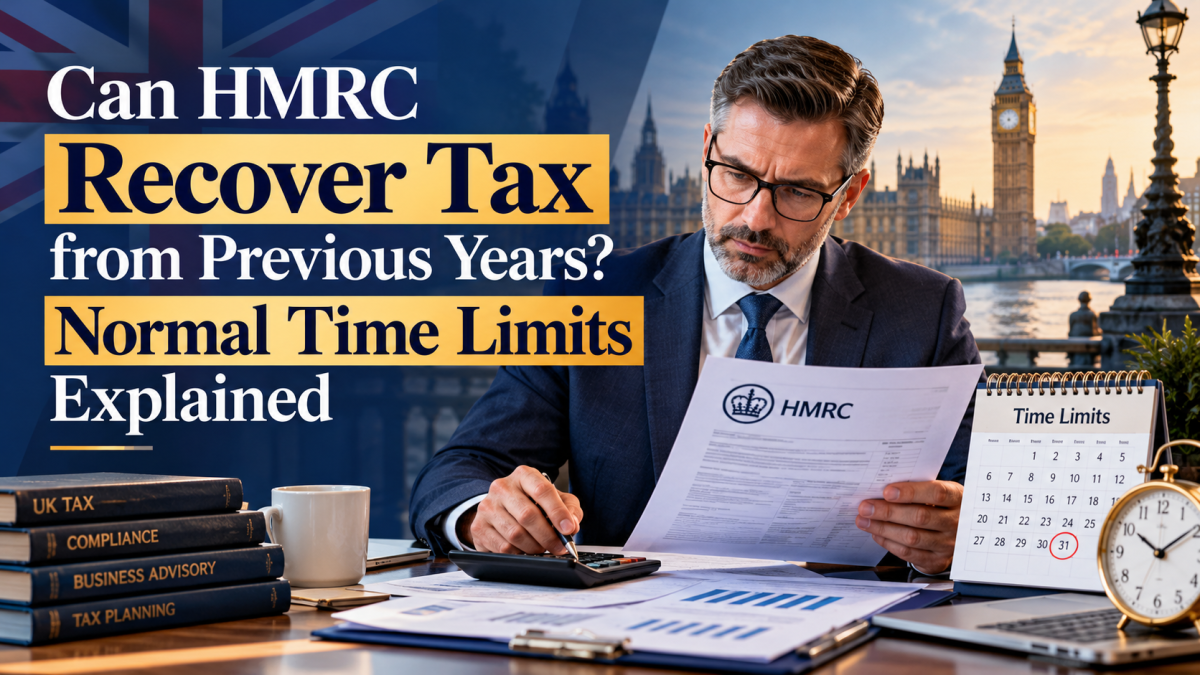
Can HMRC Recover Tax from Previous Years? Normal Time Limits Explained in 2026
Recover Tax from previous years? This is a common concern for UK taxpayers, landlords, self-employed individuals and limited company directors who discover mistakes in historic tax returns or receive unexpected correspondence from HM Revenue & Customs (HMRC).
Many people assume HMRC can investigate their financial affairs indefinitely. Others believe that once a tax return has been submitted and accepted, the figures can never be challenged. Neither assumption is entirely correct.
HMRC has statutory powers to Recover Tax that has been underpaid, incorrectly declared or refunded in error. However, those powers are generally restricted by specific assessment deadlines.
Understanding when HMRC can Recover Tax is particularly important for individuals with rental income, capital gains, overseas investments, self-employment profits or company tax liabilities.
The applicable deadline depends on the type of tax, the circumstances surrounding the error and whether the taxpayer acted reasonably, carelessly or deliberately.
This guide explains how HMRC can Recover Tax from previous years, the normal four-year assessment limit, extended periods of six, twelve and twenty years, and the steps taxpayers can take when challenging historic tax demands.
Can HMRC Recover Tax from Previous Years?
Yes. HMRC can Recover Tax relating to earlier financial years when it identifies an underpayment or another circumstance that legally justifies an assessment.
However, its authority is not unlimited.
Under HMRC’s Compliance Handbook CH52100, the normal assessment period is four years from the end of the relevant tax period.
This rule generally applies where HMRC needs to Recover Tax that was under-assessed, under-declared, over-repaid or incorrectly credited.
For example, a self-employed individual might accidentally exclude business income from a tax return. Alternatively, a landlord might incorrectly claim expenditure that is not deductible when calculating taxable rental profits.
In both situations, HMRC may seek to Recover Tax if a valid assessment can be issued within the applicable statutory period.
The important distinction is that HMRC must follow the correct legal process. Simply identifying an old discrepancy does not automatically mean HMRC has unrestricted authority to issue an additional assessment.
The legislation provides safeguards designed to balance the government’s responsibility to collect revenue with taxpayers’ need for certainty.
Consequently, before accepting a historic tax demand, taxpayers should establish whether HMRC is legally entitled to Recover Tax for the particular year concerned.
The Normal Four-Year Assessment Time Limit
The standard four-year rule forms the foundation of HMRC’s assessment framework.
HMRC can normally Recover Tax within four years following the end of the relevant tax period, provided the statutory requirements for the assessment are satisfied.
For individuals, the UK tax year runs from 6 April to the following 5 April.
Consider an individual who submitted a Self Assessment return for the 2021/22 tax year.
That tax year ended on 5 April 2022. The normal four-year assessment deadline was therefore 5 April 2026.
If HMRC subsequently identifies understated income, it would generally need to establish a valid reason for applying an extended deadline before issuing a new assessment after that date.
The four-year rule is particularly relevant where HMRC wants to Recover Tax arising from ordinary errors rather than careless or deliberate behaviour.
Examples include incorrect calculations, overlooked taxable income and mistakes involving otherwise reasonable tax treatments.
However, it is important to understand that the four-year limit does not necessarily prevent HMRC from collecting tax that was already validly assessed.
It regulates when particular assessments can be made, rather than imposing a universal expiry date on every outstanding tax debt.
Therefore, anyone receiving a historic demand should distinguish between HMRC attempting to Recover Tax through a new assessment and HMRC collecting an existing liability.
Example: Calculating the Four-Year Deadline
Assume a landlord omitted £4,000 of taxable rental profit from their 2022/23 Self Assessment return.
The tax year ended on 5 April 2023.
Under the ordinary four-year rule, HMRC generally has until 5 April 2027 to issue a qualifying assessment.
If the relevant legal conditions are met, HMRC could Recover Tax attributable to that omission during this period.
However, if the omission was caused by carelessness, a longer assessment period may apply.
This illustrates why assessment deadlines must be considered alongside the underlying circumstances.
When Can HMRC Recover Tax Beyond Four Years?
Although four years is the normal assessment period, UK tax legislation provides longer deadlines in specific circumstances.
The principal assessment periods are summarised below.
| Circumstances | Assessment time limit |
|---|---|
| Normal assessment | 4 years |
| Loss of tax arising from carelessness | 6 years |
| Qualifying offshore matters or transfers | 12 years |
| Deliberate behaviour or certain other statutory failures | 20 years |
These limits are not interchangeable, and the twelve-year offshore rule applies only to specified taxes and qualifying circumstances.
HMRC cannot simply decide to Recover Tax from an earlier year because the amount involved is substantial.
There must be a valid legislative basis for using the extended period.
Furthermore, the relevant conduct may involve the taxpayer or someone acting on their behalf, depending on the legislation.
A taxpayer should therefore request clarification where HMRC relies on an extended assessment period without explaining its justification.
Understanding these distinctions can help prevent taxpayers from accepting assessments that may fall outside HMRC’s statutory powers.
The Six-Year Rule: Careless Tax Errors
HMRC may generally Recover Tax within six years after the end of the relevant tax period where the loss of tax resulted from careless behaviour.
Carelessness broadly involves failing to take reasonable care when meeting tax obligations.
For example, a taxpayer might repeatedly omit income despite having access to records that clearly identify the receipts.
Similarly, a business owner might submit incorrect figures without carrying out reasonable checks.
HMRC may conclude that the taxpayer’s actions resulted in an avoidable understatement of tax.
In those circumstances, the six-year assessment period may allow HMRC to Recover Tax beyond the normal four years.
Nevertheless, an incorrect tax return does not automatically establish carelessness.
Tax legislation can be complex, particularly in areas involving property expenses, overseas income, employment status and company distributions.
A taxpayer who makes a reasonable interpretation of the rules, keeps appropriate records and seeks professional advice may have evidence supporting reasonable care.
Whether HMRC can Recover Tax using the extended period will depend on the facts and the applicable statutory test.
Example: An Incorrect Rental Expense Claim
Suppose a landlord claims substantial capital improvement expenditure as a revenue deduction.
The resulting calculation understates taxable rental profits.
If the landlord made the claim without checking the treatment of the expenditure, HMRC may investigate whether reasonable care was exercised.
A finding of carelessness could allow HMRC to Recover Tax for up to six years.
However, the classification of the work, the information available and any advice received should all be considered.
The assessment period must be justified rather than assumed.
The Twelve-Year Rule: Overseas Income and Assets
Offshore tax compliance is an area where HMRC has enhanced assessment powers.
In qualifying cases involving overseas matters or transfers, HMRC may Recover Tax over a twelve-year period.
This extended rule applies to Income Tax, Capital Gains Tax and Inheritance Tax, subject to specific statutory conditions.
Relevant circumstances may involve foreign rental income, overseas investment returns, foreign property disposals or certain offshore transfers.
For example, a UK tax resident may own property abroad and incorrectly assume that rental income is taxable only in the country where the property is located.
That assumption can produce an incorrect UK tax return.
Where the legal conditions are satisfied, HMRC may be entitled to Recover Tax using the offshore assessment provisions.
Importantly, qualifying offshore cases for tax years 2015/16 onwards can fall within the twelve-year period even without careless conduct.
Special transitional rules apply to earlier years, and the twelve-year limit does not apply automatically to every transaction involving a foreign bank account.
There are also exceptions, including circumstances where HMRC received relevant overseas information in time and could reasonably have acted earlier.
Consequently, the mere existence of overseas assets does not automatically establish HMRC’s entitlement to Recover Tax over twelve years.
Example: Overseas Rental Income
Consider a UK resident who received rental income from a property in another country but omitted that income from several UK tax returns.
The individual paid tax overseas and believed no additional UK reporting was required.
Depending on residence status, the applicable double taxation agreement and the statutory offshore provisions, the income may still require UK reporting.
HMRC might be able to Recover Tax for qualifying earlier periods.
However, foreign tax credits and other relevant reliefs must be considered when determining whether additional UK tax is actually payable.
Taxpayers should also check whether an applicable exception prevents HMRC from using the extended deadline.
The Twenty-Year Rule: Deliberate Behaviour
The longest commonly encountered assessment period is twenty years.
In qualifying circumstances, HMRC can Recover Tax where the loss resulted from deliberate behaviour.
Deliberate behaviour generally involves knowingly providing incorrect information or intentionally failing to disclose something that should have been reported.
Examples could include intentionally concealing taxable income, knowingly submitting false expense claims or deliberately understating business profits.
Where the statutory requirements are met, HMRC may Recover Tax for periods extending up to twenty years after the relevant tax year.
However, the twenty-year period is not limited exclusively to deliberate inaccuracies.
Certain failures to notify chargeability and specified tax avoidance reporting failures may also trigger extended assessment powers.
This is an important distinction because a taxpayer may believe the absence of dishonest intent automatically rules out a twenty-year assessment.
That is not necessarily correct.
Nevertheless, HMRC must identify the applicable legal basis before seeking to Recover Tax under these provisions.
An allegation of deliberate behaviour should be examined carefully because it may also have significant implications for penalties.
Example: Deliberately Concealed Trading Income
Assume a business owner knowingly excludes cash sales from their accounts over several years.
The understated turnover results in reduced taxable profits and unpaid tax.
If HMRC establishes deliberate conduct, it may be able to Recover Tax using the twenty-year assessment period.
The taxpayer could also face penalties and interest, depending on the circumstances.
This differs significantly from an individual who makes a genuine arithmetic error despite maintaining reliable records.
The distinction between carelessness and deliberate conduct can therefore materially affect the years HMRC is permitted to assess.
How HMRC Identifies Underpaid Tax
HMRC receives information from numerous sources when checking whether individuals and businesses have declared their liabilities correctly.
These sources may include employer payroll submissions, bank information obtained through lawful information powers, property transaction records, Companies House filings and overseas information exchange arrangements.
HMRC can also identify discrepancies during tax enquiries or compliance checks.
For example, information about a property disposal may indicate that a taxpayer should have reported a capital gain.
Alternatively, differences between accounting records and submitted Corporation Tax returns may suggest that further investigation is needed.
Where HMRC identifies an apparent shortfall, it may attempt to Recover Tax through the appropriate statutory mechanism.
However, information indicating a possible discrepancy does not itself establish that additional tax is due.
There may be valid explanations involving reliefs, exemptions, repayment adjustments, timing differences or incorrectly matched information.
Taxpayers should therefore review the underlying evidence before accepting a revised calculation.
This is especially important where HMRC attempts to Recover Tax from an older period and relies on an extended assessment deadline.
Discovery Assessments and Previous Tax Returns
A discovery assessment is a statutory mechanism that can allow HMRC to assess previously undeclared or under-assessed tax.
For Income Tax and Capital Gains Tax, the relevant provisions include Section 29 of the Taxes Management Act 1970.
Broadly, HMRC may issue a discovery assessment where it discovers that income or gains have not been assessed, an assessment is insufficient, or excessive relief has been given.
However, further statutory conditions may apply where the taxpayer has already submitted a return.
Those conditions are important when deciding whether HMRC can Recover Tax for a year that was previously reported through Self Assessment.
For example, HMRC may need to establish that the loss of tax resulted from careless or deliberate conduct, or satisfy the relevant condition concerning information reasonably available to an HMRC officer.
A discovery assessment is not therefore an unrestricted opportunity to reopen every completed return.
The normal and extended statutory deadlines must also be satisfied.
Before accepting a discovery assessment, taxpayers should check its date, the relevant tax year, the factual basis and the particular statutory conditions relied upon.
Where appropriate, professional advice can help establish whether HMRC has complied with the legal requirements.
Does Filing a Tax Return Stop HMRC Investigating?
Submitting a tax return does not permanently prevent HMRC from examining the figures.
HMRC normally has a defined enquiry window during which it can open a formal enquiry into a Self Assessment return.
For a return submitted on or before the statutory filing deadline, the enquiry window generally runs for twelve months from the date HMRC receives it.
Different rules apply to late returns and certain amendments.
For example, a 2024/25 Self Assessment return submitted on 20 December 2025 would ordinarily be open to enquiry until 20 December 2026.
After the enquiry window closes, HMRC generally cannot open a routine enquiry into that return under the normal rules.
However, it may still be possible to Recover Tax through a valid discovery assessment where the necessary conditions are met.
This distinction is frequently misunderstood.
The enquiry window governs the ability to open a particular type of investigation, while discovery assessments operate under a different statutory framework.
Therefore, taxpayers should not assume that the end of the enquiry window eliminates every possibility of a later assessment.
Can HMRC Recover Tax from Limited Companies?
Limited companies are also subject to statutory assessment deadlines.
Corporation Tax errors may arise from incorrectly calculated profits, disallowed expenditure, capital allowances, director transactions or omitted company income.
Where a company has understated its liability, HMRC may be able to Recover Tax through the appropriate Corporation Tax assessment or enquiry procedures.
The normal four-year framework and relevant extended limits can apply, although the detailed Corporation Tax rules must be checked.
For example, a company may have incorrectly treated personal expenditure incurred by a director as an allowable business expense.
If this resulted in understated taxable profits, HMRC could investigate the treatment and potentially Recover Tax.
However, whether an additional assessment can be issued depends on the accounting period, the statutory mechanism and the applicable deadline.
Companies should maintain adequate financial records, supporting invoices, reconciliations and evidence of significant accounting decisions.
These records can be valuable when defending a historic tax position or demonstrating that reasonable care was exercised.
VAT: Why Different Assessment Rules Matter
VAT assessments involve additional time limits that taxpayers should not overlook.
Although the general four-year framework is relevant, VAT legislation contains separate requirements governing when assessments must be made.
Under Section 73 of the Value Added Tax Act 1994, a two-year assessment rule applies in specified circumstances.
Where HMRC relies on later evidence, a one-year evidence-of-facts rule may also become relevant, subject to the applicable four-year or extended limit.
For instance, HMRC may identify underdeclared output VAT during a business compliance check.
The question is not simply whether HMRC can Recover Tax within four years.
It must also determine whether the assessment satisfies the additional statutory requirements concerning the relevant VAT period and the evidence available.
Special rules can apply to fraud and other specified circumstances.
Businesses should therefore avoid assuming that Income Tax assessment principles apply identically to VAT.
VAT assessments require a separate examination of the relevant legislation and dates.
What Happens If HMRC Issues an Incorrect Assessment?
An HMRC assessment should not be accepted without reviewing its factual and legal basis.
Taxpayers who disagree with an assessment may have the right to appeal, request a statutory review or refer the dispute to the First-tier Tribunal.
The usual appeal deadline is thirty days from the relevant decision or assessment notice, although particular rules and exceptions may apply.
An appeal should identify the disputed matters and explain why the taxpayer believes the assessment is incorrect.
Where HMRC seeks to Recover Tax outside the normal period, the taxpayer may challenge the claimed basis for the extended deadline.
Evidence could include accounting records, bank statements, correspondence, professional advice and documents demonstrating reasonable care.
It may also be necessary to dispute the amount of the alleged tax shortfall rather than solely the assessment period.
Importantly, taxpayers should not ignore official correspondence while preparing their challenge.
Missing the appeal deadline may make resolving the dispute more difficult.
Can HMRC Collect Tax Debts Older Than Four Years?
Assessment time limits and tax debt collection are separate legal concepts.
The normal four-year assessment period does not mean that an outstanding tax debt automatically disappears after four years.
Where tax has already been validly assessed, HMRC may have continuing powers to pursue payment.
In England and Wales, ordinary tax debts are generally excluded from the usual six-year limitation period for many civil debts under the Limitation Act 1980.
Different considerations may apply to National Insurance Contributions, other statutory debts and liabilities arising in different UK jurisdictions.
Therefore, HMRC may be able to Recover Tax that became legally payable many years earlier.
For example, where an individual submitted a Self Assessment return showing tax due but never paid it, HMRC would ordinarily be pursuing an existing debt rather than creating a new assessment.
The age of the original tax year does not necessarily prevent collection.
Taxpayers should establish whether a demand concerns an existing assessed liability, a newly issued assessment or another type of statutory recovery.
Penalties and Interest on Historic Tax Liabilities
Additional tax assessments can also result in interest and penalties.
Interest generally compensates the Exchequer for the late payment of tax.
Penalties are different because they depend on the applicable penalty regime and the taxpayer’s conduct.
A genuine mistake does not necessarily result in a penalty, particularly where reasonable care was taken.
However, careless or deliberate inaccuracies may lead to financial penalties in addition to the underlying tax.
If HMRC seeks to Recover Tax from several previous years, accumulated interest can significantly increase the total amount demanded.
Penalty reductions may be available depending on disclosure, cooperation and the relevant statutory rules.
This makes early engagement important, especially where the taxpayer discovers an error before HMRC contacts them.
Taxpayers should review tax, interest and penalties separately rather than assuming every amount shown on an HMRC calculation is necessarily correct.
What Should You Do If You Discover a Historic Tax Error?
Discovering an error in an earlier tax return does not always mean waiting for HMRC to contact you is the best approach.
An appropriate voluntary disclosure can help establish the correct liability and may positively influence the applicable penalty treatment.
The first step is identifying the affected tax years and obtaining the relevant supporting documents.
Next, determine whether the discrepancy actually creates additional UK tax after considering available allowances, exemptions and reliefs.
If tax has been understated, the correct disclosure procedure depends on the tax involved and the circumstances.
For certain historic Income Tax matters, HMRC’s digital disclosure arrangements may be relevant.
Property-related income may be suitable for the Let Property Campaign where the relevant eligibility conditions are satisfied.
Where offshore income or gains are involved, additional disclosure requirements may need consideration.
Professional advice can help ensure that the disclosure is complete and the calculation is accurate.
It is also important to consider whether HMRC can Recover Tax for every affected period under the applicable legislation.
A voluntary disclosure should be based on the correct legal position rather than an unsupported assumption that every historic year is assessable.
Practical Steps to Protect Yourself
Keeping comprehensive records is one of the most effective ways to reduce disputes involving previous tax years.
Individuals and businesses should retain sufficient documentation to support income, expenses, deductions and significant financial transactions.
Landlords should maintain rental statements, mortgage interest records, invoices and evidence distinguishing repairs from capital improvements.
Limited companies should preserve accounting records, Corporation Tax computations, bank reconciliations and relevant director transaction information.
Where overseas income is involved, foreign tax statements and evidence of taxes paid abroad may also be important.
If HMRC attempts to Recover Tax for an earlier period, organised records can make it easier to establish the correct liability.
Taxpayers should also seek timely advice where tax treatment is uncertain.
Professional guidance does not automatically prevent an assessment, but relevant contemporaneous advice may help demonstrate reasonable care.
Finally, review HMRC correspondence promptly and keep copies of all submissions, calculations and appeal documents.
Frequently Asked Questions
Can HMRC go back more than four years?
Yes. HMRC can Recover Tax beyond four years where a valid extended assessment period applies.
Examples include six years for qualifying careless behaviour, twelve years for specified offshore matters and twenty years for deliberate behaviour or certain other statutory failures.
Can HMRC investigate a return that was already accepted?
Yes, in some circumstances.
Although the normal enquiry window may have closed, HMRC may still issue a valid discovery assessment if the statutory conditions and deadlines are satisfied.
Acceptance of a return does not necessarily amount to permanent approval of every figure.
Can HMRC assess tax from ten years ago?
Potentially. HMRC may Recover Tax from ten years ago if the circumstances fall within an applicable extended assessment period.
For example, qualifying offshore matters or deliberate behaviour could permit an assessment covering that period.
Does HMRC have to prove carelessness?
Where HMRC relies on carelessness to extend the assessment period, the relevant statutory requirements must be established.
An incorrect return alone does not automatically prove that reasonable care was absent.
Can an accountant’s mistake affect the assessment period?
Yes. Depending on the circumstances, careless or deliberate behaviour by a person acting on the taxpayer’s behalf can be relevant.
However, whether the extended assessment period applies depends on the legislation and the facts of the case.
Can HMRC pursue unpaid tax indefinitely?
A tax liability that has already been validly established may remain recoverable beyond the normal assessment period.
The rules governing the enforcement of existing debts must be distinguished from those governing new assessments.
What if I cannot afford to pay the tax demanded?
Taxpayers experiencing payment difficulties should contact HMRC promptly to discuss available arrangements.
HMRC may consider a Time to Pay arrangement based on the taxpayer’s financial circumstances.
Disputing a tax assessment and negotiating payment terms are separate matters, so both should be considered where appropriate.
Final Thoughts
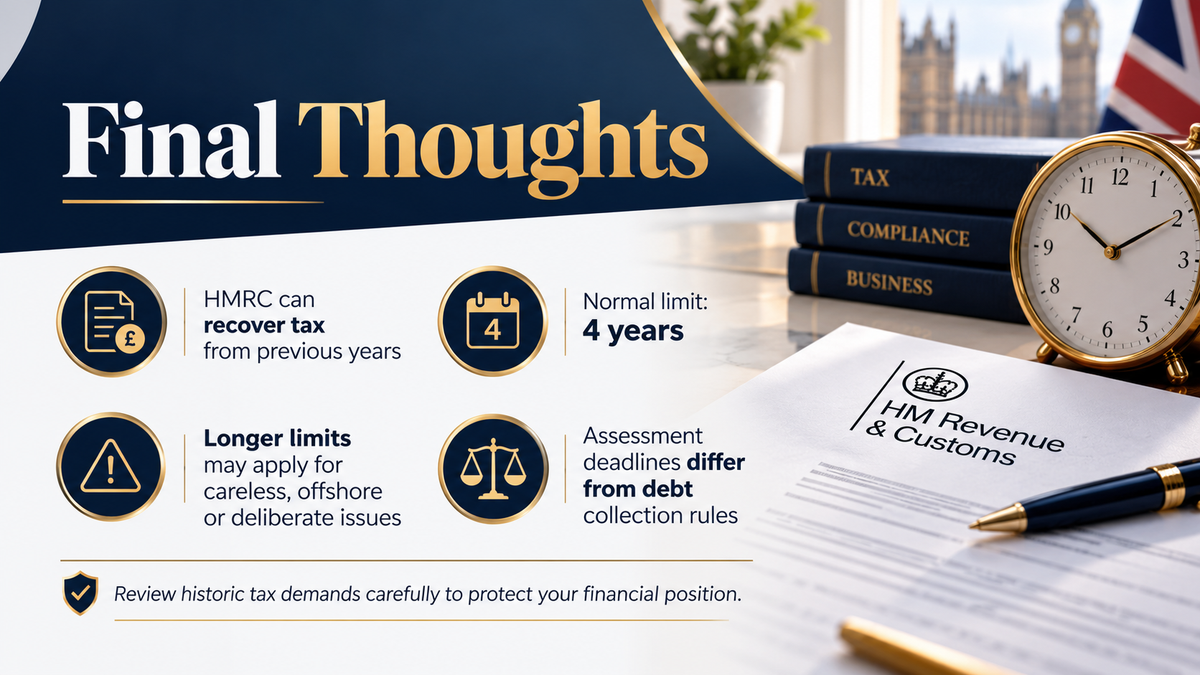
HMRC has significant statutory powers to Recover Tax from previous years, but those powers operate within a legal framework.
The normal assessment limit is four years, with longer periods applying to specified circumstances involving careless behaviour, offshore matters, deliberate conduct or other statutory failures.
Understanding these rules helps taxpayers identify when HMRC can legitimately Recover Tax and when an assessment may require further scrutiny.
It is equally important to remember that the deadline for issuing an assessment is different from the rules governing collection of an existing tax debt.
Whether you are a landlord, sole trader, company director or individual taxpayer, reviewing historic tax demands carefully can help protect your financial position.
Need help with an HMRC assessment or historic tax liability?
Need help deciding what’s best for your situation?
📞 Call 0161 710 1901
📧 Email Tax@TaxesDoneRight.co.uk
Visit Our Website: www.taxesdoneright.co.uk