
Can HMRC Recover Tax from Previous Years? Normal Time Limits Explained in 2026
October 12, 2026
Company Money Isn’t Your Money: Avoid These Costly Mistakes
October 14, 2026
Off-Payroll Working: Will Your Company’s Responsibilities Change?
Off-Payroll Working rules have become an important consideration for UK businesses that engage contractors through personal service companies (PSCs). Whether your business is growing, approaching a new financial threshold or reviewing its existing contractor arrangements, understanding who is responsible for determining employment status is essential.
Changes to company size thresholds introduced from 6 April 2025 mean that some businesses may no longer be responsible for applying the client-side Off-Payroll Working rules, while others could become responsible as their operations expand.
These changes can affect how businesses engage contractors, assess employment status, operate PAYE and manage potential tax liabilities.
For company directors, finance teams, recruitment agencies and contractors, understanding the distinction between the different sets of rules is particularly important.
A business that previously made employment status decisions might find that responsibility shifts to the contractor’s intermediary. Conversely, a growing company could eventually become responsible for issuing status determinations and ensuring the correct tax treatment is applied.
This article explains how Off-Payroll Working operates, the revised company size thresholds, when responsibilities change and the practical steps businesses should consider.
1. What Is Off-Payroll Working?
Off-Payroll Working refers to tax legislation designed to ensure that individuals who work in a manner similar to employees pay broadly equivalent Income Tax and National Insurance contributions, even when providing services through an intermediary.
The legislation is commonly associated with IR35, although there are important distinctions between the original intermediary rules and the client-side rules.
Typically, an arrangement involves three parties:
- A contractor providing services.
- A personal service company through which the contractor operates.
- An organisation receiving the contractor’s services.
Recruitment agencies or other intermediaries may also form part of the contractual chain.
The purpose of Off-Payroll Working is to identify situations where a contractor would be regarded as an employee for tax purposes if engaged directly by the client.
Where the relevant rules apply and the engagement is determined to be inside IR35, employment taxes generally need to be accounted for on the appropriate deemed employment payment.
However, responsibility for determining employment status and operating PAYE depends on the type and size of the client organisation.
This distinction becomes particularly significant when a private-sector company crosses the statutory size thresholds.
2. Why Company Size Matters for Off-Payroll Working
Company size determines whether the client-side Off-Payroll Working rules apply to many private-sector organisations.
For medium and large private-sector clients, responsibility generally rests with the client to assess the contractor’s employment status for tax purposes.
Where the client is a small private-sector organisation, the contractor’s intermediary normally retains responsibility for considering the original IR35 rules.
This means two companies engaging contractors under similar arrangements may have different compliance responsibilities simply because they fall into different size categories.
For example, a small consultancy business engaging an IT contractor through a limited company may not need to issue a formal Status Determination Statement.
A larger consultancy engaging the same contractor for comparable services may need to assess employment status, communicate its decision and operate an appropriate dispute process.
The revised size thresholds are therefore relevant not only to growing businesses but also to established organisations that previously qualified as medium-sized.
Importantly, the changes do not automatically make contractors self-employed or remove the requirement to consider IR35.
They determine which party is responsible for applying the relevant legislation.
3. What Changed From 6 April 2025?
The UK government increased the monetary thresholds used to determine company size under the Companies Act 2006, with the changes applying to financial years beginning on or after 6 April 2025.
These changes also affect the company size assessment used for Off-Payroll Working purposes.
Previously, the principal small-company thresholds were:
| Criteria | Previous threshold | Revised threshold |
|---|---|---|
| Annual turnover | £10.2 million | £15 million |
| Balance sheet total | £5.1 million | £7.5 million |
| Average employees | 50 | 50 |
A company generally qualifies as small when it meets at least two of the three applicable conditions, subject to the relevant statutory rules and exclusions.
The employee threshold remains unchanged, while the turnover and balance sheet thresholds have increased.
This means a business previously treated as medium-sized may now satisfy the criteria for a small company.
However, the revised financial reporting thresholds and their impact on IR35 responsibilities do not necessarily take effect simultaneously.
For many existing businesses, the interaction between accounting periods, the two-year size assessment and the tax-year timing rules means that any change in responsibility may arise later.
Businesses should therefore avoid assuming that their obligations automatically changed on 6 April 2025.
4. When Will the New Thresholds Affect Your Company?
The timing of a change is one of the most important practical considerations.
Although the higher company size thresholds apply to relevant financial years beginning on or after 6 April 2025, the client-side rules operate using a separate tax-year framework.
Broadly, the relevant company size assessment looks at financial information from the applicable accounting period, and the result determines responsibilities for a subsequent tax year.
For many companies, the first potential change resulting from the increased thresholds will be from 6 April 2026, although the precise outcome depends on accounting dates, statutory size rules and the company’s circumstances.
Consider a company with a financial year ending 31 March 2026.
Its financial year began before 6 April 2025, meaning the revised Companies Act thresholds would not ordinarily apply to that accounting year.
By contrast, a company with a financial year beginning 1 May 2025 may apply the revised thresholds when assessing its size for that year.
The consequences for contractor arrangements must then be considered under the relevant Off-Payroll Working timing provisions.
This is why directors should review both their financial year dates and the applicable tax year rather than relying on turnover figures alone.
5. Understanding the Two-Year Company Size Rule
The statutory assessment of company size generally considers whether the relevant conditions have been satisfied over two consecutive financial years.
This is particularly important where a company moves between small and medium-sized classifications.
A single year of increased turnover will not always immediately change its classification.
Likewise, a company experiencing reduced turnover may not automatically regain small-company status after one accounting period.
For example, imagine a business that has historically qualified as small but experiences rapid growth following the acquisition of several major contracts.
Its annual turnover increases above £15 million, while its balance sheet total and employee numbers also increase.
The business must consider the applicable two-year rules before concluding that it has become medium-sized.
Where the classification changes, the client-side IR35 responsibilities may subsequently transfer to the business.
Companies should also consider whether they belong to a group, because group arrangements can affect the relevant assessment.
A company should not assess its position in isolation where statutory group rules apply.
6. What Happens When Your Company Becomes Small?
A business that previously qualified as medium-sized may become small under the revised thresholds.
Where that change takes effect for Off-Payroll Working purposes, responsibility for assessing IR35 status will generally move away from the private-sector client and back to the contractor’s intermediary.
This can reduce the client’s administrative responsibilities.
For example, the company may no longer be required under the client-side legislation to issue Status Determination Statements for relevant engagements.
It may also cease to have the associated statutory responsibility for making client-side employment status decisions.
However, existing arrangements should not simply be ignored.
Businesses should review contracts, communicate changes to contractors and agencies, and identify the date on which responsibility legally transfers.
Any employment tax obligations relating to earlier periods remain relevant.
A change in company size does not retrospectively remove liabilities arising when the client-side rules applied.
Businesses should retain supporting records, including previous status assessments and correspondence, in case HMRC subsequently reviews an engagement.
7. What Happens When Your Company Becomes Medium or Large?
Growing companies face the opposite situation.
When a private-sector organisation becomes medium-sized or large for the relevant tax year, it may become responsible for applying the client-side Off-Payroll Working legislation.
This represents a significant compliance change.
The company will generally need to assess whether each relevant contractor would be regarded as an employee for tax purposes if engaged directly.
It must then communicate its conclusion through a Status Determination Statement, supported by reasons.
The organisation also needs to establish a process for dealing with disagreements about employment status.
Where an engagement falls inside IR35, the party responsible for paying the contractor’s intermediary may need to operate PAYE and account for relevant employment taxes.
Failure to follow the legislation can expose businesses to unexpected liabilities, interest and potentially penalties.
For this reason, companies approaching the thresholds should begin reviewing contractor arrangements before the change takes effect.
Early preparation is generally easier than attempting to assess numerous engagements immediately before a new tax year.
8. Who Is Responsible for Determining IR35 Status?
Responsibility depends on the client and the contractual arrangements.
For medium and large private-sector clients, the client generally determines employment status.
The client must take reasonable care when making its decision.
For small private-sector clients, the contractor’s intermediary normally determines whether the original IR35 legislation applies.
Public-sector clients are generally subject to the client-side rules regardless of the ordinary private-sector company size thresholds.
Overseas organisations may require separate consideration, particularly where the client has no UK connection for the purposes of the legislation.
The distinction matters because a contractor should not assume that the same party is responsible in every engagement.
Similarly, a business should not rely solely on a contractor’s statement that their arrangement falls outside IR35.
Where the client-side legislation applies, the client must make its own properly supported determination.
9. What Is a Status Determination Statement?
A Status Determination Statement, commonly called an SDS, records the client’s conclusion about a contractor’s employment status for tax purposes.
An SDS should state whether the engagement is inside or outside IR35 and explain the reasons supporting that conclusion.
The client must take reasonable care when reaching its decision.
Simply issuing a generic statement without properly considering the working arrangements may not satisfy this requirement.
Relevant factors can include:
- The degree of control exercised over the contractor.
- Whether a genuine right of substitution exists.
- Mutuality of obligation and the wider contractual relationship.
- Financial risk and business independence.
- The actual working practices compared with written terms.
No single factor necessarily determines the outcome.
The overall relationship must be considered.
Where required, the SDS should be provided to the contractor and the person or organisation with which the client contracts.
Businesses should retain evidence supporting their assessments and review determinations when working arrangements materially change.
10. How Does PAYE Work for Inside IR35 Contractors?
Where the client-side legislation applies and an engagement is inside IR35, the fee-payer is generally responsible for operating PAYE on the relevant deemed direct payment.
The fee-payer is usually the qualifying party immediately above the contractor’s intermediary in the payment chain.
This may be the client itself or a recruitment agency.
The relevant deductions generally include Income Tax and employee National Insurance contributions.
The fee-payer is also responsible for applicable employer National Insurance contributions and, where relevant, the Apprenticeship Levy.
Employer National Insurance is not simply deducted from the contractor’s agreed fee as though it were an employee deduction.
Businesses should therefore consider the additional cost when budgeting for inside-IR35 engagements.
Importantly, being inside IR35 for tax purposes does not automatically establish employment rights such as holiday pay or statutory redundancy entitlement.
Employment status for tax and employment law purposes can involve different legal considerations.
Companies should ensure payroll systems, agency agreements and internal processes correctly reflect their responsibilities.
11. Does Outside IR35 Mean No Tax Is Payable?
No. An outside-IR35 determination does not mean that contractor income is tax-free.
It generally means that the engagement is not subject to the relevant deemed employment payment treatment.
The contractor’s limited company remains responsible for its ordinary tax obligations.
These may include Corporation Tax, VAT where applicable, PAYE on salaries and personal tax on dividends.
A contractor operating outside IR35 may have greater flexibility over how profits are retained or distributed.
However, this flexibility must be exercised within the relevant tax legislation.
Businesses should also recognise that an outside-IR35 determination needs to reflect the actual contractual relationship.
A written contract describing someone as self-employed is not sufficient if the practical working arrangements indicate otherwise.
HMRC can examine both the contract and the reality of how services are provided.
12. How Should Companies Assess Employment Status?
A reliable employment status assessment should consider the full circumstances of the engagement.
Control is an important factor.
For example, a contractor who independently determines how services are delivered may present a different status profile from someone whose daily activities are closely directed by the client.
Substitution rights can also be relevant, particularly where the contractor genuinely has the ability to provide a suitably qualified replacement.
Financial risk, responsibility for correcting defective work and the provision of equipment may provide further evidence.
However, none of these factors should be assessed in isolation.
HMRC provides the Check Employment Status for Tax tool, commonly known as CEST, to assist with determining employment status.
Businesses can use CEST as part of their assessment process, provided the information entered accurately reflects the engagement.
HMRC generally says it will stand by CEST results where the tool has been used in accordance with its guidance and the information supplied is accurate.
Professional advice may be appropriate where the position is uncertain or the engagement involves complex contractual arrangements.
13. Can Contractors Challenge an IR35 Decision?
Yes. Where the client-side rules apply, a contractor or deemed employer can disagree with a client’s status determination.
The client must have a process for considering representations about its decision.
Generally, the client must respond within 45 days of receiving the disagreement.
It should either confirm its original determination with reasons or issue a new determination.
If the client fails to meet the statutory disagreement requirements, responsibility for relevant PAYE obligations may transfer to the client.
This makes a documented review procedure particularly important.
Businesses should ensure that disagreements are considered objectively rather than automatically rejecting challenges.
A contractor may provide additional evidence about substitution arrangements, working practices or contractual obligations.
Where new information materially affects the assessment, the client should reconsider its conclusion.
An effective disagreement process can reduce the likelihood of prolonged disputes and help demonstrate reasonable care.
14. How Do Recruitment Agencies Affect Responsibilities?
Recruitment agencies can introduce additional complexity into contractor arrangements.
A typical supply chain may involve the end client, a recruitment agency, the contractor’s personal service company and the individual contractor.
Where the client-side rules apply, the end client is generally responsible for determining employment status.
However, the agency paying the intermediary may be responsible for operating PAYE where the engagement falls inside IR35.
The client must communicate its determination through the contractual chain in accordance with the legislation.
Failure to provide a valid determination or take reasonable care can affect which party is liable.
Agencies and clients should therefore agree clear responsibilities for sharing information, operating payroll and handling status disagreements.
Contractual indemnities may help allocate commercial risks between parties, but they do not automatically override statutory obligations.
A well-documented supply chain is essential for reducing misunderstandings.
15. What About Groups and Connected Companies?
Companies operating within groups should take particular care when assessing their size.
The statutory rules can require consideration of the wider group rather than treating every subsidiary as an entirely separate business.
This means a relatively small subsidiary may still fall within the client-side regime because of its group circumstances.
Businesses should review ownership structures, group accounts and relevant statutory definitions before reaching a conclusion.
Artificially dividing operations into several companies should not be assumed to remove client-side responsibilities.
The correct treatment depends on the applicable legislation and the actual corporate structure.
Groups with several trading subsidiaries may benefit from a centralised process for reviewing contractor engagements.
This can promote consistent employment status assessments and reduce duplicated administration.
However, individual engagements still require appropriate consideration of their actual terms and working practices.
16. What Are the Risks of Getting the Rules Wrong?
Incorrectly applying the legislation can create substantial financial exposure.
Where a client or fee-payer fails to meet its obligations, HMRC may seek unpaid employment taxes and associated National Insurance contributions from the party legally responsible.
Interest and penalties may also arise, depending on the circumstances.
A business could face additional costs where several contractors have been incorrectly classified over an extended period.
The financial consequences can become particularly significant when employer National Insurance and other liabilities are included.
Administrative failures can also create problems.
For example, a company might correctly conclude that a contractor is inside IR35 but fail to communicate the determination properly.
Alternatively, it might incorrectly assume that it remains small after crossing the relevant thresholds.
Companies should therefore consider both the accuracy of employment status decisions and compliance with the procedural requirements.
17. Practical Steps Before Your Responsibilities Change
Businesses should prepare for potential changes well before the relevant tax year.
Review company size: Examine turnover, balance sheet totals, employee numbers, accounting periods and any group relationships.
Identify contractor arrangements: Prepare a register of contractors engaged through personal service companies and relevant intermediaries.
Check existing determinations: Review whether previous employment status assessments remain appropriate.
Update contracts: Ensure contractual documentation reflects genuine working arrangements and clearly allocates administrative responsibilities.
Review payroll procedures: Confirm whether the company or an agency will be responsible for operating PAYE.
Communicate with contractors: Explain any changes to the assessment process and the expected implementation date.
Maintain records: Retain financial calculations, status determinations, correspondence and supporting evidence.
Seek specialist advice: Obtain professional guidance where company size or employment status is uncertain.
A structured approach can help prevent unexpected tax liabilities and unnecessary disruption to contractor relationships.
18. Common Misunderstandings About the Rules
One common misunderstanding is that the increased company size thresholds automatically exempt all businesses with turnover below £15 million.
In reality, the statutory assessment considers at least two of three criteria, together with other applicable rules.
Another misconception is that a small company can ignore IR35 completely.
Although the client-side responsibilities may not apply, the contractor’s intermediary can still have obligations under the original legislation.
Some businesses also assume that every contractor working through a limited company must be inside IR35.
This is incorrect.
The outcome depends on the nature of the individual engagement and the hypothetical employment relationship.
Likewise, being outside IR35 does not automatically guarantee that HMRC will accept the treatment if the underlying facts are different.
Finally, companies should not confuse accounting classification changes with the precise date on which their client-side responsibilities change.
These are related but distinct considerations.
19. Why Regular Reviews Are Important
Company size and contractor working arrangements can change over time.
A business may acquire another company, expand its workforce or experience substantial revenue growth.
Any of these developments could affect its classification and future responsibilities.
Similarly, a contractor initially engaged for a defined project may gradually become integrated into the client’s ordinary operations.
Changes in supervision, responsibilities or working practices could affect the original status determination.
Regular reviews can help identify these developments before they result in compliance problems.
For growing businesses, it may be appropriate to include company size and contractor status within annual tax planning and year-end procedures.
Finance teams should coordinate with HR, procurement and operational managers to ensure that assessments reflect actual working practices.
20. Final Thoughts: Will Your Company’s Responsibilities Change?
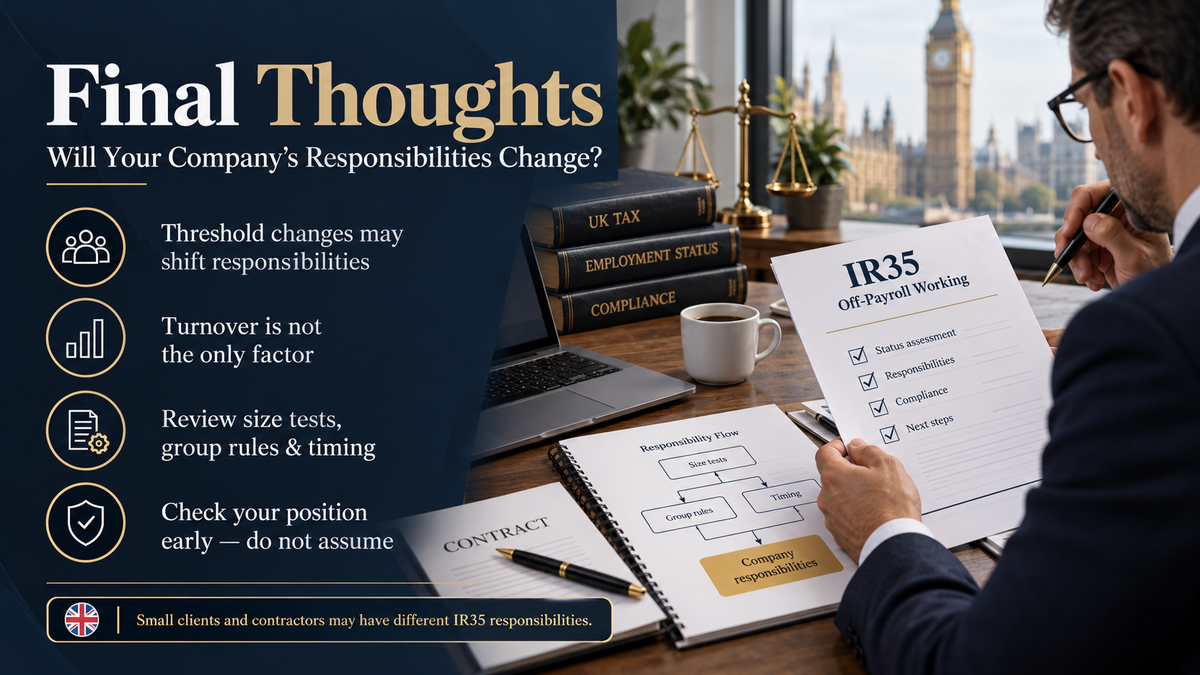
The increased company size thresholds create an opportunity for some businesses to move outside the client-side Off-Payroll Working regime, while growing organisations may eventually enter it.
However, the outcome depends on more than annual turnover.
Companies must consider the applicable statutory thresholds, accounting periods, two-year classification rules, group structures and the timing provisions governing IR35 responsibilities.
Where responsibility transfers away from a small private-sector client, the contractor’s intermediary generally becomes responsible for applying the original IR35 legislation.
Where a company becomes medium-sized or large, it may need to take responsibility for employment status determinations, communicating decisions and ensuring that the appropriate parties account for employment taxes.
The key is to review your position early rather than assume that the revised thresholds automatically change your obligations.
Need help understanding your company’s IR35 responsibilities?
At Taxes Done Right Ltd, we help UK limited companies, contractors and business owners understand tax compliance requirements, review their obligations and plan for changes in legislation.
Need help deciding what’s best for your situation?
📞 Call: 0161 710 1901
📧 Email: Tax@TaxesDoneRight.co.uk
Visit: www.taxesdoneright.co.uk