
Employing Your First Member of Staff: payroll, auto-enrolment and what to expect
November 17, 2026
Marriage Allowance: Who Can Claim and How to Backdate It
November 19, 2026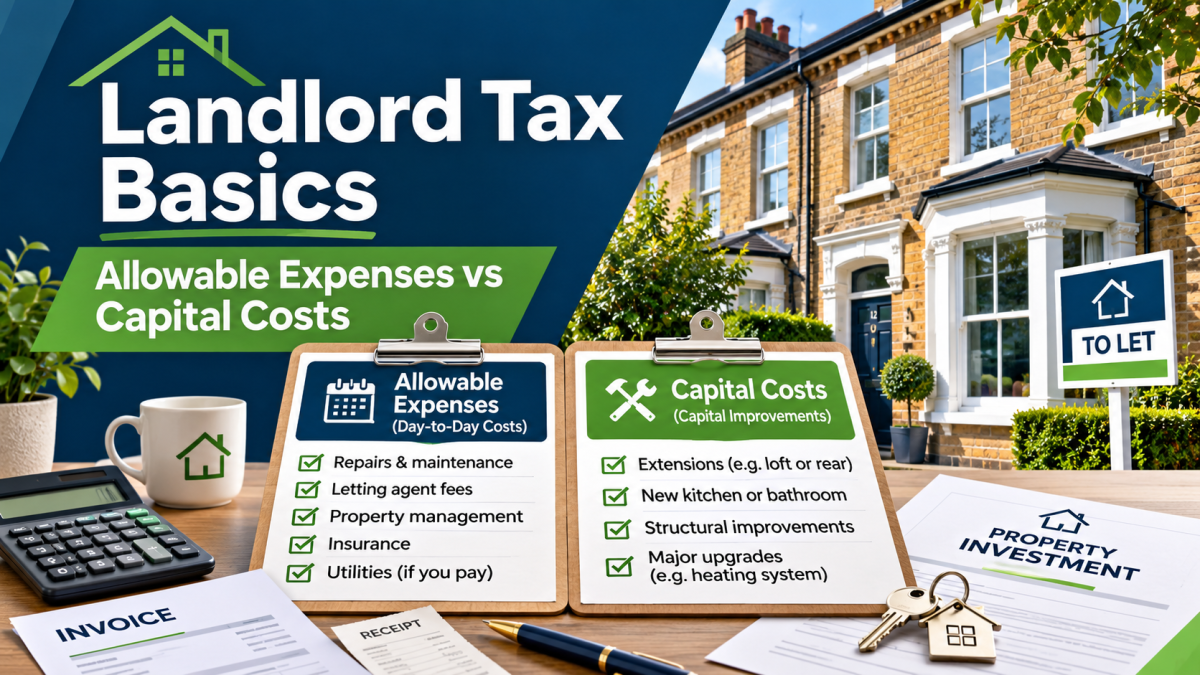
Landlord Tax Basics: Allowable Expenses vs Capital Costs
Landlord tax basics are essential for anyone earning rental income from UK property. Whether you own a single buy-to-let property or manage an expanding portfolio, understanding the difference between allowable expenses and capital costs can significantly affect your tax liability.
One of the most common mistakes landlords make is assuming that every property-related expense can be deducted from rental income. Unfortunately, HMRC applies different rules depending on the nature and purpose of the expenditure.
For example, repairing a leaking roof may qualify as an allowable expense, while building an extension is generally treated as capital expenditure. Both involve spending money on a property, but their tax treatment is different.
Understanding Landlord tax basics can help property owners calculate rental profits accurately, claim legitimate deductions and avoid unnecessary HMRC enquiries.
In this guide, we explain Landlord tax basics, including everyday running expenses, property improvements, replacement furnishings, mortgage interest and the records landlords should maintain.
1. Understanding Landlord Tax Basics: Allowable Expenses vs Capital Costs
The starting point for Landlord tax basics is understanding how HMRC distinguishes everyday running costs from expenditure on acquiring or improving a property.
Allowable expenses are generally costs incurred wholly and exclusively for running a property rental business. These expenses normally reduce taxable rental profits in the relevant accounting period.
Capital costs, however, relate to acquiring, creating or significantly improving an asset. These expenses are generally not deductible directly against rental income.
For instance, repairing a damaged bathroom fitting is usually a revenue expense. Installing an entirely new bathroom in an additional part of the property may represent capital expenditure.
The distinction is important because the tax benefit may arise at different stages of property ownership.
A fundamental principle of Landlord tax basics is that the purpose and nature of the work matter more than the amount spent.
An expensive repair can still be deductible, while a relatively inexpensive improvement may be capital.
Landlords should therefore examine each invoice carefully rather than relying on the contractor’s description.
2. What Are Allowable Expenses for UK Landlords?
Understanding deductible running costs is an important part of Landlord tax basics, particularly when preparing annual Self Assessment tax returns.
HMRC generally permits landlords to deduct qualifying expenditure incurred in operating and maintaining their rental properties.
Common examples include:
- Letting agent management and tenant-finding fees.
- Landlord building and contents insurance.
- Repairs and routine maintenance.
- Accountancy and qualifying professional fees.
- Advertising costs for finding tenants.
- Cleaning and gardening services.
- Council Tax and utility bills paid by the landlord.
- Qualifying ground rent and service charges.
- Relevant telephone, stationery and administrative expenses.
These costs must relate to the rental business rather than private expenditure.
For example, electricity paid during a vacant period may be deductible where the property remains available for letting.
Applying Landlord tax basics correctly also means considering whether expenditure has a private element requiring adjustment.
Landlords should retain supporting invoices and distinguish property expenses from personal household spending.
Good bookkeeping makes Landlord tax basics easier to apply and reduces the risk of overlooking legitimate deductions.
3. What Counts as Capital Expenditure?
Capital expenditure is another important area within Landlord tax basics, particularly when landlords renovate or improve rental properties.
Capital costs generally relate to purchasing property, creating new assets or making significant improvements that go beyond restoring existing condition or function.
Typical examples include:
- Purchasing a buy-to-let property.
- Constructing an extension.
- Converting a loft into additional accommodation.
- Adding an entirely new bathroom.
- Creating additional rooms.
- Substantially upgrading a property beyond its previous standard.
- Certain acquisition and disposal costs.
These expenses generally cannot be deducted directly from annual rental income.
However, qualifying capital improvement expenditure may reduce a future chargeable gain when the property is sold, provided the relevant conditions are satisfied.
Understanding Landlord tax basics helps landlords avoid confusing immediate income tax relief with potential Capital Gains Tax relief.
Importantly, not every capital expense qualifies for a future CGT deduction.
Correctly applying Landlord tax basics requires landlords to consider the specific rules governing each category of expenditure.
4. Repairs vs Improvements: Why the Difference Matters
One of the most misunderstood areas of Landlord tax basics is the distinction between repairs and improvements.
A repair generally restores something that has become worn, damaged or defective. An improvement usually creates something new or significantly enhances the property beyond its previous condition.
For example, replacing several broken roof tiles will normally qualify as a repair.
Replacing an entire existing roof may also constitute a repair, depending on the circumstances and whether the work restores the existing building rather than fundamentally improving it.
By contrast, adding another storey to the property is normally a capital improvement.
Modern replacement materials do not automatically make expenditure capital. Replacing outdated materials with reasonable modern equivalents may still qualify as a repair.
Understanding Landlord tax basics therefore involves assessing the actual work completed, not simply whether new materials were used.
Where a building project includes both repairs and improvements, the expenditure may need to be divided on a reasonable, evidence-based basis.
Applying Landlord tax basics carefully can prevent both excessive claims and missed deductions.
5. Replacing Kitchens and Bathrooms
Kitchen and bathroom renovations frequently create uncertainty when applying Landlord tax basics.
Suppose a landlord replaces worn kitchen cupboards, damaged worktops and outdated fittings with broadly equivalent modern replacements.
Where the expenditure restores the existing kitchen without substantially improving it, the costs may qualify as repairs.
Similarly, replacing an existing bath, sink or toilet with a comparable modern fitting will often be treated as maintenance.
However, installing an additional kitchen, significantly enlarging a bathroom or completely changing the property’s facilities can involve capital expenditure.
Understanding Landlord tax basics helps landlords distinguish replacement of existing fixtures from the creation of new assets.
A project containing both elements should be reviewed carefully. Where practical, contractors should separately identify maintenance and improvement work.
This can provide valuable evidence if HMRC questions a deduction.
Correct treatment under Landlord tax basics depends on the property’s previous condition, the scope of work and the nature of the resulting changes.
6. Decorating and General Property Maintenance
Routine decorating is usually one of the more straightforward areas of Landlord tax basics.
Landlords commonly repaint walls, replace damaged wallpaper and refresh properties between tenancies.
These costs will generally qualify as allowable expenses where they restore the property to its previous condition.
Other routine maintenance may include gutter cleaning, repairing doors, fixing plumbing leaks and replacing broken electrical components.
However, decorating expenditure undertaken as part of a substantial capital redevelopment may require different treatment.
For example, decorating an entirely new extension is generally part of the capital project rather than an independent maintenance expense.
Understanding Landlord tax basics means considering the wider circumstances surrounding the work.
A landlord should not assume that every invoice described as painting, decorating or maintenance is automatically deductible.
Maintaining a clear record of the purpose of each project helps demonstrate compliance with Landlord tax basics and supports accurate tax reporting.
7. Replacement of Domestic Items Relief
Replacement of Domestic Items Relief is an important element of Landlord tax basics for residential landlords providing furniture and appliances.
The relief allows qualifying landlords to deduct the cost of replacing certain domestic items used by tenants.
Examples include beds, sofas, curtains, carpets, fridges, washing machines and other qualifying household items.
However, the relief generally applies to replacements rather than the initial purchase of furnishings.
For example, buying a washing machine for a previously unfurnished property does not normally qualify under this relief.
Replacing an existing washing machine with a broadly equivalent model may qualify.
Understanding Landlord tax basics is particularly important where a replacement is more expensive or luxurious than the original item.
Relief is generally limited to the cost of an equivalent replacement, together with eligible incidental costs, less any proceeds from disposing of the old item.
Applying Landlord tax basics correctly helps landlords obtain legitimate relief without claiming initial furnishing costs incorrectly.
8. Mortgage Interest and Finance Costs
Mortgage interest is among the most financially significant areas of Landlord tax basics for highly leveraged property investors.
Individual landlords with residential rental properties are generally unable to deduct residential mortgage interest directly when calculating taxable rental profits.
Instead, qualifying residential finance costs normally attract a basic-rate Income Tax reduction, subject to statutory restrictions.
For example, suppose a landlord receives £18,000 in annual rental income, incurs £4,000 in allowable running expenses and pays £7,000 in qualifying mortgage interest.
The rental profit before the finance cost tax reduction would generally be £14,000.
A tax reduction of up to £1,400 may then be available, subject to the applicable limits and the landlord’s circumstances.
Understanding Landlord tax basics is essential because this restriction can affect higher-rate taxpayers particularly significantly.
Companies owning rental properties generally follow different Corporation Tax rules, under which qualifying interest may be deductible, subject to applicable restrictions.
Applying Landlord tax basics correctly also means distinguishing mortgage interest from capital repayments, which are not deductible rental expenses.
9. Property Purchase Costs and SDLT
Buying a rental property involves several expenses that fall outside ordinary running costs.
Understanding Landlord tax basics can prevent landlords from incorrectly claiming acquisition expenditure against their annual rental income.
The purchase price, Stamp Duty Land Tax in England and Northern Ireland, and qualifying acquisition legal fees are generally capital costs.
Land Transaction Tax applies in Wales, while Land and Buildings Transaction Tax applies in Scotland.
Qualifying acquisition costs may form part of the property’s capital gains tax base cost when the property is eventually sold.
Mortgage arrangement fees and other financing costs require separate consideration because they are governed by financing rules rather than automatically forming part of the property’s acquisition cost.
A key principle of Landlord tax basics is that buying an asset and operating that asset are different activities for tax purposes.
Keeping purchase documentation from the outset is therefore important.
Accurate records support Landlord tax basics throughout ownership and may prevent difficulties when calculating a future disposal gain.
10. Initial Repairs Before the First Tenant
Initial refurbishment costs are a particularly complex part of Landlord tax basics.
Landlords sometimes purchase properties requiring substantial repairs before tenants can move in.
Whether those costs are deductible depends on the circumstances.
If a property was acquired in a seriously dilapidated condition, was unsuitable for letting and the purchase price reflected the defects, expenditure needed to make it usable may be capital.
However, repairs completed before the first tenancy are not automatically capital merely because the property has not yet been let.
The nature of the repairs, purchase circumstances and whether the rental business has commenced are all relevant.
Understanding Landlord tax basics helps landlords recognise that timing alone does not determine the tax treatment.
For example, repainting a previously habitable property before advertising it may be treated differently from reconstructing a property purchased in an unusable condition.
Professional review is advisable where Landlord tax basics involve substantial pre-letting renovation expenditure.
11. Legal, Professional and Accountancy Fees
Professional fees are another important consideration within Landlord tax basics.
Many ordinary property management expenses qualify for deductions, provided they relate directly to the rental business.
Examples include fees for preparing rental accounts, managing tenancy agreements, collecting rent and obtaining relevant legal advice.
Legal fees connected with ordinary short-term tenancies may also be allowable.
However, fees associated with acquiring property, arranging certain long-term interests or disposing of property may be capital rather than revenue expenditure.
Understanding Landlord tax basics means identifying the specific service provided before deciding how the invoice should be treated.
For example, fees relating to a tenancy agreement can have different tax treatment from conveyancing fees incurred when purchasing the property.
Where a professional invoice covers multiple services, a reasonable allocation may be necessary.
Good record-keeping supports Landlord tax basics and enables landlords to justify their expenditure classifications if requested by HMRC.
12. Insurance, Council Tax and Utility Bills
Property-related running costs form a central part of Landlord tax basics.
Landlords may generally deduct qualifying buildings insurance, landlord contents insurance and other relevant property insurance premiums.
Council Tax and utility bills may also be deductible where the landlord is responsible for paying them in connection with the rental business.
These situations commonly arise during vacant periods, between tenancies or where bills are included within the rental agreement.
However, expenses attributable to personal occupation cannot simply be claimed as business expenditure.
Understanding Landlord tax basics is especially important where landlords occasionally use the property themselves or share costs between private and rental activities.
Only the qualifying business element should be included in the rental accounts.
Insurance reimbursements and other recoveries must also be considered to prevent duplicated deductions.
Applying Landlord tax basics consistently helps landlords report their true rental profits instead of overstating their costs.
13. Energy Efficiency Improvements and EPC Costs
Energy efficiency spending is increasingly relevant to Landlord tax basics, particularly for owners of older residential properties.
Landlords may incur expenditure on insulation, heating systems, replacement windows and Energy Performance Certificates.
The tax treatment depends on the work undertaken.
Replacing an existing boiler with a reasonable modern equivalent may qualify as a repair.
Similarly, replacing single-glazed windows with double-glazed alternatives can sometimes remain revenue expenditure where the replacement represents the nearest modern equivalent.
However, constructing additional facilities or making substantial enhancements may constitute capital expenditure.
Understanding Landlord tax basics means recognising that improving energy efficiency does not automatically make every expense tax-deductible.
EPC assessment fees incurred for genuine rental business purposes may generally qualify as running expenses.
Government grants or financial assistance can also affect the overall treatment and should be examined separately.
Applying Landlord tax basics appropriately is particularly important before committing to expensive energy efficiency projects.
14. Landlord Tax Basics for Limited Company Property Owners
The tax treatment of rental property can differ depending on whether ownership is personal or through a limited company.
Understanding Landlord tax basics helps investors compare these structures.
Individual landlords generally pay Income Tax on taxable rental profits, while companies normally pay Corporation Tax on their taxable profits.
A significant distinction concerns financing costs.
Companies can generally deduct qualifying property finance interest, subject to Corporation Tax rules and any applicable restrictions.
Individual residential landlords normally receive the restricted basic-rate finance cost tax reduction instead.
However, purchasing property through a company can introduce additional accounting, administration, financing and tax considerations.
Applying Landlord tax basics requires looking beyond individual deductions and considering the overall ownership structure.
Company profits distributed to shareholders can create further personal tax liabilities.
Therefore, understanding Landlord tax basics should support long-term investment decisions rather than focusing exclusively on immediate tax savings.
15. Capital Costs and Capital Gains Tax
Capital expenditure may become relevant when a landlord eventually sells the rental property.
Understanding Landlord tax basics can help investors preserve information needed for future Capital Gains Tax calculations.
For personally owned investment properties, qualifying costs of acquisition, disposal and capital improvements may reduce the chargeable gain.
For example, a genuine extension that increases the property’s usable floor area may qualify as enhancement expenditure.
However, the improvement must satisfy the relevant CGT conditions, including being reflected in the property’s state or nature when sold.
Routine maintenance costs do not normally qualify as CGT enhancement expenditure.
A crucial principle of Landlord tax basics is that expenditure cannot simply be claimed twice against rental income and a future capital gain.
Companies generally pay Corporation Tax on chargeable property gains rather than Capital Gains Tax.
Maintaining separate capital expenditure records makes Landlord tax basics easier to manage when a property is disposed of.
16. Common Landlord Tax Mistakes to Avoid
Several recurring errors demonstrate why Landlord tax basics deserve careful attention.
A common mistake is deducting every renovation invoice from rental income without distinguishing repairs from improvements.
Another is claiming the initial purchase of furniture under Replacement of Domestic Items Relief.
Some landlords also incorrectly treat mortgage capital repayments as deductible expenses.
Other errors include failing to apportion private expenditure, overlooking eligible management fees and discarding invoices for capital improvements.
Understanding Landlord tax basics can prevent these mistakes before they affect a Self Assessment return.
Landlords should also avoid assuming that payments made from a dedicated property bank account automatically qualify for tax relief.
The nature and purpose of each expense remain decisive.
Regular bookkeeping reviews and professional support can help identify incorrect classifications.
Applying Landlord tax basics consistently reduces the risk of underpaid tax, unnecessary penalties and disputes over unsupported claims.
17. Example: Repairs and Capital Improvements
A practical example demonstrates how Landlord tax basics affect rental profit calculations.
Consider a landlord receiving annual rental income of £20,000.
During the year, the landlord incurs £2,500 in qualifying property repairs, £1,200 in letting agent fees, £500 in insurance premiums and £8,000 constructing an extension.
The repairs, letting agent fees and insurance total £4,200.
Assuming there are no other adjustments, the taxable rental profit before finance cost considerations would be £15,800.
The £8,000 extension would generally be treated as capital expenditure rather than an immediate rental expense.
Understanding Landlord tax basics prevents the landlord from incorrectly deducting the entire £12,200 of expenditure against rental income.
Subject to the relevant conditions, the extension cost may instead be considered when calculating a future property disposal gain.
This example shows how Landlord tax basics affect both annual taxation and long-term investment records.
18. Keeping Accurate Records for HMRC
Good record-keeping is fundamental to Landlord tax basics and effective rental property management.
Landlords should retain evidence of rental income, operating costs, repairs, improvements and other property transactions.
Useful documentation includes contractor invoices, bank statements, tenancy agreements, purchase completion statements, insurance policies and professional fee invoices.
Where substantial renovation work takes place, photographs showing the property’s condition before and after the work may provide valuable supporting evidence.
Understanding Landlord tax basics also means recording why expenditure was incurred, rather than simply noting the payment amount.
For instance, an invoice labelled refurbishment may cover both deductible repairs and capital improvements.
Separating these items at the bookkeeping stage can make annual accounts significantly easier to prepare.
HMRC record retention requirements depend on the taxpayer’s circumstances, and capital records may need to be kept until after the property is sold.
Following Landlord tax basics throughout ownership reduces the risk of missing important supporting information.
19. Property Income Allowance vs Actual Expenses
The £1,000 property income allowance is another consideration within Landlord tax basics.
Qualifying individuals may benefit from a property income allowance of up to £1,000 per tax year.
Where gross qualifying property income does not exceed £1,000, it may be covered by the allowance, subject to applicable conditions and exclusions.
If gross income exceeds £1,000, eligible landlords can generally choose between deducting actual allowable expenses and claiming the available property income allowance.
They cannot claim both against the same income.
Understanding Landlord tax basics helps landlords assess which method produces the more favourable result.
For example, where annual rent is £8,000 and actual qualifying expenses total £2,500, claiming actual expenses would normally be more beneficial than using a £1,000 allowance.
However, personal circumstances and restrictions must still be considered.
Reviewing Landlord tax basics before filing a return can prevent landlords from overlooking a more suitable tax calculation method.
20. How Professional Tax Advice Can Help
Property taxation becomes increasingly complex as landlords acquire additional properties, undertake refurbishments or change ownership structures.
Understanding Landlord tax basics provides a useful foundation, but some transactions require detailed professional examination.
A qualified accountant can assess whether expenditure represents repairs, improvements, financing costs or another category.
Professional advice can also assist with rental profit calculations, Self Assessment returns, Corporation Tax, property ownership structures and potential Capital Gains Tax liabilities.
For landlords considering substantial renovations, obtaining advice before starting the work may help avoid unexpected tax consequences.
Applying Landlord tax basics from the beginning can be considerably easier than correcting classifications several years later.
At Taxes Done Right Ltd, we support UK landlords, buy-to-let investors and property companies with tax compliance and property-related accounting matters.
Our approach to Landlord tax basics focuses on accurate reporting, legitimate reliefs and practical guidance tailored to each landlord’s circumstances.
Final Thoughts

Understanding Landlord tax basics is essential for protecting rental profitability and meeting HMRC requirements.
The difference between allowable expenses and capital costs can affect both annual rental profits and the tax payable when a property is eventually sold.
Repairs, property management costs and qualifying replacements may provide immediate deductions, while significant improvements generally require separate capital treatment.
Applying Landlord tax basics carefully means examining each expense, maintaining accurate records and obtaining advice where the classification is uncertain.
For professional assistance with Landlord tax basics, contact Taxes Done Right Ltd.
Need help deciding what’s best for your situation?
📞 Call 0161 710 1901
📧 Email Tax@TaxesDoneRight.co.uk
Visit www.taxesdoneright.co.uk
Disclaimer: This article provides general guidance on UK property taxation and does not constitute personalised tax advice. Tax treatment depends on individual circumstances, legislation and HMRC requirements applicable to the relevant tax year.