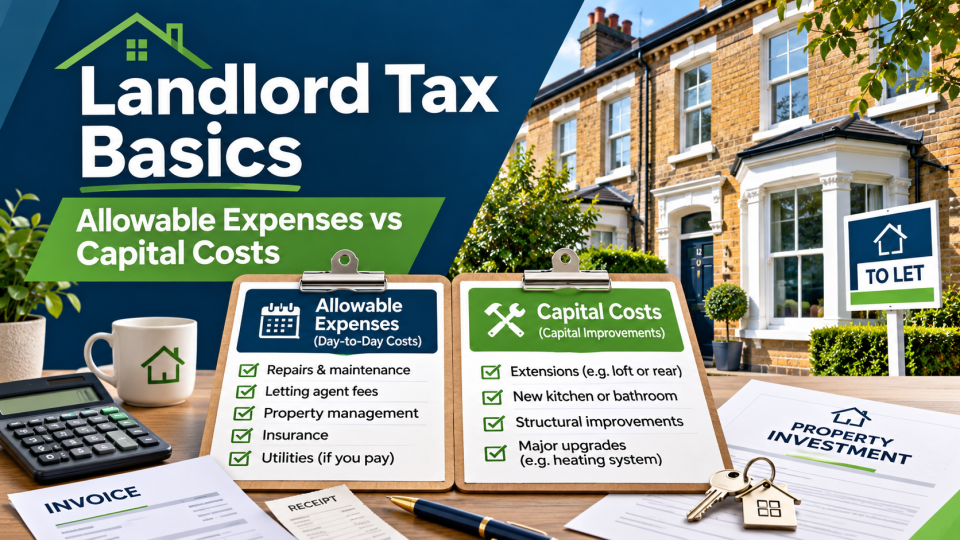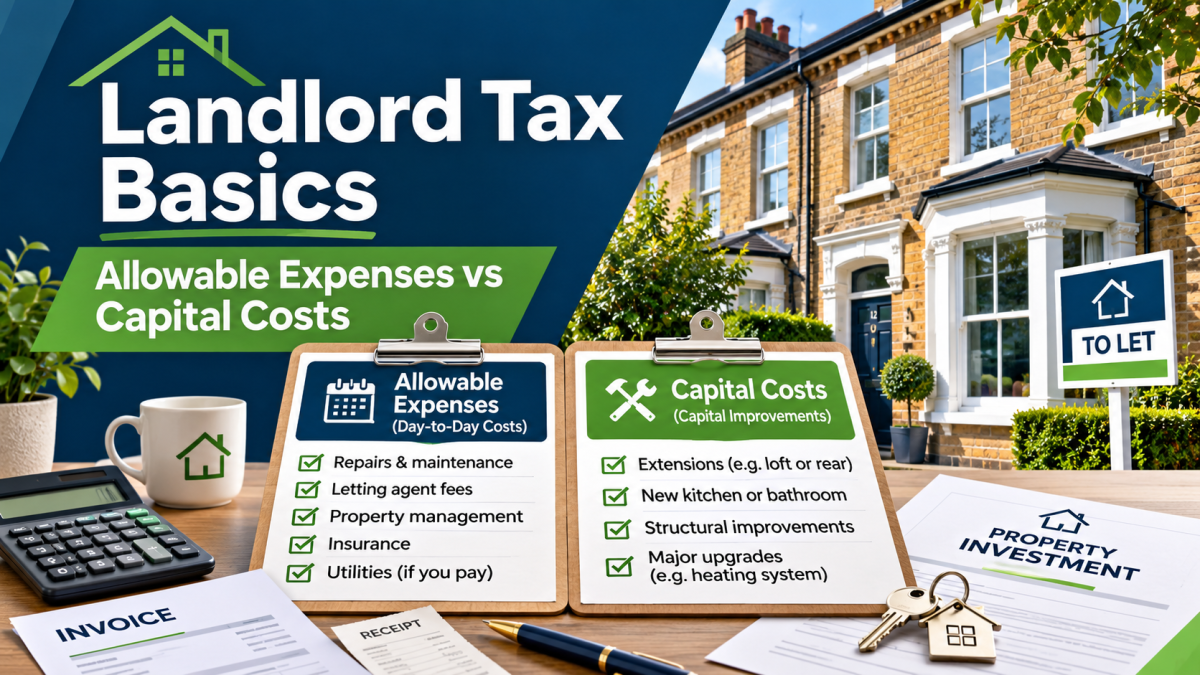
Landlord Tax Basics: Allowable Expenses vs Capital Costs
November 18, 2026
Smart ways to Avoid the Child Benefit Charge Legally
November 21, 2026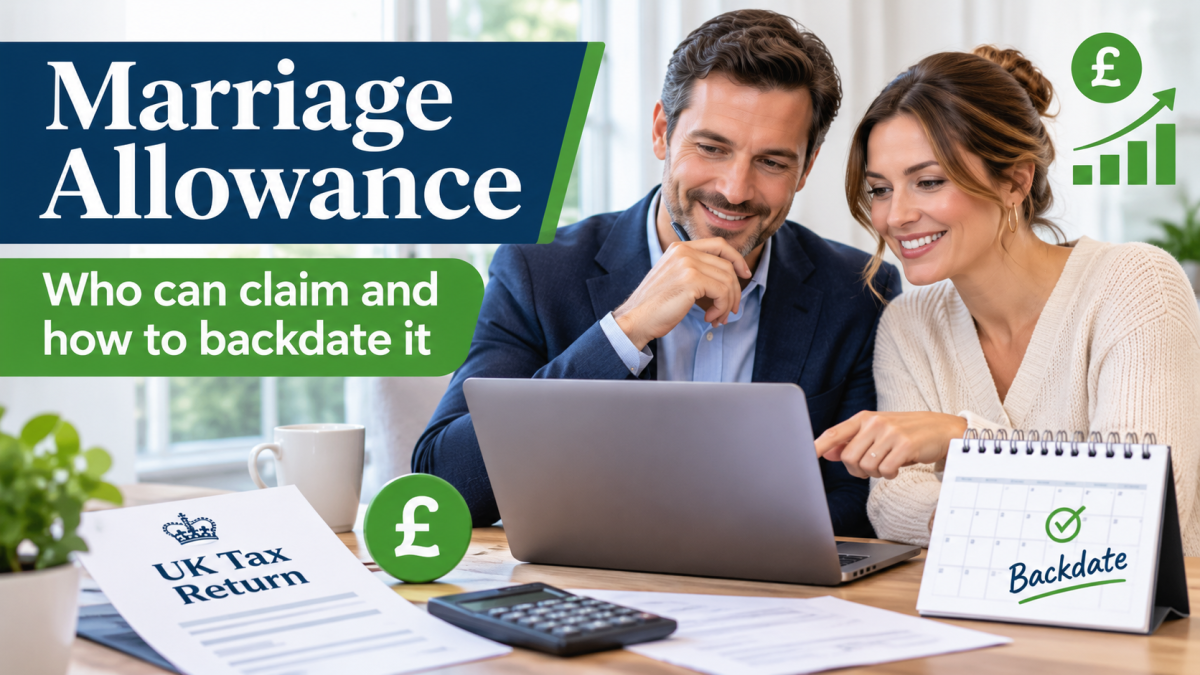
Marriage Allowance: Who Can Claim and How to Backdate It
Marriage Allowance is one of the simplest ways for eligible married couples and civil partners in the UK to reduce their household Income Tax bill. Yet many couples overlook this valuable relief because they are unaware of the eligibility rules or assume the tax saving is automatically applied.
For the 2026/27 tax year, Marriage Allowance allows an eligible individual to transfer £1,260 of their Personal Allowance to their spouse or civil partner, potentially reducing the recipient’s Income Tax liability by up to £252 annually.
What makes Marriage Allowance particularly attractive is the opportunity to backdate a claim for up to four previous tax years. Eligible couples who have never claimed could potentially recover up to £1,260 across five tax years, including the current year.
However, Marriage Allowance is not available to every married couple. Income levels, tax bands, relationship status and other sources of taxable income can affect eligibility.
Understanding Marriage Allowance can help households avoid missing legitimate tax savings. This guide explains who qualifies, how the relief works, how to make a claim, how far back claims can go and which common mistakes should be avoided.
1. What Is Marriage Allowance and How Does It Work?
Marriage Allowance is a government tax relief designed to help qualifying married couples and civil partners make better use of their available tax-free allowances.
Most UK taxpayers are entitled to a Personal Allowance, currently £12,570 for the 2026/27 tax year. This is generally the amount an individual can earn before paying Income Tax.
When one spouse earns less than their Personal Allowance, part of that allowance may otherwise remain unused.
Marriage Allowance allows the lower-earning spouse to transfer a fixed £1,260 to their partner, provided the eligibility conditions are met.
The receiving partner obtains a tax reduction of up to £252, calculated at the basic Income Tax rate of 20%.
Importantly, Marriage Allowance does not transfer income between spouses or change who legally owns that income. It simply adjusts the couple’s tax position.
Example:
Consider a couple with the following annual incomes:
- Partner A earns £8,000.
- Partner B earns £30,000.
- Partner A has unused Personal Allowance.
- Partner B pays Income Tax at the basic rate.
Through Marriage Allowance, Partner A transfers £1,260 of their allowance to Partner B.
Because Partner A remains below their reduced Personal Allowance of £11,310, they incur no additional Income Tax.
Partner B receives a £252 tax reduction.
The household therefore saves £252 for that tax year.
2. Who Can Claim Marriage Allowance?
Marriage Allowance is available only when specific conditions are satisfied. Being married does not automatically establish entitlement.
You must be married or in a civil partnership
The first requirement for Marriage Allowance is that the individuals must be legally married or registered civil partners.
Couples living together without marriage or civil partnership registration cannot claim, regardless of how long they have lived together.
This applies even where couples share children, mortgages, household expenses or joint bank accounts.
One partner must have relatively low income
Marriage Allowance generally benefits households where one person earns less than the standard Personal Allowance of £12,570.
The lower earner usually transfers the allowance.
However, where the transferor’s income exceeds £11,310, transferring the allowance could produce an additional tax liability for them.
That does not necessarily eliminate the overall household benefit, but the calculation becomes more important.
The receiving partner must qualify
For most taxpayers in England, Wales and Northern Ireland, the receiving spouse must not be liable to higher-rate or additional-rate Income Tax.
For a straightforward employment income situation, this normally means income within the basic-rate band, generally up to £50,270.
Scottish taxpayers follow different Income Tax thresholds for non-savings, non-dividend income.
In Scotland, the recipient can qualify where they pay Income Tax at the starter, basic or intermediate rate, subject to the applicable rules.
Both partners must meet the relevant requirements
Marriage Allowance eligibility should be assessed for each tax year independently.
A couple might qualify during one year and become ineligible during another because of changes in earnings, investments or employment.
Marriage Allowance can also be available where one partner receives a pension or where a qualifying individual lives abroad and remains entitled to a UK Personal Allowance.
3. How Much Tax Can Couples Save?
The potential Marriage Allowance saving is relatively modest annually, but it can become meaningful when several eligible years are combined.
For 2026/27, the transferable allowance is £1,260, generating a maximum annual tax reduction of £252.
The precise saving depends on the circumstances of both individuals.
| Tax year | Maximum tax saving |
|---|---|
| 2022/23 | £252 |
| 2023/24 | £252 |
| 2024/25 | £252 |
| 2025/26 | £252 |
| 2026/27 | £252 |
| Potential total | £1,260 |
This illustrates why Marriage Allowance backdating is worth considering when a couple has not previously applied.
However, Marriage Allowance does not guarantee a £252 refund for every eligible year.
The receiving spouse must have sufficient Income Tax liability to benefit from the relief.
The transferring spouse’s tax position also matters.
Couples should calculate the combined outcome rather than focusing solely on the amount credited to one individual.
The available saving may be smaller where the lower earner uses more of their Personal Allowance or the recipient has a relatively small tax liability.
4. How to Backdate Marriage Allowance for Previous Tax Years
One of the most useful features of Marriage Allowance is the ability to claim retrospectively.
HMRC generally permits eligible taxpayers to backdate claims for the previous four tax years.
As at November 2026, Marriage Allowance claims can potentially cover the following years:
- 2022/23
- 2023/24
- 2024/25
- 2025/26
A claim can also be made for the current 2026/27 tax year.
This means a qualifying couple could potentially benefit from five separate years.
Why the backdating deadline matters
Marriage Allowance claims are subject to statutory time limits.
For the 2022/23 tax year, the usual four-year deadline is 5 April 2027.
After this deadline, the opportunity to claim relief for that particular tax year would ordinarily be lost.
For example, suppose a couple married in 2020 and one spouse has consistently earned below their Personal Allowance.
If the other spouse remained eligible throughout the relevant years, a claim made during 2026/27 could potentially recover tax relief beginning with 2022/23.
Marriage Allowance backdating therefore deserves attention before the oldest eligible year expires.
Important: Backdating does not mean every previous year automatically qualifies. The conditions must be satisfied separately for each year claimed.
5. How to Apply Through HMRC
Applying for Marriage Allowance is generally straightforward, and HMRC does not charge an application fee.
The application is normally made by the lower-earning partner who is transferring part of their Personal Allowance.
Step 1: Check eligibility
Before claiming Marriage Allowance, establish both partners’ taxable income and Income Tax positions.
Review employment earnings, pension income, rental profits, dividends and any other relevant taxable receipts.
Step 2: Gather the necessary information
HMRC usually requires both partners’ National Insurance numbers and the applicant’s identity verification details.
For historical Marriage Allowance claims, it is helpful to have income information for each relevant tax year.
Step 3: Submit the application
Eligible applicants can use the official GOV.UK service to apply online.
Claims can also be submitted using HMRC’s designated MATCF postal form, where appropriate.
For Marriage Allowance backdating, follow HMRC’s specific guidance to ensure the correct earlier years are included.
Step 4: Await confirmation
HMRC will review the claim and, where appropriate, adjust the tax position.
The receiving partner may benefit through an amended PAYE tax code, a Self Assessment calculation or a refund relating to earlier tax years.
The method depends on how the individual’s Income Tax is administered.
Step 5: Check the result
Once Marriage Allowance has been processed, review the tax code or calculation carefully.
A successful application should not simply be assumed to produce the maximum saving.
Check that all qualifying years have been included and that neither spouse has been incorrectly assessed.
6. Claiming Through Self Assessment
Marriage Allowance is particularly relevant to households where one or both partners complete annual Self Assessment tax returns.
This might include landlords, company directors, sole traders and individuals with additional taxable income.
If the lower earner submits Self Assessment, they can generally make the transfer through the relevant section of their tax return.
The receiving spouse should not independently duplicate that transfer election.
Marriage Allowance claims can therefore require some coordination between the two returns.
For example, one spouse might receive a small salary while the other receives employment income and rental profits.
Although the employment income alone may suggest eligibility, rental profits could push the recipient into a higher tax band.
Marriage Allowance calculations must take all relevant taxable income into account, not merely the salary shown on a P60.
An accountant can check the combined position before submissions are finalised, reducing the risk of incorrect claims or unexpected adjustments.
7. Can Pensioners Claim?
Marriage Allowance is not restricted to working-age couples.
Retired individuals can qualify where the relevant conditions are met.
For example, one spouse might receive a modest State Pension, while the other receives State Pension income together with an occupational pension.
Where the lower earner has unused Personal Allowance and the recipient meets the tax-band conditions, Marriage Allowance could reduce their combined Income Tax liability.
However, pension income must be included in the calculation even where tax is not deducted directly from the pension payment.
State Pension income, in particular, is generally taxable despite normally being paid without PAYE deductions.
Some older couples may instead qualify for Married Couple’s Allowance.
This is a separate tax relief associated with individuals born before 6 April 1935.
Marriage Allowance and Married Couple’s Allowance cannot be received simultaneously.
Therefore, older couples should compare their entitlement before deciding which relief offers the greatest financial benefit.
8. What If One Partner Is Self-Employed?
Self-employment does not automatically prevent someone from claiming Marriage Allowance.
Eligibility depends on taxable profits and the wider tax circumstances rather than employment status alone.
A self-employed individual with modest annual profits might be able to transfer part of their Personal Allowance to an employed spouse.
For instance, a sole trader earning £9,000 in taxable profits and a spouse earning £28,000 through employment could potentially qualify.
The important figure is the sole trader’s taxable profit, not gross business turnover.
Marriage Allowance calculations should also reflect other taxable income received by either individual.
This includes property income, dividends, pensions and taxable benefits.
Where profits fluctuate significantly between years, entitlement should be checked annually.
A self-employed person might qualify in one tax year but lose eligibility in another following an increase in profits.
9. Can Landlords and Company Directors Benefit?
Marriage Allowance can provide tax savings for landlords and limited company directors, although their circumstances may be more complex.
Landlords must consider taxable rental profits after allowable deductions, rather than simply looking at rent collected.
A spouse receiving rental profits of £7,000 alongside employment earnings of £6,000 may have total income of £13,000.
That level of income requires closer analysis because part of the reduced Personal Allowance could become taxable following a transfer.
Similarly, company directors often receive a mixture of salary and dividends.
Marriage Allowance eligibility cannot be determined by salary alone when dividends or other taxable income are also present.
For example, a director receiving a small PAYE salary but substantial dividends may not be the appropriate spouse to transfer an allowance.
Dividend taxation can also change the overall benefit of the arrangement.
Couples operating family businesses should therefore assess their complete tax calculations before making elections.
10. What Happens When Income Changes?
Changes in employment, earnings or family circumstances can affect Marriage Allowance eligibility.
Common examples include returning to work after parental leave, receiving a promotion, retiring or starting a business.
Suppose the transferring spouse originally earned £7,000 but later begins earning £20,000 annually.
Their additional earnings may mean that Marriage Allowance no longer provides a household benefit.
Likewise, if the receiving partner becomes liable to higher-rate Income Tax, entitlement may cease.
Marriage Allowance normally continues automatically into subsequent tax years unless the transfer is cancelled.
Therefore, couples should not assume the original election remains appropriate indefinitely.
It is important to notify HMRC when circumstances change sufficiently to affect entitlement.
Otherwise, incorrect tax-code adjustments or underpaid Income Tax could arise.
11. Can You Claim After Divorce or Separation?
Marriage Allowance is intended for qualifying spouses and civil partners, but relationship changes can create uncertainty.
A couple who separates may remain legally married until their divorce is finalised.
However, the continued application of Marriage Allowance and the appropriate cancellation date should be checked against HMRC rules and the particular circumstances.
The transfer does not always stop automatically simply because the couple has separated.
HMRC should be informed when the relationship ends or the parties are no longer entitled to the relief.
Marriage Allowance cancellation can affect the relevant tax year and future years.
A claim for earlier years might still be appropriate where the couple satisfied all conditions during those periods.
Individuals should avoid assuming that a later divorce necessarily invalidates every historical claim.
12. Can a Surviving Spouse Backdate a Claim?
In certain circumstances, Marriage Allowance can still be claimed following the death of a spouse or civil partner.
HMRC specifically allows qualifying retrospective claims where a partner has died since 5 April 2022.
The surviving spouse should contact HMRC’s Income Tax helpline rather than relying on the usual online process.
Where the deceased individual was the lower earner, the person responsible for managing their tax affairs may need to make contact.
Marriage Allowance entitlement must still be established for the relevant historical years.
This includes checking both individuals’ taxable income and the conditions applying before death.
For bereaved households, reviewing historical tax allowances may identify relief that was never claimed.
However, the process can involve additional documentation and should be handled carefully.
13. Common Mistakes That Can Cost Couples Money
Although Marriage Allowance is relatively straightforward, several recurring errors can lead to missed savings or incorrect tax calculations.
Assuming eligibility is automatic
Marriage Allowance normally requires an election. Being married does not automatically ensure HMRC has applied the relief.
Ignoring additional income
Savings interest, dividends, rental profits and pensions can change the tax calculation. Checking employment income alone is insufficient.
Failing to consider the transferor’s tax
Marriage Allowance reduces the transferring spouse’s Personal Allowance. This could create additional Income Tax where their income exceeds the remaining allowance.
Missing historical deadlines
Delaying a Marriage Allowance backdating claim could result in the oldest eligible year falling outside the permitted period.
Using paid refund companies unnecessarily
Some commercial providers charge fees or retain a percentage of refunds. HMRC’s direct application service is free.
Failing to monitor changes
Marriage Allowance generally renews automatically, meaning an outdated election might continue after the couple’s circumstances have changed.
Taking a few minutes to review both tax positions can help prevent these problems.
14. Is It Always Worth Claiming?
Marriage Allowance can be beneficial, but it is not necessarily advantageous in every situation.
Consider a spouse earning £12,000 annually.
Before transferring any allowance, their income falls below the standard £12,570 Personal Allowance.
After transferring £1,260, their remaining Personal Allowance becomes £11,310.
Consequently, £690 becomes taxable.
At a 20% tax rate, this creates an additional £138 tax liability.
If the receiving spouse obtains the full £252 reduction, the couple’s net saving is £114.
Marriage Allowance still produces a benefit in this example, but not the maximum advertised amount.
The calculation may become more complicated where different tax rates or income types are involved.
For this reason, Marriage Allowance should be assessed at household level rather than assuming the transfer is always worthwhile.
15. How to Check Whether You Have Already Claimed
Before submitting a new Marriage Allowance application, check whether an existing transfer is already operating.
An individual’s PAYE tax code can provide a useful indication.
A tax code ending in M generally indicates that the individual receives the allowance.
A tax code ending in N generally indicates that the individual transfers the allowance.
For example, standard codes might appear as 1383M for the recipient and 1131N for the transferor, although actual codes can differ because of other tax adjustments.
Marriage Allowance details may also appear in HMRC’s online Personal Tax Account or Self Assessment records.
Where the position is unclear, ask HMRC to confirm the years for which the relief has been applied.
This is particularly important before requesting retrospective adjustments.
16. Final Thoughts: Don’t Miss Out on Tax Relief

Marriage Allowance offers qualifying UK married couples and civil partners a practical opportunity to reduce their household Income Tax liability.
While the maximum annual saving is £252, the ability to backdate eligible claims means the cumulative benefit can be substantially higher.
However, Marriage Allowance should never be assessed using marital status or one partner’s salary alone.
Employment income, self-employment profits, rental income, dividends and pensions may all influence the calculation.
The key is to establish whether Marriage Allowance produces a genuine combined tax saving and whether previous tax years remain available for a claim.
Couples who have never claimed should review their eligibility promptly, particularly where older tax years are approaching the statutory deadline.
At Taxes Done Right Ltd, we help individuals, landlords, company directors and self-employed taxpayers understand their Income Tax obligations and identify available reliefs.
If you are unsure whether Marriage Allowance applies to your household or need assistance reviewing previous tax years, professional tax advice can help establish your correct position.
Contact Taxes Done Right Ltd
📞 Call 0161 710 1901
📧 Email Tax@TaxesDoneRight.co.uk
Visit www.taxesdoneright.co.uk
Disclaimer: This article provides general UK tax information based on the rules applicable in November 2026. Individual circumstances may affect eligibility and tax savings. Tax legislation and HMRC guidance may change, so obtain professional advice where necessary.