
Selling Rental Property: What Expenses Can You Claim When Selling a Rental Property?
August 10, 2026
P11D Changes April 2027: What’s Changing for Employers?
August 12, 2026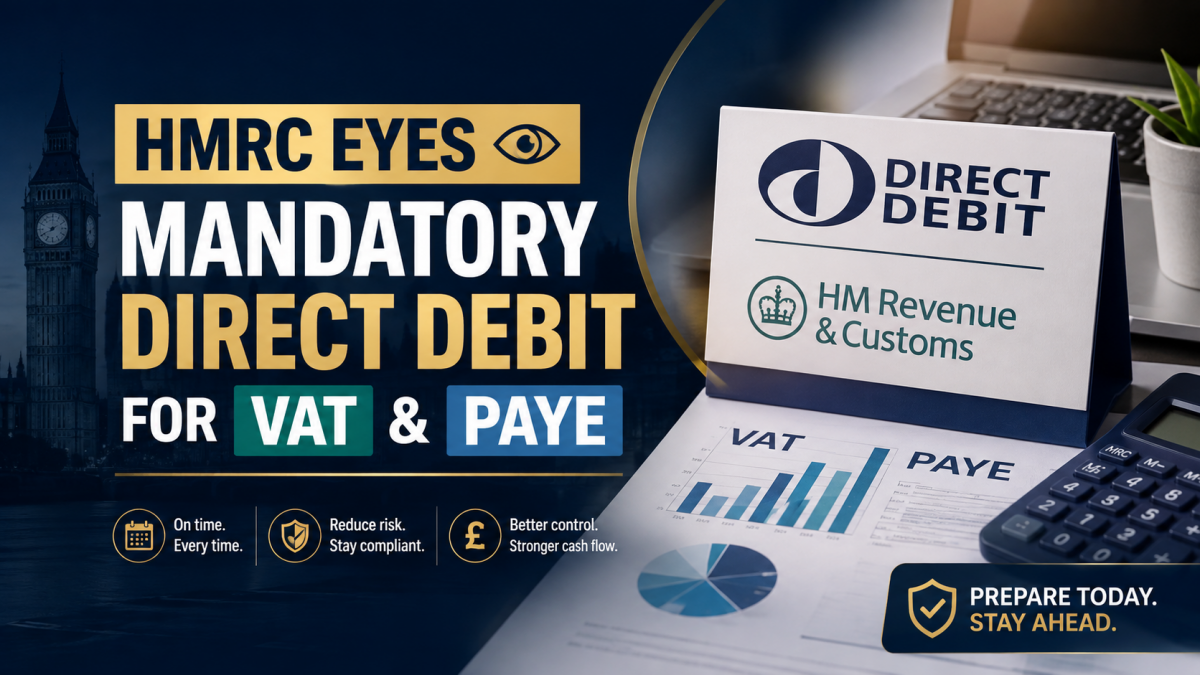
Mandatory Direct Debit for VAT and PAYE: 7 Key Changes Businesses Need to Know
Direct Debit could become a much more important part of how UK businesses pay their VAT and PAYE liabilities. HMRC is consulting on proposals that could require businesses and employers to pay these taxes by Direct Debit rather than choosing from the range of payment methods currently available.
For many businesses, paying HMRC by Direct Debit is already convenient. Once the arrangement is established, payments can be collected automatically based on the relevant VAT return or PAYE information. However, making Direct Debit mandatory would be a significant change, particularly for businesses that currently prefer bank transfers, cards or other payment methods.
Direct Debit could soon become a much bigger part of how UK businesses pay VAT and PAYE, as HMRC considers making this payment method mandatory.
The proposed Direct Debit changes could simplify tax payments and reduce late payments, but they may also affect how businesses manage cash flow and control payment timings.
While mandatory Direct Debit has not yet been introduced, businesses should understand HMRC’s proposals and consider how the potential changes could affect their VAT and PAYE processes.
It is important to stress that mandatory Direct Debit for VAT and PAYE is currently a proposal under consultation, rather than a rule that has already taken effect. HMRC’s consultation was published on 23 June 2026 and is considering how greater use of Direct Debit could result in more timely tax payments.
So, why is HMRC considering the change, how could it work, and what should businesses be thinking about now?
Why Is HMRC Considering Mandatory Direct Debit?
HMRC wants businesses to pay the correct amount of tax at the correct time. Late payments create additional administration for HMRC and can also result in interest and penalties for taxpayers.
Following the Spring Statement 2025, HMRC updated its guidance so that Direct Debit was presented as the primary payment method. However, HMRC says this did not lead to a material increase in businesses choosing Direct Debit.
The government is therefore considering going further.
Rather than simply encouraging businesses to use Direct Debit, the consultation examines whether payment by Direct Debit should become mandatory for VAT and PAYE return liabilities.
The objective is relatively straightforward: if HMRC can automatically collect the liability following submission of the relevant return, there may be fewer situations where businesses file their returns correctly but forget or fail to make the associated payment.
For businesses, however, the change could have wider consequences.
Many companies deliberately make tax payments manually because it gives them greater control over exactly when money leaves their bank account. Moving to an automatic system would require businesses to pay closer attention to their cash position before collection dates.
HMRC is considering making Direct Debit mandatory for VAT and PAYE payments, potentially changing how thousands of UK businesses manage their regular tax liabilities. The proposal aims to improve payment compliance and reduce the number of businesses that file returns but fail to pay on time.
While Direct Debit could make tax payments simpler and reduce missed deadlines, businesses may have less control over exactly when funds leave their bank accounts. This could make accurate cash-flow planning, sufficient account balances and effective VAT and PAYE processes even more important.
How VAT Payments Currently Work
VAT-registered businesses currently have several ways to settle their VAT liability.
These can include bank transfers through Faster Payments, BACS or CHAPS, debit or corporate credit cards through HMRC’s payment service and, in certain circumstances, standing orders or other permitted methods.
Many businesses already choose Direct Debit.
When a VAT Direct Debit is established through the business’s VAT online account, HMRC automatically collects the amount due.
For electronically submitted VAT returns, the usual VAT payment deadline is one calendar month and seven days after the end of the VAT accounting period. Under the current Direct Debit arrangements, HMRC normally collects the payment three working days after the due date and provides advance notification of the amount and collection date.
This can make administration easier because the business does not have to remember to initiate a separate payment after completing its VAT return.
However, businesses using bank transfers often value the ability to decide exactly when within the payment window the liability is settled.
Mandatory collection would reduce some of that flexibility.
What Could Mandatory Direct Debit Mean for VAT?
If the proposals ultimately become law, businesses that currently pay VAT manually could potentially be required to establish a Direct Debit with HMRC.
For businesses already paying this way, the practical difference may be relatively small.
For others, the impact could be more noticeable.
A business would need to ensure sufficient funds were available in its nominated bank account when HMRC attempted to collect the VAT liability. This could make accurate cash-flow forecasting even more important.
Consider a business with a VAT liability of £25,000.
Under a manual system, its finance team might schedule the payment around incoming customer receipts while still ensuring HMRC receives the money by the appropriate deadline.
Under an automatic Direct Debit system, the collection process would be controlled by the established payment timetable. The business would therefore need to plan around the expected collection rather than initiating the payment itself.
This does not necessarily make the system worse, but it does change how businesses manage their tax payments.
Direct Debit for PAYE: What Could Change?
The consultation also considers whether Direct Debit should become mandatory for PAYE liabilities.
Employers currently have several methods available for paying PAYE and National Insurance liabilities, including Direct Debit, Faster Payments, BACS, CHAPS and certain card payments.
Large employers with at least 250 employees are already required to make payments electronically, although this does not necessarily mean they must specifically use Direct Debit.
For employers using Direct Debit, HMRC can calculate the collection amount based on the PAYE information submitted through Real Time Information (RTI).
This can reduce the administrative task of separately arranging a PAYE payment every month.
However, payroll liabilities can be substantial.
Employers therefore need to ensure the figures reported through payroll are accurate and that adequate funds are available for the subsequent collection.
If Direct Debit eventually becomes compulsory, reviewing payroll information before submission could become even more important.
Why Businesses May Prefer Other Payment Methods
Although automatic payments offer convenience, there are legitimate reasons why some businesses prefer other methods.
One of the biggest is cash-flow control.
A business may prefer to make its VAT or PAYE payment manually because its finance team can choose the exact day the money leaves the account.
Another issue is internal approval.
Larger businesses may operate payment controls requiring tax payments to be reviewed and authorised by one or more members of the finance team. Automatic collection can interact differently with those internal processes.
Businesses may also operate several bank accounts and decide which account should fund a particular tax liability depending on available balances.
Some organisations simply prefer bank transfers because they provide a clear payment trail that fits their existing accounting processes.
HMRC’s consultation specifically seeks views from businesses about the benefits they obtain from alternative electronic payment methods and the potential impact of mandatory collection on accounting processes and wider business operations.
Potential Benefits of Direct Debit
There are nevertheless some clear advantages.
Automatic collection can reduce the risk of a business submitting its return but forgetting to make the corresponding payment.
For example, a business could submit its VAT return on time and assume the job is complete, only to discover later that nobody actually authorised the bank payment.
A Direct Debit can remove this additional step.
It may also reduce administrative work for businesses with regular VAT and PAYE obligations.
Instead of repeatedly entering HMRC bank details, payment references and amounts, the collection can happen automatically after the necessary information has been submitted.
This could be particularly useful for smaller businesses where the director is responsible for bookkeeping, payroll and tax administration alongside running the company.
Automation can therefore improve efficiency — provided the business maintains enough money in the relevant account.
The Cash-Flow Risk Businesses Should Consider
The biggest practical consideration is likely to be cash flow.
VAT and PAYE are amounts businesses need to account for throughout their normal operations, but the money often remains within the company’s bank account until the payment deadline.
That can sometimes create a misleading picture of available cash.
A company might have £50,000 in its bank account but have £20,000 VAT and £12,000 PAYE due shortly. Its genuinely available operational cash is therefore considerably lower.
With automatic collection, businesses may need stronger processes for ring-fencing tax liabilities.
One practical approach could be maintaining a separate tax reserve account and regularly transferring estimated VAT, PAYE and Corporation Tax amounts into it.
The important point is that money collected or withheld for tax purposes should not accidentally be treated as available working capital.
Better forecasting could therefore become increasingly valuable if automatic HMRC collections become more widespread.
What About Businesses Without UK Bank Accounts?
There is also an important practical limitation.
The UK Direct Debit scheme requires a UK bank account.
This potentially creates difficulties for overseas businesses registered for UK VAT but operating without a UK bank account.
HMRC recognises this issue within its consultation and is considering the appropriate scope and possible exceptions.
There are also existing exceptions from electronic VAT filing for certain taxpayers, and the interaction between these exceptions and any future mandatory payment arrangements will need to be considered.
This is one reason businesses should not assume the eventual rules will simply require every taxpayer, without exception, to use exactly the same payment process.
The final design will depend on the outcome of the consultation and subsequent policy development.
Could There Be Penalties for Not Using Direct Debit?
Another significant area being considered is how HMRC could encourage or enforce compliance if the payment method becomes mandatory.
The consultation considers both incentives to encourage uptake and potential sanctions for businesses that fail to comply with any future requirement.
The details are not yet finalised.
This distinction matters.
Businesses should not interpret the consultation as meaning that a new penalty already exists for paying VAT or PAYE through an alternative currently accepted payment method.
Until legislation and implementation details are confirmed, businesses should continue following HMRC’s existing payment rules.
What Should Businesses Do Now?
There is no need for businesses to panic or immediately change established payment arrangements solely because of the consultation.
However, this is a useful opportunity to review existing processes.
Mandatory Direct Debit could change how businesses manage VAT and PAYE payments, particularly those that currently prefer bank transfers or other payment methods.
Using Direct Debit may reduce the risk of missed payments and make tax administration simpler, but businesses will need to ensure sufficient funds are available when HMRC collects the amount due.
If mandatory Direct Debit is introduced, strong cash-flow planning and accurate VAT and PAYE records will become even more important for businesses.
Businesses should know who is responsible for submitting VAT returns, who processes PAYE payments, which bank account is used for tax liabilities and how sufficient funds are maintained before deadlines.
Those already using Direct Debit should ensure the nominated bank details remain correct.
Businesses relying on manual payments should consider how compulsory automatic collection could affect their internal approval procedures and cash-flow planning.
It is also worth reviewing accounting and payroll systems to ensure reported liabilities are accurate before returns are submitted.
The greater the level of automation in tax collection, the more important accurate underlying records become.
Direct Debit and the Wider Move Towards Tax Automation
The proposal should also be viewed within the broader digitalisation of the UK tax system.
Making Tax Digital has already increased the role of software and digital records in tax compliance. Payroll information is routinely reported through RTI, while VAT returns are generally submitted digitally.
Automatic Direct Debit collection could represent another step in connecting tax reporting more closely with tax payment.
From HMRC’s perspective, this could help improve payment compliance and reduce outstanding tax debt.
From the business perspective, greater automation can save time, but it can also reduce opportunities to manually control each stage of the payment process.
That makes good bookkeeping, accurate payroll reporting and cash-flow management increasingly important.
Final Thoughts

Direct Debit could eventually become the standard required method for paying VAT and PAYE, but businesses should remember that the proposal is still going through the consultation process.
Mandatory Direct Debit for VAT and PAYE could represent an important change in how UK businesses pay their tax liabilities. While HMRC’s proposals are intended to improve payment compliance and reduce late payments, businesses will need to consider how automatic collections could affect their existing payment processes and day-to-day cash-flow management.
For many businesses, Direct Debit could make paying VAT and PAYE simpler by removing the need to manually arrange payments after submitting returns. However, businesses would need to ensure sufficient funds are available in the nominated bank account when HMRC collects the payment, making accurate bookkeeping and cash-flow forecasting increasingly important.
For now, mandatory Direct Debit remains a proposal rather than an existing requirement. Businesses should keep an eye on HMRC developments and review their VAT and PAYE payment arrangements so they are prepared if the changes are introduced.
For some businesses, mandatory Direct Debit could make tax administration simpler. Automatic collection may reduce missed payments, remove repetitive payment tasks and provide a more streamlined link between filing a return and paying the resulting liability.
For other businesses, Direct Debit could create concerns around cash-flow control, internal payment approvals and the timing of withdrawals from business bank accounts.
Businesses using Direct Debit will need to ensure that sufficient funds are available when HMRC collects the liability. Businesses currently avoiding Direct Debit may need to reconsider their processes if the proposals eventually become law.
Mandatory Direct Debit for VAT and PAYE could significantly change how UK businesses manage their tax payments, making preparation and cash-flow planning increasingly important.
Although Direct Debit may simplify payments and reduce missed deadlines, businesses could have less control over exactly when funds leave their accounts.
For now, mandatory Direct Debit remains a proposal. Businesses should monitor HMRC developments and ensure their VAT, PAYE and cash-flow processes are ready for any future changes.
The key is preparation rather than panic.
Understanding how Direct Debit works, maintaining accurate accounting records and planning for VAT and PAYE liabilities can help businesses adapt if HMRC proceeds with the change.
We help businesses understand their VAT, PAYE and wider tax obligations and keep their tax affairs organised and compliant.
If you are unsure how the proposed changes could affect your business or want help managing your VAT and PAYE obligations, get in touch with our team for professional UK tax advice, we will guide to the right path in right correction.
Need help deciding what’s best for your situation?
📞 Call 0161 710 1901
📧 Email Tax@TaxesDoneRight.co.uk
Visit www.taxesdoneright.co.uk