
Mandatory Direct Debit for VAT and PAYE: 7 Key Changes Businesses Need to Know
August 11, 2026
MTD No Show: HMRC to Start Signing Up Taxpayers Who Missed the MTD Deadline
August 13, 2026
P11D Changes April 2027: What’s Changing for Employers?
P11D Changes April 2027 will introduce an important shift in how certain employee benefits in kind are reported and taxed in the UK. From 6 April 2027, employers providing certain taxable benefits will need to report those benefits through payroll software in real time rather than relying primarily on the traditional year-end P11D process.
P11D Changes April 2027 will bring important changes for UK employers, particularly in how certain benefits in kind are reported and taxed. From 6 April 2027, mandatory payrolling will begin for benefits including company cars, car fuel, vans, van fuel and employer-provided medical benefits.
Understanding the P11D Changes April 2027 early can help employers prepare their payroll systems, improve record keeping and avoid costly reporting mistakes. With more benefits moving towards real-time payroll reporting, businesses should start reviewing their current processes well before the new rules take effect.
For employers, payroll teams and company directors, the P11D Changes April 2027 mean benefits in kind will increasingly become part of normal payroll administration. Initially, the mandatory rules will apply to company cars, car fuel, vans, van fuel and employer-provided medical benefits. Most other benefits in kind are expected to move into mandatory payrolling from April 2028.
The move is intended to modernise the system and allow tax on benefits to be collected closer to the time employees receive them. However, it also means employers will need accurate information much earlier than under the traditional annual P11D process.
Understanding the P11D Changes April 2027 now gives businesses time to review their payroll software, benefits records and internal procedures before the new requirements begin.
What Are P11Ds and How Does the Current System Work?
A P11D is used to report certain taxable expenses and benefits provided to employees and directors. Typical examples can include company cars, private medical insurance, beneficial loans and other non-cash benefits.
Under the existing system, employers can report taxable benefits after the end of the tax year using forms P11D where those benefits have not already been payrolled. The employee’s tax position can then be adjusted by HMRC, often through their PAYE tax code.
Employers also have responsibilities relating to Class 1A National Insurance contributions on relevant taxable benefits. At present, employers generally submit a P11D(b) after the end of the tax year to report their Class 1A National Insurance liability.
Some employers already voluntarily payroll eligible benefits. In those circumstances, the taxable value is processed through payroll during the tax year so that the employee pays Income Tax on the benefit throughout the year rather than waiting for an adjustment after the year end.
The P11D Changes April 2027 move the system further towards real-time reporting, although the transition will now happen in phases rather than requiring every benefit to move across at the same time.
P11D Changes April 2027: What Is Actually Changing?
From 6 April 2027, mandatory payrolling will initially apply to five main categories of benefits:
- Company cars
- Car fuel
- Vans
- Van fuel
- Employer-provided medical benefits
For these benefits, employers will generally need to report the taxable benefit through payroll software and Real Time Information (RTI). This means the relevant Income Tax will be dealt with much closer to when the employee receives the benefit.
The P11D Changes April 2027 therefore represent more than simply replacing one form with another. Employers will need to incorporate benefit calculations into their regular payroll processes.
Instead of gathering information after the tax year has finished, businesses may need systems that identify new benefits, changes to existing benefits and employees joining or leaving benefit schemes during the year.
This creates a significant operational change. Payroll may need information from HR, finance, fleet management and other departments before each relevant payroll submission.
For example, if an employee receives a company car, payroll will need sufficient information to calculate and report the appropriate taxable benefit. Similarly, changes affecting the taxable value of medical cover or vehicle benefits may need to reach the payroll team promptly.
The P11D Changes April 2027 therefore make accurate and timely communication between different parts of the business increasingly important.
Why Is HMRC Making These Changes?
The aim behind the P11D Changes April 2027 is to modernise the reporting and taxation of benefits in kind.
Under the traditional system, there can be a delay between an employee receiving a taxable benefit and the corresponding tax being collected. This can sometimes lead to changes to PAYE codes or tax adjustments after the end of the tax year.
Real-time reporting is intended to bring the taxation of benefits closer to the way normal salary is taxed through PAYE.
For employees, this may make the tax consequences of receiving benefits more immediate. For employers, it should eventually reduce reliance on separate year-end P11D reporting for benefits that have moved completely into the payroll system.
However, moving from an annual process to a real-time process also places greater emphasis on the quality and timing of information supplied to payroll.
Which Benefits Will Be Affected From April 2027?
The first phase is deliberately narrower than originally expected. The P11D Changes April 2027 will make payrolling mandatory for company cars, car fuel, vans, van fuel and employer-provided medical benefits.
This phased approach is particularly important for employers to understand.
Not every taxable benefit will suddenly become subject to mandatory payrolling on 6 April 2027. HMRC has confirmed that mandatory payrolling for most remaining benefits is intended to follow from April 2028.
This gives employers and payroll software providers additional time to prepare for the broader transition.
Businesses should therefore identify exactly which benefits they provide rather than assuming that every existing P11D item must immediately move into payroll in April 2027.
What Happens to Other Benefits in Kind?
Most remaining benefits are expected to move to mandatory payrolling from April 2028.
This means the P11D Changes April 2027 should be viewed as the first major stage of a wider reform rather than the complete removal of the existing P11D framework overnight.
Employers may also have the opportunity to payroll other benefits voluntarily. HMRC has indicated that a new voluntary registration service is expected to be available from November 2026 for benefits that have not yet become mandatory.
Loans and accommodation require particular attention. HMRC has indicated that employers will be able to payroll employment-related loans and accommodation voluntarily, while the timing of mandatory payrolling for these benefits is to be confirmed separately.
Businesses providing several different types of benefits could therefore find themselves operating a mixture of mandatory payrolling, voluntary payrolling and existing reporting arrangements during the transition.
P11D Changes April 2027 and Real-Time Payroll Reporting
One of the biggest practical consequences of the P11D Changes April 2027 is the move towards reporting benefits through the Full Payment Submission (FPS).
Employers already use the FPS to report salary, tax and other payroll information to HMRC. Under the new arrangements, relevant benefit information will also need to form part of the real-time reporting process.
This changes the timing of compliance.
Under an annual P11D process, employers have time after the tax year ends to gather information and calculate benefits. With real-time reporting, the information needs to reach payroll considerably sooner.
The P11D Changes April 2027 may therefore require businesses to redesign internal processes.
For example, HR may need to notify payroll immediately when private medical cover starts. Fleet managers may need to provide details when company cars are allocated or changed. Finance teams may need to identify benefit-related costs earlier.
Waiting until the end of the tax year to reconcile everything may no longer be sufficient for benefits subject to mandatory payrolling.
What Will Happen to Class 1A National Insurance?
Class 1A National Insurance is another important consideration when preparing for the P11D Changes April 2027.
The new framework is designed to bring reporting of relevant benefits increasingly into RTI and to change how associated employer liabilities are dealt with.
Employers should therefore avoid assuming that the only change concerns employees’ Income Tax. The employer-side National Insurance implications are equally important when planning payroll systems and processes.
HMRC is continuing to develop guidance around the detailed operation of the new regime. Employers should ensure that their payroll software is capable of supporting the requirements that apply from April 2027 and should monitor further HMRC guidance as implementation approaches.
Will P11D Forms Completely Disappear?
Not immediately.
Although the P11D Changes April 2027 significantly reduce reliance on annual P11D reporting for the benefits entering mandatory payrolling, the P11D system will not simply disappear for every employer and every benefit on 6 April 2027.
The phased implementation means some benefits will remain outside mandatory payrolling during 2027/28.
Employment-related loans and accommodation are particularly important examples because mandatory payrolling for these benefits has not yet been given the same implementation date.
There may also be specific circumstances requiring separate treatment.
Employers should therefore avoid interpreting the P11D Changes April 2027 as meaning that P11D compliance can simply be removed from their year-end checklist. Instead, businesses need to establish which benefits are being payrolled and which remain subject to other reporting requirements.
How Will Employees Be Affected?
Employees receiving benefits included within the P11D Changes April 2027 may notice that tax is collected differently.
Rather than HMRC adjusting their tax position later through a tax code or year-end reconciliation, tax on relevant payrolled benefits will generally be collected through PAYE during the year.
This may make deductions appear more directly connected with the benefit being received.
Employers should consider communicating the change to affected employees before April 2027. Without an explanation, an employee could see a change in their payslip deductions and assume their salary or tax code has been processed incorrectly.
Clear communication can reduce payroll queries and help employees understand that the underlying benefit has not necessarily changed — it is the method and timing of taxation that is changing.
What Should Employers Do Before April 2027?
Preparation for the P11D Changes April 2027 should begin well before the start of the 2027/28 tax year.
Employers should first create an accurate list of all taxable benefits currently provided to employees and directors. These should then be separated between benefits becoming mandatory from April 2027 and those expected to move later.
Payroll software should also be reviewed. Employers should speak with their payroll provider or software developer to establish how the new benefit fields and calculations will work.
Internal responsibilities should then be considered. Who tells payroll when a company car changes? Who reports new private medical cover? How quickly is payroll informed when an employee leaves a benefit scheme?
The P11D Changes April 2027 make these questions more important because delays could result in incorrect real-time submissions.
Employers should also review payroll cut-off dates, benefit policies and employee communications.
Common Risks Employers Should Watch For
A major risk created by the P11D Changes April 2027 is incomplete or late information.
If payroll does not know that a benefit has started, ended or changed, the taxable amount reported through RTI could be incorrect.
Another risk is assuming that payroll software will solve everything automatically. Software can calculate and report information, but it still relies on accurate underlying data.
Employers operating company car schemes may have particularly detailed information requirements. Businesses paying for private medical insurance may also need to ensure that employee-level benefit information is available in time for payroll processing.
The transition period itself creates another potential complication because different benefits may be subject to different reporting methods.
A strong reconciliation process will therefore remain important after the P11D Changes April 2027 take effect.
How Small Businesses and Directors Could Be Affected
The P11D Changes April 2027 are not relevant only to large employers.
Owner-managed companies can provide taxable benefits to directors, including company cars, fuel or private medical insurance. Where those benefits fall within the mandatory categories, the company will also need to follow the new reporting requirements.
Small companies that currently process payroll monthly but deal with P11Ds only once a year may notice the administrative change most clearly.
The benefit information will need to become part of the regular payroll cycle.
Businesses using an external accountant or payroll bureau should establish who will provide the benefit information, when it needs to be supplied and who is responsible for checking its accuracy.
Preparing Your Payroll Systems
Businesses should use the period before April 2027 to test their procedures.
Start by comparing existing P11D records with payroll records and identifying where information currently comes from.
Employers should confirm that their payroll solution will support mandatory payrolling and RTI reporting for the benefits included in the first phase.
It may also be useful to run internal checks before the new tax year begins.
The P11D Changes April 2027 are much easier to manage when payroll teams already know which employees receive benefits and have reliable procedures for recording changes.
Leaving the transition until the first payroll run after 6 April 2027 could create unnecessary pressure and increase the risk of errors.
Final Thoughts
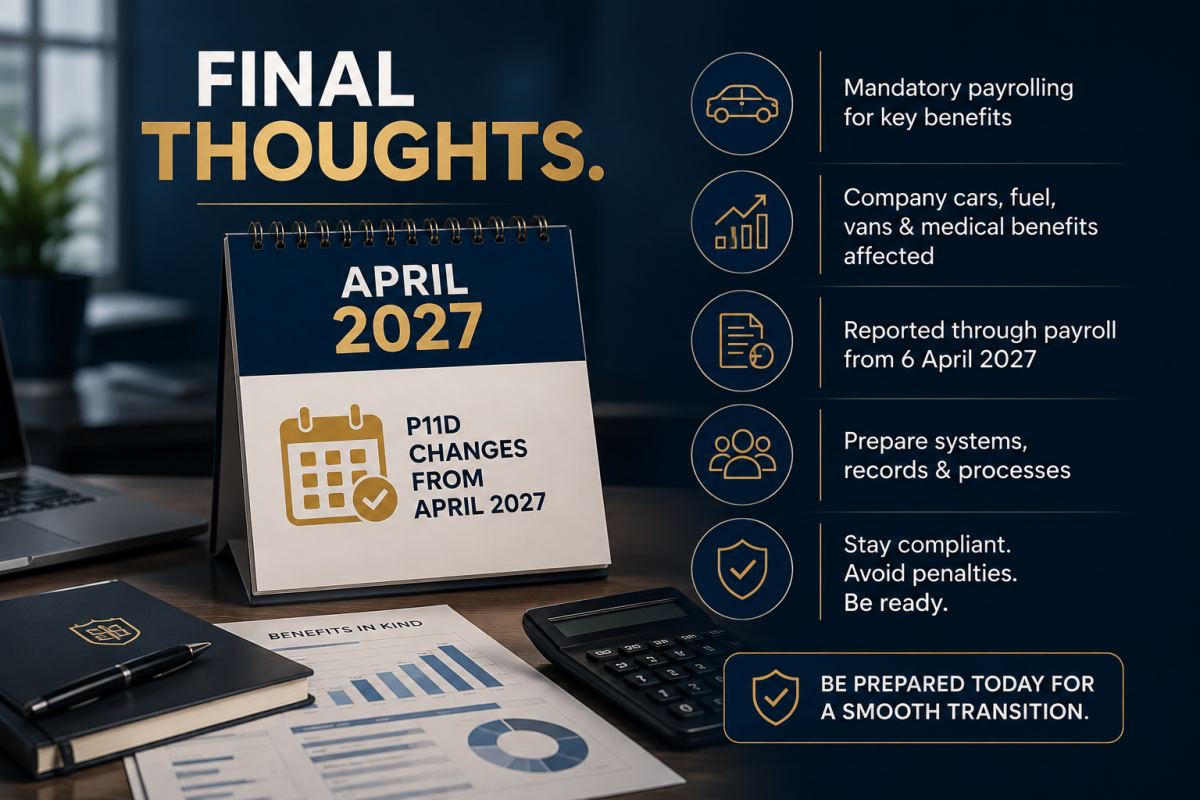
The P11D Changes April 2027 represent a major change in the administration of UK employee benefits. From 6 April 2027, company cars, car fuel, vans, van fuel and employer-provided medical benefits will move into mandatory real-time payrolling.
P11D Changes April 2027 will mark an important shift in how UK employers report and manage certain benefits in kind. With mandatory payrolling beginning for specific benefits, employers will need to ensure their payroll systems, records and internal processes are ready before the new rules take effect.
Preparing early for P11D Changes April 2027 can help businesses avoid reporting errors, unexpected payroll issues and unnecessary pressure. Employers should review the benefits they provide, confirm that their payroll software can handle the changes and make sure benefit information reaches the payroll team promptly.
P11D Changes April 2027 may require some adjustment, but good preparation can make the transition much smoother. At Taxes Done Right, we can help employers understand the new requirements, review their benefits in kind and prepare their payroll processes for the upcoming changes.
The P11D Changes April 2027 will require employers to think differently about benefit reporting. Instead of treating benefits mainly as a year-end compliance exercise, relevant benefit information will increasingly need to become part of routine payroll administration.
The phased approach gives employers some additional breathing room, with most remaining benefits expected to move to mandatory payrolling from April 2028. However, the P11D Changes April 2027 still require preparation now.
Employers should review their benefits, payroll software, internal reporting procedures and employee communications before the new rules take effect.
At Taxes Done Right, we can help employers understand the P11D Changes April 2027, review their benefits in kind and prepare their payroll processes for the new reporting requirements.
Preparing early for the P11D Changes April 2027 can help reduce payroll errors, avoid last-minute compliance problems and make the transition to real-time benefits reporting much smoother.
Need help deciding what’s best for your situation?
📞 Call 0161 710 1901
📧 Email Tax@TaxesDoneRight.co.uk
Visit www.taxesdoneright.co.uk