Personal vs Limited Company: Which Leaves Landlords Better Off in 2026/27?
September 17, 2026
Sole Trader or Limited Company: Which Structure Is Right for You?
Sole Trader or Limited Company is one of the biggest decisions you will make when starting or growing a business in the UK. Your choice affects how profits are taxed, how easily you can take money from the business, the level of paperwork involved and the degree of legal separation between you and the business.
There is no universal answer to this. A structure that suits a freelancer making £25,000 may not suit a consultant making £90,000. Equally, someone who needs to withdraw almost every pound of profit may reach a different conclusion from an owner who can leave money in the business for future investment.
This guide explains the main Sole Trader or Limited Company differences for 2026/27. It covers tax, National Insurance, Corporation Tax, dividends, pensions, Making Tax Digital, liability, administration and future growth so you can understand the factors that should drive your Sole Trader or Limited Company decision.
What is a sole trader?
For Sole Trader or Limited Company, a sole trader is an individual who runs a business personally. You can trade under your own name or a business name, but there is no separate legal person between you and the business. That point is fundamental when comparing Sole Trader or Limited Company.
With Sole Trader or Limited Company, starting as a sole trader is normally straightforward. You do not need to incorporate a company, issue shares or file company accounts at Companies House. You keep appropriate records, calculate taxable business profits and report them to HMRC through the relevant tax process.
Under Sole Trader or Limited Company, the money earned by the business belongs to you. You can usually transfer cash from the business account to your personal account without declaring dividends or running payroll. However, withdrawals do not determine your taxable profit. If the business makes £60,000 taxable profit, taking only £30,000 for yourself does not normally reduce the amount on which you are taxed.
In Sole Trader or Limited Company, that distinction can make Sole Trader or Limited Company particularly important when a profitable business produces more cash than the owner needs to spend personally.
For Sole Trader or Limited Company, the main legal disadvantage is unlimited liability. Because the business is not separate from you, business debts and certain claims can potentially affect your personal finances. Insurance can reduce some risks, but it does not create legal separation.
What is a limited company?
With Sole Trader or Limited Company, a limited company is a separate legal entity. It can own assets, sign contracts, employ staff, borrow money and owe debts in its own name. Shareholders own the company, while directors are responsible for managing it.
This separation is one of the strongest non-tax arguments in a Sole Trader or Limited Company comparison. In normal circumstances, shareholders benefit from limited liability, although directors can still have personal exposure in situations such as personal guarantees or breaches of their legal duties.
Under Sole Trader or Limited Company, company money also belongs to the company. If a customer pays £10,000 into the company bank account, the director cannot simply treat that money as personal cash. Funds taken out must be recorded properly, for example as salary, dividends, reimbursement of business expenses or repayment of money the company owes the director.
This means Sole Trader or Limited Company affects everyday cash management as well as year-end tax. A director needs clearer separation between personal and company spending.
For Sole Trader or Limited Company, a company also has additional filing requirements. These can include annual accounts, Corporation Tax filings, Companies House filings, payroll where relevant and proper documentation for dividends. Directors and people with significant control are also now within the Companies House identity-verification regime.
Sole Trader or Limited Company: the main differences
The simplest way to compare Sole Trader or Limited Company is to look at five areas: tax, legal liability, administration, access to money and future growth.
With Sole Trader or Limited Company, a sole trader pays personal tax on taxable business profit. A company normally pays Corporation Tax on its taxable profit, and the owner can then face personal tax when money is extracted from the company.
Under Sole Trader or Limited Company, a sole trader can take drawings without declaring a dividend. A director must account correctly for money withdrawn from the company.
For Sole Trader or Limited Company, a sole trader generally has fewer statutory obligations. A company has Companies House and Corporation Tax responsibilities in addition to ordinary bookkeeping.
A sole trader owns the business personally. A company can have several shareholders, which can make bringing in other owners or investors more structured.
Finally, in Sole Trader or Limited Company, legal risk is affected. The sole trader is the business, whereas a company is normally a separate legal entity.
Tax as a sole trader in 2026/27
Tax is often the first thing people think about when asking Sole Trader or Limited Company.
For Sole Trader or Limited Company, the 2026/27 standard Personal Allowance remains £12,570, although it is reduced where adjusted net income exceeds £100,000. Income Tax bands then apply to taxable income. The exact position can differ for Scottish taxpayers, so location and other income should be considered in a personalised Sole Trader or Limited Company calculation.
With Sole Trader or Limited Company, self-employed profits can also be subject to Class 4 National Insurance. For 2026/27, Class 4 is charged at 6% on profits above £12,570 up to £50,270 and 2% on profits above £50,270. Class 2 is generally treated as paid where profits reach the relevant threshold, while voluntary contributions may be available in some cases.
Under Sole Trader or Limited Company, these rules matter because a sole trader is taxed on taxable profit, not on drawings. If your taxable profit is £75,000 and you leave £20,000 in the business bank account, keeping that money aside does not normally defer the Income Tax and Class 4 National Insurance attributable to the profit.
That is why Sole Trader or Limited Company can become more significant as profits rise beyond the amount you actually need for living costs.
For Sole Trader or Limited Company, your wider position matters too. Employment income, property income, savings, dividends, student loan repayments and other taxable income can all change the final result. Two people with the same business profit may therefore reach a different Sole Trader or Limited Company conclusion.
Tax through a limited company in 2026/27
With Sole Trader or Limited Company, a company pays Corporation Tax on its taxable profits. For the financial year beginning 1 April 2026, the small profits rate is 19% for qualifying profits of £50,000 or less. The main rate is 25% for profits above £250,000, with Marginal Relief potentially applying between those limits. The thresholds can be reduced where associated companies or short accounting periods are involved.
A common mistake in Sole Trader or Limited Company planning is to compare 19% Corporation Tax directly with a sole trader’s Income Tax rate and stop there.
Under Sole Trader or Limited Company, Corporation Tax is only the company-level tax. If the owner wants to use the profits personally, another tax charge may arise depending on how money is extracted.
For Sole Trader or Limited Company, salary can be deductible for Corporation Tax where the normal conditions are met, but PAYE and National Insurance can apply. Dividends are paid from distributable post-tax profits and are not deductible for Corporation Tax.
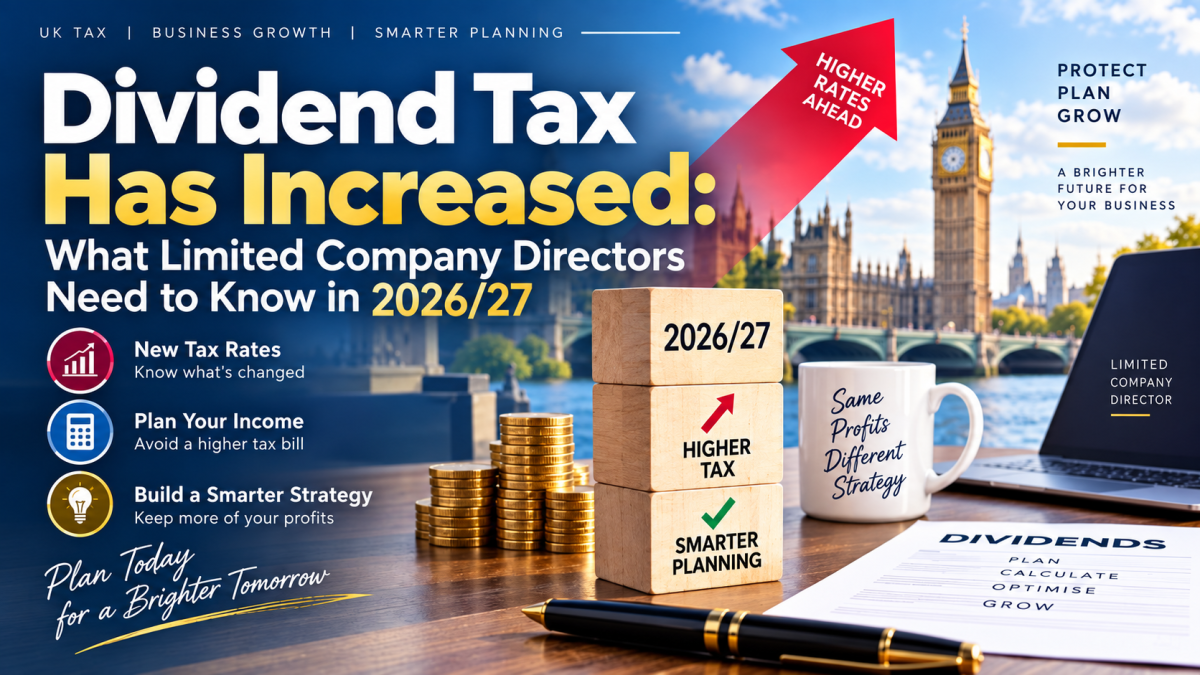
For 2026/27, the dividend allowance is £500. Dividend tax above the available allowance is 10.75% at the basic dividend rate, 35.75% at the higher dividend rate and 39.35% at the additional dividend rate.
A reliable Sole Trader or Limited Company calculation therefore considers both the tax paid by the company and the personal tax paid by the owner.
Sole Trader or Limited Company: which can be more tax-efficient?
There is no single profit figure at which Sole Trader or Limited Company automatically changes from one answer to the other.
With Sole Trader or Limited Company, the result depends on profit, other income, how much cash you need personally, salary level, dividends, pension contributions, associated companies and the cost of running the company.
Under Sole Trader or Limited Company, if you need to withdraw nearly all profits for personal spending, incorporation may deliver less tax benefit than expected because company profits can suffer Corporation Tax and then personal tax on extraction.
If the business earns substantially more than you need personally, Sole Trader or Limited Company can look different. A company may retain post-Corporation Tax profits for working capital, future investment, recruitment or later distribution. This can provide more control over the timing of personal extraction, although the retained profit is not tax-free.
For example, an owner making £90,000 profit but needing £40,000 personally has very different planning possibilities from someone making the same profit but needing £85,000 personally.
This is why Sole Trader or Limited Company should be modelled using actual figures rather than a general rule such as “incorporate once profit reaches £50,000”.
For Sole Trader or Limited Company, the calculation should also include additional accountancy, payroll and software costs. A small theoretical tax saving can disappear if the company creates significantly higher compliance costs.
Salary, dividends and access to company money
The way owners access cash is a major Sole Trader or Limited Company difference.
With Sole Trader or Limited Company, a sole trader can normally take drawings whenever cash flow allows. Drawings are not a business expense and do not reduce taxable profit, but there is no need to declare a dividend to move business cash to a personal account.
Under Sole Trader or Limited Company, a company director cannot treat the company bank balance as personal money. Payments to the director need a valid accounting and tax treatment.
A director may receive salary through payroll. A shareholder may receive dividends where sufficient distributable profits exist. The company may reimburse genuine business expenses or repay money previously lent by the director.
If money is taken without being covered by one of the appropriate routes, it can create a director’s loan balance. Overdrawn director’s loans can have tax consequences, so anyone choosing Sole Trader or Limited Company needs to understand the stricter separation of company and personal funds.
For many first-time company directors, this discipline is one of the biggest practical changes after incorporation.
Administration and compliance
Administration is one of the strongest arguments for keeping a business structure simple.
For Sole Trader or Limited Company, a sole trader still needs accurate bookkeeping, evidence for business expenses and correct tax submissions. However, there are normally fewer corporate formalities.
With Sole Trader or Limited Company, a company generally has more responsibilities. Annual accounts and Companies House filings must be dealt with, Corporation Tax needs to be calculated and reported, company records must be maintained and payroll may be needed. Dividends should also be properly documented and supported by sufficient distributable profits.
Companies House identity verification is now another consideration. Directors and people with significant control are among those required to verify their identity under the new regime.
This additional work means Sole Trader or Limited Company should include the value of your own time as well as professional fees.
The administrative position for sole traders changed significantly from April 2026.
Under Sole Trader or Limited Company, from 6 April 2026, sole traders and landlords within scope must use Making Tax Digital for Income Tax where qualifying gross income from self-employment and property is over £50,000, based on the relevant earlier tax return. The threshold is scheduled to fall to more than £30,000 from April 2027 and more than £20,000 from April 2028.
Those within MTD need compatible software, digital records and quarterly updates to HMRC, in addition to their year-end obligations.
This does not make sole-trader administration the same as company administration, but it narrows the gap for some larger unincorporated businesses.
When reviewing Sole Trader or Limited Company, consider whether you are already within MTD or likely to enter it soon. Software and quarterly reporting should be included in the practical comparison.
Liability and protecting personal assets
Tax should not overshadow legal risk when deciding Sole Trader or Limited Company.
For Sole Trader or Limited Company, a sole trader and the business are legally the same person. If the business has debts it cannot meet or faces a successful legal claim, the owner’s personal finances can potentially be exposed.
With Sole Trader or Limited Company, a company is normally separate from its shareholders. This can provide an important layer of protection, although it is not absolute. Directors may give personal guarantees to banks, landlords or suppliers, and personal liability can arise in certain circumstances.
Sole Trader or Limited Company is therefore a risk-management decision as well as a tax decision.
Sole Trader or Limited Company: questions to ask before deciding
Before choosing Sole Trader or Limited Company, ask yourself the following questions.
What taxable profit do you realistically expect over the next 12 to 24 months? A decision based on one unusually good or bad year can be misleading.
How much money do you need personally each month? The ability to retain profits is far more useful when business profits substantially exceed personal spending.
Do you have other income? Employment, rental income, dividends and investments can change your tax bands and therefore the Sole Trader or Limited Company result.
What level of commercial risk does the business carry? Consider employees, borrowing, leases, customer deposits, stock and contractual obligations.
Do you want to make pension contributions? Employer pension contributions from a company can materially affect the numbers in some cases.
Will you bring in another owner or investor? If so, a company structure may make ownership changes easier to manage.
Are you comfortable with more administration? Company accounts, Corporation Tax, payroll, dividend records and Companies House requirements need regular attention.
Finally, are you comparing the total cost? A proper Sole Trader or Limited Company comparison should include tax, National Insurance, professional fees, software and the value of additional administration.
Final thoughts

Sole Trader or Limited Company does not have one correct answer for every business owner.
A sole trader can offer simplicity, easy access to business cash and lower administration. A limited company can offer legal separation, more flexibility around profit extraction and pensions, and a structure that may be better suited to future growth.
The right Sole Trader or Limited Company answer depends on profit, personal drawings, other income, business risk, pension objectives, future investment and the administrative burden you are prepared to manage.
Tax rates and business circumstances change, so a Sole Trader or Limited Company calculation carried out several years ago may no longer be relevant today.
At Taxes Done Right, we can compare Sole Trader or Limited Company using your actual figures rather than generic assumptions. We can review estimated tax, your required monthly income, pension planning and the ongoing responsibilities of each option.
If incorporation is appropriate, we can also assist with company formation, bookkeeping, payroll, annual accounts, Corporation Tax and Self Assessment.
Choosing Sole Trader or Limited Company should support both your finances today and your longer-term business goals. Reviewing the position before profits increase significantly, before taking on major commitments or before introducing another owner can help you make a more informed decision.
Need help deciding what’s best for your situation?
📞 Call 0161 710 1901
📧 Email Tax@TaxesDoneRight.co.uk
Visit www.taxesdoneright.co.uk