
Limited Cost Trader Rules Explained And Why They Catch People Out
April 30, 2026
VAT Registration Exception Explained (Avoid Costly Mistakes When Applying to HMRC)
May 1, 2026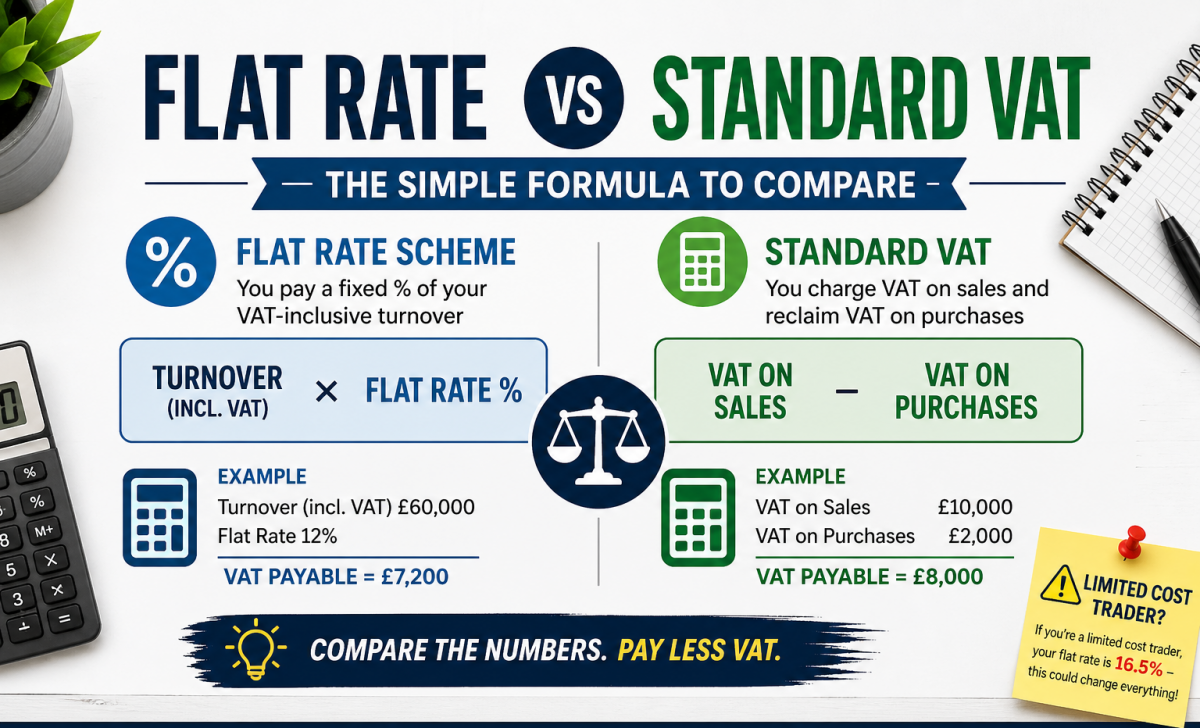
Choosing between the VAT Flat Rate Scheme and Standard VAT isn’t about guesswork. There’s a simple way to compare them side by side — and it can save (or cost) you thousands.
Step 1: Understand the Key Difference
- Flat Rate Scheme (FRS): You pay a fixed % of your gross (VAT-inclusive) turnover to HMRC
- Standard VAT: You charge VAT on sales and reclaim VAT on purchases
Step 2: Use This Simple Comparison Formula
Flat Rate VAT payable:
Turnover (incl. VAT) × Flat Rate %
Standard VAT payable:
VAT on sales – VAT on purchases
Step 3: Quick Worked Example
Let’s say:
- Turnover (excl. VAT): £50,000
- VAT charged (20%): £10,000
- Total income (incl. VAT): £60,000
- Purchases (incl. VAT): £12,000 (VAT element = £2,000)
Flat Rate Scheme (e.g. 12%):
£60,000 × 12% = £7,200 payable to HMRC
Standard VAT:
£10,000 (output VAT) – £2,000 (input VAT) = £8,000 payable
In this case, Flat Rate saves £800
Step 4: The Hidden Trap – Limited Cost Trader
If you’re classed as a limited cost trader, your flat rate jumps to 16.5%.
Using the same example:
£60,000 × 16.5% = £9,900
Now you’re £1,900 worse off than Standard VAT
Step 5: When Flat Rate Works Best
Flat Rate is usually beneficial if:
- You have low VATable expenses
- You’re not a limited cost trader
- Your industry flat rate % is relatively low
Step 6: When Standard VAT is Better
Standard VAT tends to win if:
- You have high costs with reclaimable VAT
- You regularly buy materials, stock, or equipment
- You fall into the limited cost trader rules
Final Thought
Don’t assume one scheme is always better. The right choice depends on your numbers — and they can change as your business grows.
A quick calculation using the formula above can highlight if you’re overpaying.
If you want us to run the numbers properly for your business:
📞 Call: 0161 710 1901
📧 Email: Tax@TaxesDoneRight.co.uk
Dm Us:
www.taxesdoneright.co.uk