
Waiting Until January: Why Waiting Until January Is So Expensive (UK Guide 2026)
July 16, 2026
Best MTD Software UK 2026: 7 Best HMRC-Approved Solutions for Businesses, Landlords & Sole Traders
July 20, 2026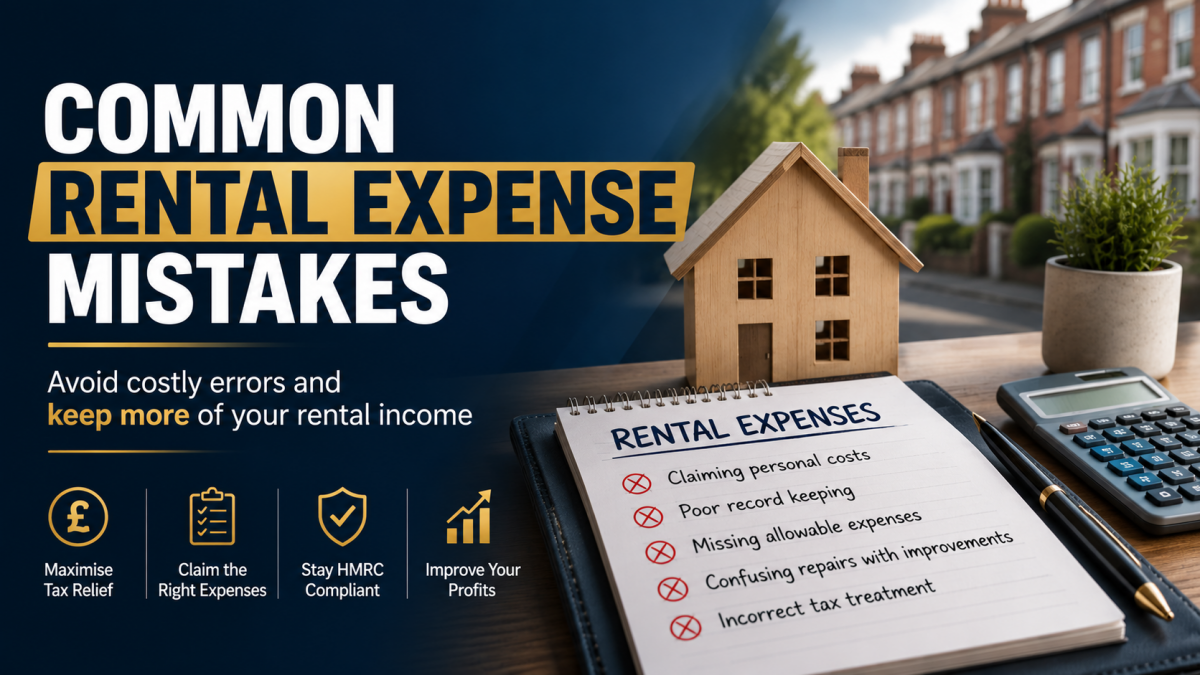
Rental Expense Mistakes: Common Mistakes That Cost UK Landlords Money
Rental Expense claims can significantly reduce your tax bill when they are made correctly. However, many UK landlords either claim expenses that are not allowable or fail to claim legitimate costs they are entitled to. Both mistakes can prove expensive.
HMRC expects landlords to maintain accurate records and only claim expenses that are wholly and exclusively incurred for running their rental business. Incorrect claims could result in enquiries, penalties, additional tax, and interest, while overlooked expenses simply mean paying more tax than necessary.
Whether you own a single buy-to-let property or a growing portfolio, understanding the rules surrounding Rental Expense claims is essential for staying compliant and maximising your after-tax profits.
This guide explains the most common Rental Expense mistakes landlords make and how you can avoid them.
Why Rental Expense Claims Matter
Every allowable Rental Expense reduces your taxable rental profit. Lower taxable profits usually mean paying less Income Tax.
Although many landlords understand the importance of keeping receipts, far fewer understand which expenses qualify for tax relief and which should instead be treated as capital expenditure.
Even small errors repeated over several years can become costly.
Common consequences include:
- Paying unnecessary tax
- HMRC enquiries
- Interest on underpaid tax
- Financial penalties
- Time spent correcting previous tax returns
Getting your Rental Expense claims right from the beginning helps avoid these problems.
Rental Expense Mistakes: Claiming Capital Improvements as Repairs
One of the biggest Rental Expense mistakes is confusing repairs with improvements.
Repairs restore an item to its original condition and are generally allowable.
Examples include:
- Fixing a leaking roof
- Replacing broken roof tiles
- Repairing damaged plaster
- Repainting existing walls
- Repairing existing plumbing
However, improvements increase the property’s value or significantly upgrade it. These are normally capital costs rather than allowable revenue expenses.
Examples include:
- Building an extension
- Converting a loft
- Installing an entirely new conservatory
- Adding an additional bathroom
- Major structural alterations
These costs may instead be considered when calculating Capital Gains Tax if you later sell the property.
Understanding the difference is essential before including any large Rental Expense claim.
Claiming Personal Expenses
Another common mistake is claiming costs that are partly or entirely personal.
HMRC only allows expenses that relate directly to the rental business.
Examples of personal costs include:
- Family travel unrelated to the property
- Personal mobile phone bills
- Home utility bills with no rental connection
- Personal subscriptions
- Clothing
Where an expense has both business and personal use, only the business proportion may normally be claimed.
For example:
- Business-use element of your phone
- Internet used for managing properties
- Mileage for property inspections
Maintaining evidence for any business allocation is important.
Rental Expense Records: Poor Record Keeping
Many landlords lose valuable Rental Expense claims simply because they cannot produce supporting evidence.
HMRC can request records years after the expense was incurred.
Useful records include:
- Receipts
- Bank statements
- Invoices
- Mortgage statements
- Letting agent statements
- Insurance schedules
- Service charge invoices
Digital bookkeeping software can make record keeping much easier and reduce the chance of missing expenses.
The better your records, the easier your Self Assessment becomes.
Forgetting Allowable Rental Expenses
Many landlords focus only on mortgage interest and repairs while overlooking numerous legitimate expenses.
Some commonly forgotten allowable expenses include:
- Landlord insurance
- Letting agent fees
- Property management fees
- Accountancy fees
- Advertising for new tenants
- Safety certificates
- Gas safety inspections
- EPC costs
- Electrical inspections
- Gardening
- Cleaning between tenants
- Replacement domestic items
- Stationery
- Telephone costs relating to property management
- Postage
- Software subscriptions
- Property licence fees
Missing several smaller Rental Expense claims each year can substantially increase your tax bill.
Misunderstanding Mortgage Interest Relief
Mortgage interest causes confusion for many landlords.
Following the Section 24 mortgage interest rules, individual landlords generally cannot deduct residential mortgage interest from rental profits in the traditional way.
Instead, eligible finance costs usually receive a basic rate tax reduction.
This means:
- Higher-rate taxpayers often receive less relief than before.
- Rental profits may appear higher.
- Tax calculations become more complicated.
Many landlords incorrectly deduct the full mortgage interest as a Rental Expense, resulting in incorrect tax returns.
If your properties are owned through a limited company, different Corporation Tax rules usually apply.
Professional advice is particularly valuable where finance costs are significant.
Claiming Initial Property Purchase Costs
Many landlords incorrectly assume every property purchase cost qualifies as a Rental Expense.
Generally, costs associated with purchasing a property are capital in nature.
Examples include:
- Solicitor fees relating to acquisition
- Stamp Duty Land Tax
- Survey fees
- Mortgage arrangement fees connected with purchasing
These costs normally cannot be deducted from annual rental income.
Instead, they may become relevant when calculating Capital Gains Tax on disposal.
Understanding this distinction avoids one of the most common Rental Expense errors.
Ignoring Property-Specific Expenses
Some landlords own multiple rental properties but fail to allocate expenses correctly.
Each expense should relate to the appropriate rental business.
Examples include:
- Property-specific repairs
- Individual insurance policies
- Separate service charges
- Individual utility bills
- Ground rents
Proper allocation improves accuracy and helps if HMRC requests supporting information.
Rental Expense Errors When Using Cash Payments
Cash payments are not prohibited, but they can create evidence problems.
Whenever possible:
- Obtain receipts
- Request invoices
- Keep photographs of completed work
- Record contractor details
- Maintain bank evidence where available
Without supporting documentation, HMRC may refuse a Rental Expense claim.
Electronic payments generally provide a clearer audit trail.
Failing to Separate Revenue and Capital Costs
Large refurbishment projects often contain both allowable repairs and capital improvements.
For example:
A bathroom renovation may include:
Allowable repairs:
- Replacing broken tiles
- Repairing damaged plumbing
- Replacing worn sanitary ware with similar items
Capital improvements:
- Enlarging the bathroom
- Installing luxury upgrades
- Structural alterations
Separating these costs correctly ensures accurate Rental Expense claims.
Professional advice can often save significant tax where major refurbishments are involved.
Overlooking Travel Costs
Travel directly connected with managing rental properties is often overlooked.
Examples may include:
- Property inspections
- Meeting contractors
- Visiting letting agents
- Attending the property between tenancies
Accurate mileage logs should include:
- Date
- Destination
- Purpose
- Distance travelled
Keeping contemporaneous records strengthens your Rental Expense claim.
Not Reviewing Expenses Every Year
Tax legislation changes regularly.
An expense claimed several years ago may no longer receive the same treatment today.
Likewise, landlords often acquire new expenses as their portfolio grows.
Annual reviews help identify:
- Missed deductions
- Incorrect classifications
- Duplicate claims
- Changes in HMRC guidance
Regular reviews can significantly improve the accuracy of Rental Expense reporting.
Using the Wrong Accounting Method
Some landlords qualify for the Cash Basis, while others use the Traditional Accrual Basis.
Choosing the appropriate method affects:
- Timing of expenses
- Timing of income
- Loss calculations
- Finance cost treatment
Selecting the wrong method can alter taxable profits unnecessarily.
Professional guidance helps ensure the most suitable approach is used.
Tips for Better Rental Expense Management
To reduce mistakes and improve compliance:
- Keep digital copies of every receipt.
- Separate personal and rental finances.
- Use dedicated bookkeeping software.
- Reconcile bank accounts regularly.
- Keep invoices organised by property.
- Record mileage promptly.
- Review expenses before submitting your tax return.
- Seek professional advice for large refurbishment projects.
- Understand the difference between repairs and improvements.
- Keep records for the required HMRC retention period.
These habits make managing Rental Expense claims far easier throughout the year.
When Should You Speak to an Accountant?
Professional advice becomes particularly valuable if you:
- Own multiple rental properties
- Operate through a limited company
- Have overseas rental income
- Carry out significant refurbishments
- Have mixed-use properties
- Receive furnished holiday letting income
- Are buying or selling rental properties
- Have previously submitted incorrect returns
Correct advice often saves considerably more than the cost of professional fees.
Final Thoughts
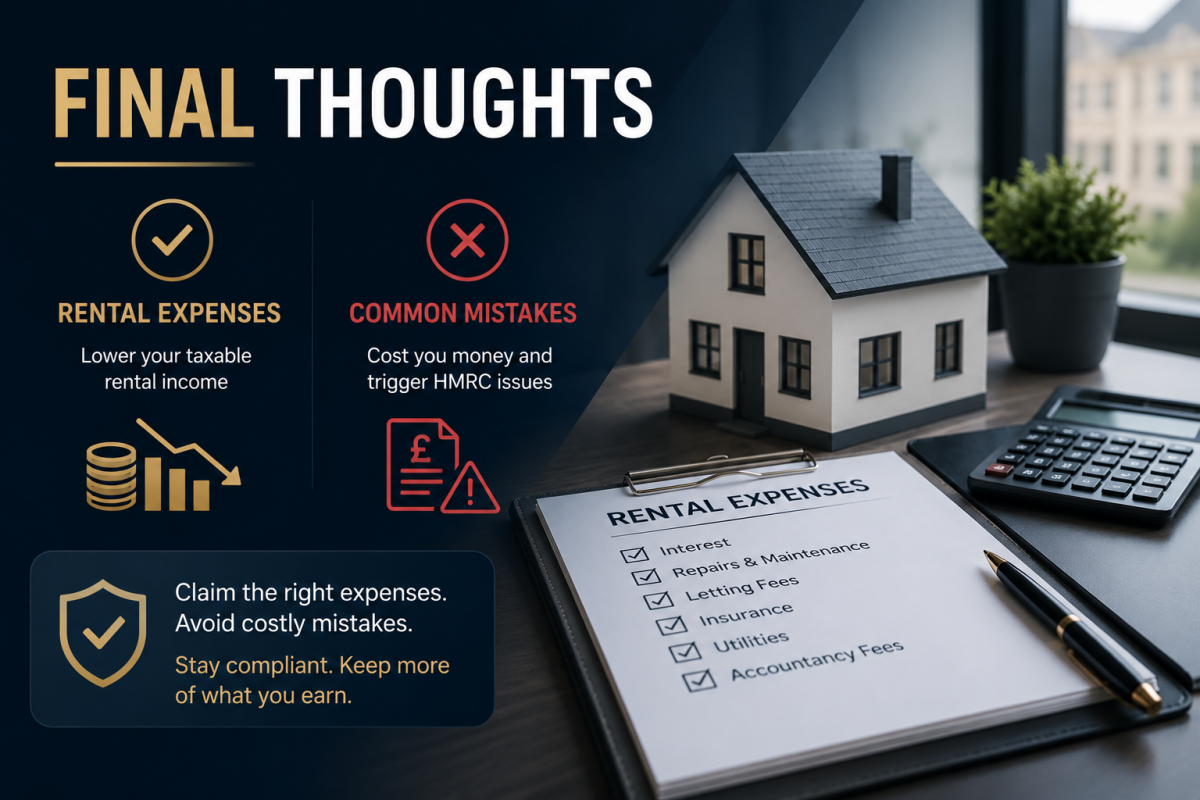
Managing your Rental Expense claims correctly is one of the simplest ways to improve the profitability of your property investment while remaining fully compliant with HMRC rules.
Many landlords unknowingly lose thousands of pounds over the years by missing allowable expenses, incorrectly claiming capital improvements, or failing to maintain proper records. At the same time, incorrect claims can trigger unnecessary HMRC enquiries, penalties, and additional tax liabilities.
Taking a proactive approach—keeping organised records, reviewing expenses regularly, and understanding the distinction between allowable and non-allowable costs—can make a significant difference to your annual tax position. Even seemingly minor Rental Expense mistakes can accumulate over time, especially for landlords with multiple properties.
If you’re unsure whether a particular cost qualifies or want confidence that your tax return is accurate, seeking professional advice before submission can help you maximise legitimate tax relief while avoiding costly errors. Getting your Rental Expense claims right today could save you both money and stress for years to come.
Need help deciding what’s best for your situation?
📞 Call 0161 710 1901
📧 Email Tax@TaxesDoneRight.co.uk
Visit www.taxesdoneright.co.uk