The 60-day CGT reporting rule for UK property sales: common mistakes (Capital Gains)
November 9, 2026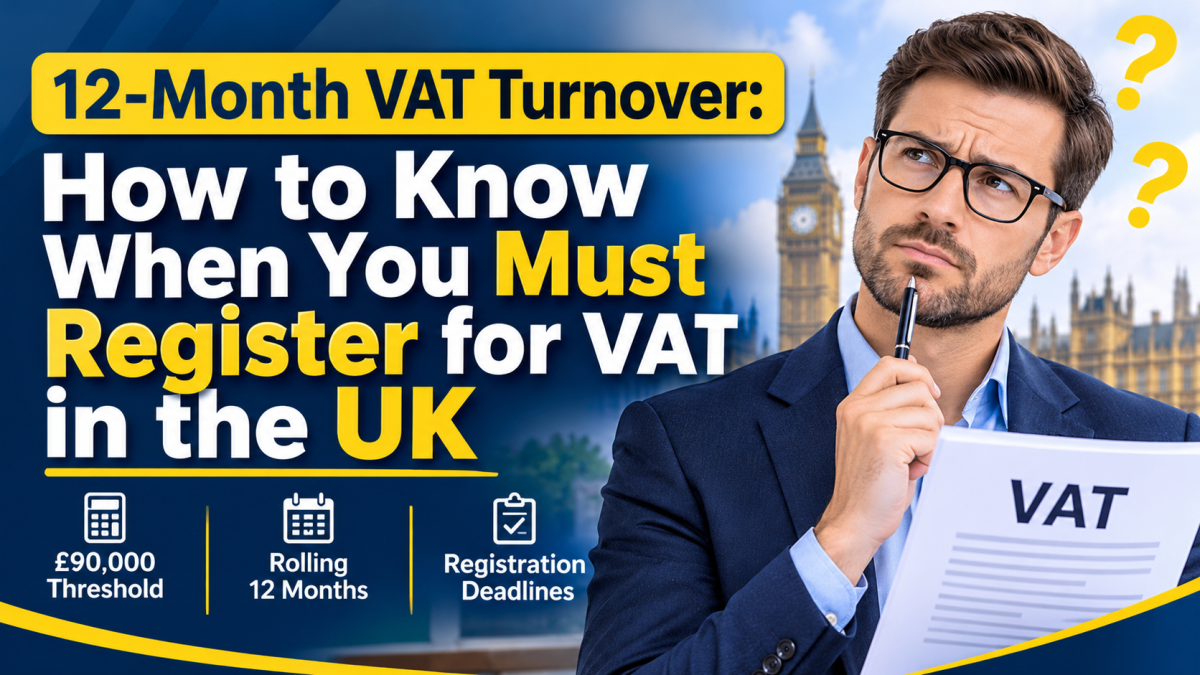
12-Month VAT Turnover: How to Know When You Must Register for VAT in the UK
For many UK business owners, VAT registration can be confusing, particularly when turnover fluctuates throughout the year. One of the biggest misunderstandings is assuming that VAT registration only becomes compulsory when annual sales exceed a certain amount within a financial or tax year.
In reality, HMRC uses a rolling 12-month calculation, meaning your VAT position can change every month, regardless of your accounting year-end.
Understanding 12-month VAT turnover is essential for sole traders, limited companies, freelancers, contractors and growing businesses. Failing to monitor taxable turnover correctly could result in unexpected VAT liabilities, backdated payments and potential HMRC penalties.
The good news is that VAT compliance becomes much easier when you understand what counts towards the threshold, how the calculation works and when registration becomes mandatory.
This guide explains the UK VAT registration rules, provides practical examples and highlights common mistakes businesses should avoid.
1. What Is the Rolling 12-Month VAT Turnover Rule?
The rolling 12-month VAT turnover rule determines whether a UK business must register for Value Added Tax.
Unlike Corporation Tax or Self Assessment, where reporting normally follows specified accounting periods, VAT registration requires businesses to monitor their taxable turnover over the previous 12 months.
Under the current rules, the compulsory VAT registration threshold is £90,000.
This means that if your taxable turnover exceeds £90,000 during any consecutive 12-month period, you will generally become liable to register for VAT.
For example, imagine your company has an accounting year ending on 31 March. Your accountant prepares annual accounts based on transactions between April and March.
However, HMRC does not simply look at those annual accounts when determining whether VAT registration is required.
Instead, the business must assess its turnover at the end of every month, looking backwards over the preceding 12 months.
You can review the official HMRC VAT registration guidance for the applicable requirements.
Key point: The VAT threshold applies to rolling taxable turnover, not just turnover in your accounting year.
2. What Is the Current UK VAT Registration Threshold?
As of November 2026, the UK compulsory VAT registration threshold remains £90,000.
Businesses must generally register when either:
- Their taxable turnover exceeds £90,000 over the previous 12 months.
- They expect taxable turnover to exceed £90,000 within the next 30 days alone.
These are two separate tests, and either can trigger compulsory registration.
The registration threshold increased from £85,000 to £90,000 on 1 April 2024.
It is important to understand that the threshold concerns taxable turnover rather than business profit.
For example, a company generating £95,000 in taxable sales with £70,000 of expenses may make only £25,000 in profit. Nevertheless, the turnover figure would normally trigger VAT registration.
Similarly, a self-employed consultant with minimal operating expenses could become VAT-registered despite having significantly lower costs.
Businesses approaching the threshold should therefore monitor sales carefully rather than relying on profitability calculations.
3. How Does the Rolling 12-Month Calculation Work?
The calculation involves adding together the value of taxable supplies made during the previous 12 months.
At the end of each calendar month, remove the oldest month’s turnover and add the newest month’s turnover.
Consider the following example.
| Month | Taxable Turnover |
|---|---|
| January | £6,000 |
| February | £6,500 |
| March | £7,000 |
| April | £6,800 |
| May | £7,200 |
| June | £7,500 |
| July | £7,800 |
| August | £8,000 |
| September | £8,200 |
| October | £8,500 |
| November | £8,800 |
| December | £9,000 |
| Total | £91,300 |
By 31 December, the business has generated £91,300 in taxable turnover over the preceding 12 months.
Because this exceeds £90,000, compulsory VAT registration is normally required.
If December is the first month when the threshold has been exceeded, the business must notify HMRC by 30 January.
Its effective VAT registration date will ordinarily be 1 February.
Notice that the business did not need to wait until its financial year ended.
This distinction is particularly important for businesses experiencing rapid growth or seasonal increases in sales.
Use our simple Rolling VAT Turnover Tracker for Small Businesses
4. What Counts Towards VAT Taxable Turnover?
Not every amount entering your business bank account necessarily counts towards the VAT registration threshold.
HMRC generally includes supplies that are taxable at the standard, reduced or zero rate.
Examples include:
- Standard-rated sales, generally subject to 20% VAT.
- Reduced-rated goods and services, generally subject to 5% VAT.
- Zero-rated sales, where VAT is charged at 0%.
- Certain business goods supplied through exchanges or barter transactions.
- Relevant services subject to reverse-charge VAT rules.
- Certain other supplies specifically included under VAT legislation.
A crucial point is that zero-rated sales count towards the registration threshold, even though no VAT is ultimately charged on those particular supplies.
For example, a business selling exclusively zero-rated products may still exceed the threshold and become liable to register.
Conversely, genuinely VAT-exempt supplies are generally excluded.
HMRC’s detailed VAT Notice 700/1 explains which supplies count.
Correctly categorising business income is therefore essential before calculating taxable turnover.
5. What Income Does Not Normally Count?
Some receipts do not form part of taxable turnover when assessing VAT registration.
Common examples include:
VAT-exempt income: Certain insurance, financial, healthcare and educational supplies may qualify for exemption, depending on the circumstances.
Residential rental income: Rent from ordinary residential lettings is generally VAT-exempt and does not normally contribute towards the threshold.
Non-business receipts: Genuine loans, capital introduced by owners and certain grants may fall outside the scope of VAT.
Sales of capital assets: Disposals of business capital assets, such as equipment or vehicles, are generally disregarded for registration-threshold purposes. However, important exceptions apply to certain taxable land transactions.
Businesses should avoid assuming that every receipt classified as income in their accounting software must be included.
Equally, they should not automatically exclude overseas sales, property transactions or unusual receipts without considering their VAT treatment.
Incorrect classification could substantially distort the calculation and result in missed registration deadlines.
Where taxable and exempt activities are combined, professional advice may be particularly valuable.
6. When Exactly Must You Register for VAT?
When a business exceeds the £90,000 threshold under the rolling 12-month test, specific notification deadlines apply.
You must normally notify HMRC within 30 days after the end of the month in which the threshold was exceeded.
The effective date of VAT registration is generally the first day of the second month following that month.
For example:
| Event | Date |
|---|---|
| VAT threshold first exceeded | 20 August 2026 |
| End of relevant month | 31 August 2026 |
| Registration notification deadline | 30 September 2026 |
| Effective registration date | 1 October 2026 |
This means the business generally begins accounting for VAT from 1 October, even if HMRC processes the application later.
Business owners should distinguish between the registration application deadline and the effective registration date.
They are not necessarily the same.
An incorrect effective date could lead to VAT being calculated for the wrong accounting period, creating unnecessary complications.
7. What If You Expect to Exceed £90,000 in the Next 30 Days?
There is another compulsory registration test that businesses frequently overlook.
If you expect your taxable supplies to exceed £90,000 during the next 30 days alone, you must normally register even if your historical turnover is significantly below the threshold.
Consider a construction business that secures a £110,000 taxable contract.
On 10 November, the owner reasonably expects the work to be supplied within the following 30 days.
The forward-looking registration test may apply immediately, rather than waiting for the next monthly turnover calculation.
In this situation, the effective registration date is generally the date the expectation arose.
The business must notify HMRC within the applicable 30-day period.
This rule is especially relevant to contractors, property developers, consultants and businesses receiving unusually large orders.
Importantly, the test concerns taxable supplies expected within the next 30 days, not simply the total value of a contract to be performed over several months.
8. Does VAT Registration Apply to Sole Traders and Limited Companies?
Yes. The VAT registration threshold generally applies across different business structures.
Whether you operate as a sole trader, partnership, limited liability partnership or limited company, taxable turnover must be monitored.
However, the calculation normally applies to the taxable person or legal entity carrying on the business.
For example, a limited company generating £95,000 in taxable sales would generally need to register, even if its director personally earns very little.
Similarly, a sole trader operating two activities under the same legal identity will usually need to consider the combined taxable turnover.
A business owner providing consultancy services and operating an additional online shop cannot necessarily assess each activity separately.
Special attention is also required where connected businesses are split between different entities.
HMRC can challenge artificial business separation arrangements intended to avoid VAT registration.
Therefore, creating additional companies solely to remain beneath the threshold is not a reliable compliance strategy.
9. Does VAT Turnover Include Unpaid Invoices?
Many business owners assume turnover only arises when customers pay their invoices.
However, VAT registration calculations are not automatically based on money received into the bank account.
The timing generally follows the VAT supply and tax-point rules applicable to the transaction.
For example, work completed for a customer may count towards taxable turnover even if payment will not arrive until several weeks later.
An unpaid invoice should therefore not automatically be excluded.
Equally, invoice dates alone are not always sufficient to determine when turnover arose before registration.
The nature of the supply, completion date, advance payments and relevant VAT rules may affect the calculation.
This is particularly important for consultants, construction companies and businesses offering customers extended payment terms.
Regular bookkeeping should capture the value and timing of taxable supplies rather than merely tracking incoming bank transfers.
If your business has significant unpaid invoices, review the underlying transactions before deciding whether the registration threshold has been reached.
10. What Happens If Turnover Temporarily Exceeds £90,000?
Some businesses experience exceptional periods of trading.
For example, a retailer might receive a substantial one-off order that temporarily pushes its rolling taxable turnover above £90,000.
HMRC recognises that registration may not always be appropriate where the increase is genuinely temporary.
In certain circumstances, businesses can apply for an exception from VAT registration.
To qualify, the business must demonstrate that its taxable turnover is expected to remain below the deregistration threshold, currently £88,000, over the following 12 months.
This is not automatic.
The business must apply to HMRC and provide appropriate evidence supporting its forecast.
Potential evidence might include cancelled contracts, reduced orders or proof that exceptional sales will not recur.
HMRC’s registration exception guidance explains the application process.
Businesses should not simply ignore their registration obligation because they expect turnover to decrease.
A formal decision from HMRC is important.
11. How Should Seasonal Businesses Monitor Turnover?
Seasonal businesses face particular challenges because their sales may vary considerably throughout the year.
Examples include holiday accommodation providers, garden centres, tourism operators and Christmas retailers.
A business might generate £15,000 monthly during peak trading months but considerably less during quieter periods.
The rolling calculation captures these fluctuations.
Consequently, a business could exceed the VAT threshold even though its current monthly sales have already started declining.
For example, a retailer may experience substantial sales between October and December, pushing its previous 12-month turnover beyond £90,000.
The following January might be relatively quiet, but that does not automatically remove the requirement to register.
The correct approach is to maintain a monthly record of taxable turnover and review the cumulative rolling total.
Seasonal businesses should also prepare cash-flow forecasts before expected peak trading periods.
This allows time to consider pricing, VAT liabilities and potential registration requirements.
12. What Happens If You Register for VAT Late?
Late VAT registration can become expensive.
If HMRC determines that your business should have registered earlier, you may need to account for VAT from the correct effective registration date.
This can create serious financial difficulties, particularly where customers have already paid invoices without an additional VAT charge.
For example, a business selling services directly to consumers may discover that VAT should have been accounted for several months earlier.
Depending on the contractual pricing arrangements, the business may effectively have to fund the VAT liability from the amounts already received.
HMRC may also charge penalties and interest where applicable.
Under the relevant late VAT registration penalty rules, penalties can depend on the VAT due and how late the notification was made.
Businesses discovering a historical registration failure should establish the correct registration date, reconstruct affected transactions and address the position promptly.
Ignoring the problem can increase both financial exposure and administrative difficulties.
13. Should You Register Voluntarily Before Reaching £90,000?
Businesses do not always need to wait until compulsory registration becomes necessary.
Voluntary VAT registration can be beneficial in certain circumstances.
For example, a business supplying services predominantly to VAT-registered commercial clients may find registration relatively straightforward.
Its customers may be able to recover the VAT charged, subject to normal recovery rules.
Meanwhile, the business may be able to reclaim eligible VAT incurred on its own purchases.
Voluntary registration may therefore be attractive where substantial equipment, software or other taxable business expenses are involved.
However, it is not always advantageous.
Businesses selling primarily to private individuals could become less price-competitive if VAT increases the amount customers pay.
Alternatively, maintaining existing customer prices may reduce profit margins.
Registration also introduces additional record-keeping, invoicing and reporting responsibilities.
Business owners should evaluate customer profiles, expected sales, input VAT recovery and administration costs before deciding.
14. What Changes After VAT Registration?
Once registered, your business must comply with additional VAT requirements.
These normally include issuing appropriate VAT invoices, maintaining accurate records, calculating VAT on taxable supplies and submitting VAT returns.
For most businesses, the standard VAT rate is 20%, although reduced and zero rates apply to qualifying supplies.
VAT registration also creates opportunities to reclaim input VAT on eligible business purchases.
However, the amount recoverable depends on the nature of the expenditure and whether it relates to taxable business activities.
Most VAT-registered businesses must comply with Making Tax Digital for VAT, requiring digital records and compatible software for submitting returns.
You can find further information in HMRC’s VAT record-keeping requirements.
Businesses should also review whether their existing accounting systems are suitable.
Accurate VAT codes, correctly configured invoices and regular reconciliations can make ongoing compliance significantly easier.
15. Can You Reclaim VAT on Purchases Made Before Registration?
A potential advantage of VAT registration is the ability to recover eligible VAT incurred before the effective registration date.
Generally, HMRC allows recovery for qualifying goods purchased within the previous four years, provided the relevant conditions are satisfied.
These may include goods still held by the business at registration or goods used to produce items still held.
For qualifying services, the normal pre-registration period is six months.
For example, a newly registered business may have purchased eligible equipment or received qualifying professional services before registration.
Some of the VAT incurred could potentially be reclaimed.
However, recovery is not automatic.
The expenditure must meet the applicable conditions, relate to the registered business and be supported by appropriate evidence.
Exempt activities, private use and other restrictions may reduce or prevent recovery.
Businesses should review historic purchases carefully instead of assuming every earlier expense qualifies.
16. How Can Accounting Software Help Monitor VAT Turnover?
Modern accounting software can substantially reduce the risk of missing the registration threshold.
Platforms such as FreeAgent, Xero and other bookkeeping systems can help businesses monitor sales, categorise transactions and review financial performance.
However, software reports remain dependent on the accuracy of the underlying records.
Incorrect VAT classifications, missing sales or inconsistent transaction dates can produce misleading turnover figures.
Business owners should therefore implement a reliable monthly process.
This should involve reviewing taxable supplies, reconciling sales records and calculating the latest rolling 12-month total.
Businesses approaching £90,000 should increase monitoring frequency, particularly where substantial contracts are expected.
Some accounting systems provide turnover alerts or reporting features that can support this process.
Nevertheless, an automated notification should not replace a proper review of VAT liability.
Complex transactions, mixed supplies and unusual income streams may still require professional judgement.
17. Common Mistakes Businesses Make With VAT Registration
Several recurring mistakes cause unnecessary VAT problems.
Mistake 1: Using the financial year instead of rolling turnover. Businesses review annual accounts but fail to examine consecutive 12-month periods.
Mistake 2: Confusing profit with taxable turnover. Registration depends on qualifying sales, not earnings after expenses.
Mistake 3: Excluding zero-rated sales. These normally count towards the registration threshold.
Mistake 4: Ignoring unpaid customer invoices. Payment dates do not automatically determine when taxable turnover arises.
Mistake 5: Overlooking the forward-looking test. Large contracts can trigger registration before historical turnover exceeds £90,000.
Mistake 6: Assuming a temporary increase requires no action. An exception must be properly requested from HMRC.
Mistake 7: Waiting for HMRC to issue a VAT number. Registration liability can arise before the application is processed.
Avoiding these errors starts with accurate records and regular monitoring.
18. What If Your Turnover Falls Below the VAT Threshold?
Once registered, businesses cannot automatically cancel their VAT registration simply because sales decrease.
The VAT deregistration threshold is currently £88,000.
A business may generally apply for voluntary deregistration where it can demonstrate that expected taxable turnover over the next 12 months will be below the applicable threshold.
Other conditions may also need consideration.
For example, a business that has permanently stopped making taxable supplies may be required to cancel its registration.
Deregistration can have consequences, including potential VAT adjustments relating to certain assets held at the cancellation date.
It may also affect pricing, input VAT recovery and commercial relationships.
Therefore, businesses should assess the overall financial impact before applying.
The relevant HMRC deregistration guidance explains when registration can or must be cancelled.
19. Practical VAT Monitoring Checklist for UK Businesses
A straightforward monitoring routine can help prevent unexpected registration liabilities.
At the end of every month, businesses should:
- Review all taxable sales and relevant supplies.
- Identify exempt and genuinely out-of-scope transactions.
- Calculate taxable turnover for the preceding 12 months.
- Compare the resulting figure against £90,000.
- Review expected taxable supplies during the next 30 days.
- Record calculations and supporting evidence.
- Seek professional advice when turnover approaches the threshold.
For example, a business with rolling taxable turnover of £82,000 should not necessarily wait until registration becomes compulsory before taking action.
If sales continue increasing, it may be sensible to review customer pricing, invoicing arrangements and expected VAT payments in advance.
Proactive planning can avoid last-minute administrative pressure.
20. Frequently Asked Questions
Is the VAT threshold £90,000 or £85,000?
The current compulsory UK VAT registration threshold is £90,000. The previous £85,000 threshold applied before 1 April 2024.
Does the VAT threshold reset every April?
No. The calculation uses a rolling 12-month period rather than resetting at the beginning of the tax year.
Does £90,000 exactly trigger VAT registration?
Under the standard historical turnover test, taxable turnover must exceed £90,000. Reaching exactly £90,000 does not, by itself, exceed the threshold.
Do residential landlords need VAT registration?
Ordinary residential rental income is generally exempt. However, other taxable business activities and different types of property supplies may affect the position.
Can I charge VAT before receiving my VAT number?
You must account for VAT from the effective registration date, but you should not issue invoices separately showing VAT until you receive your VAT registration number.
Do overseas businesses have the same threshold?
Not necessarily. Certain businesses established outside the UK must register when making taxable UK supplies regardless of the normal £90,000 threshold.
Final Thoughts: Stay Ahead of Your VAT Registration Obligations
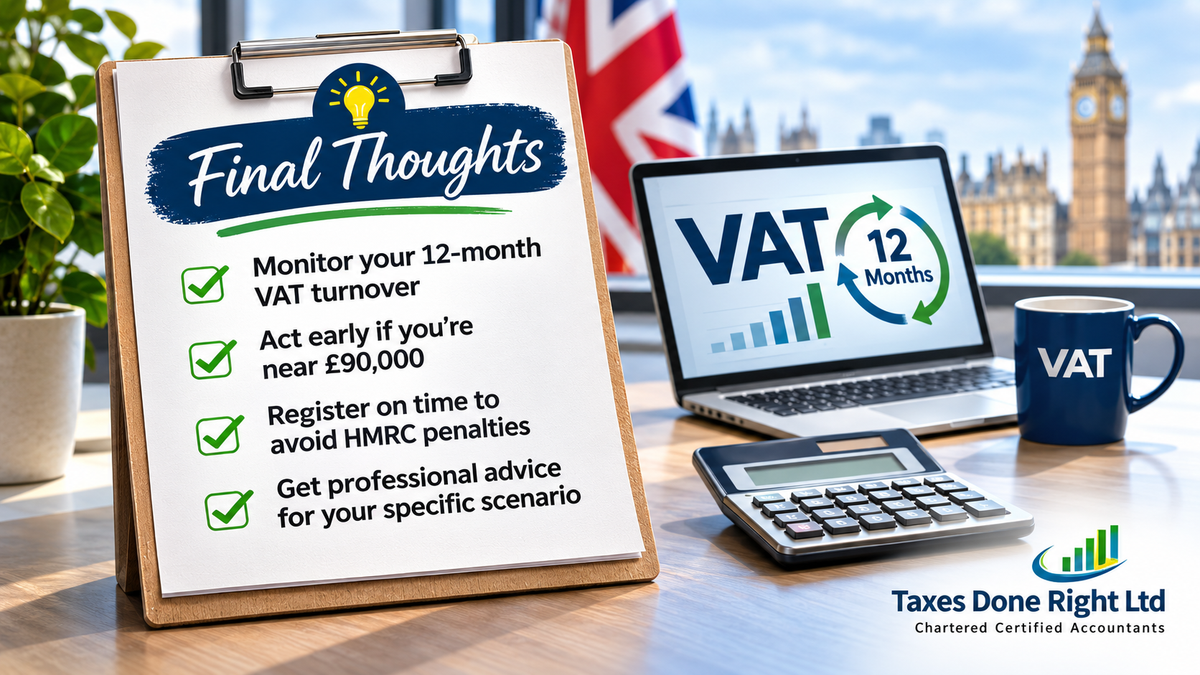
Understanding rolling VAT turnover is an important part of managing a growing UK business.
The key lesson is that VAT registration is not determined solely by annual accounts, taxable profit or the amount deposited into your bank account.
Instead, businesses must consider taxable supplies over the previous 12 months and assess whether significant sales are expected within the next 30 days.
Regular monitoring, accurate bookkeeping and timely professional advice can help prevent unexpected VAT liabilities.
At Taxes Done Right Ltd, we help UK businesses with VAT registration, turnover monitoring, VAT returns and ongoing compliance.
Whether you are approaching the £90,000 threshold, considering voluntary registration or concerned about a missed deadline, professional advice can help you understand your obligations and make informed decisions.
Need help with VAT registration or compliance?
📞 Call: 0161 710 1901
📧 Email: Tax@TaxesDoneRight.co.uk
Visit: www.taxesdoneright.co.uk
Get professional support to ensure your business expenses are recorded correctly and your tax position is managed efficiently.