
Trivial benefits: small gifts for employees and directors
November 6, 2026
12-Month VAT Turnover: How to Know When You Must Register for VAT in the UK
November 10, 2026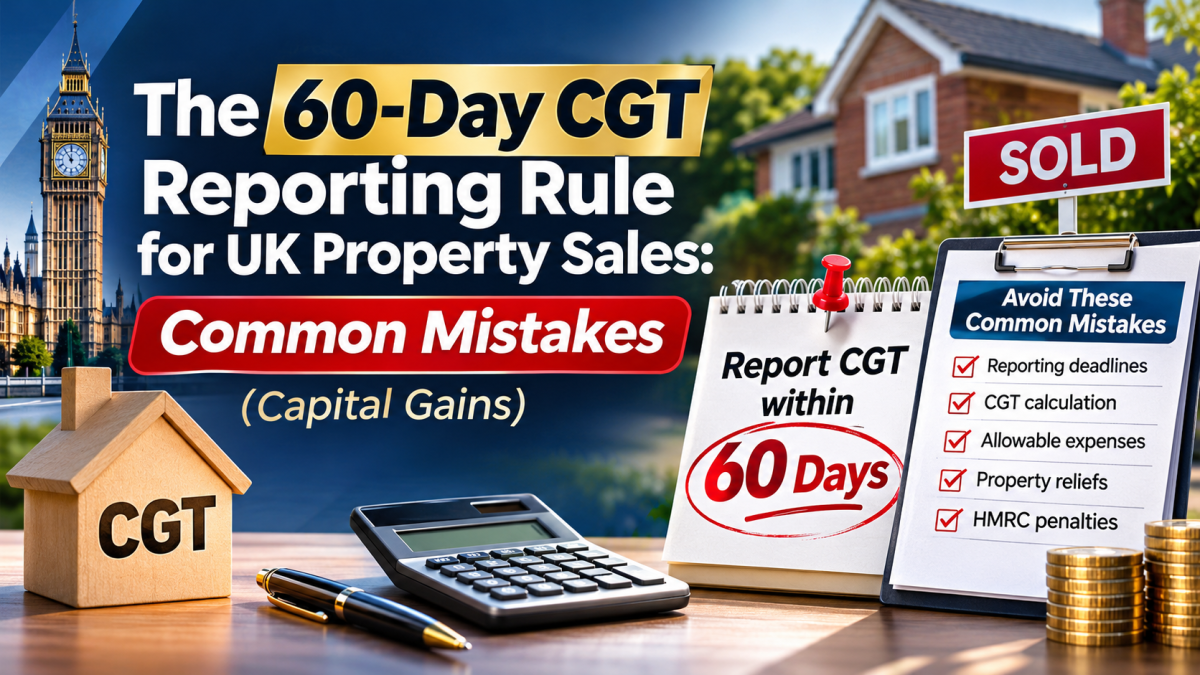
The 60-day CGT reporting rule for UK property sales: common mistakes (Capital Gains)
Selling a property in the UK can be a significant financial milestone. Whether you are disposing of a buy-to-let investment, selling a second home or transferring a property to another person, understanding your Capital Gains Tax (CGT) obligations is essential.
One of the most important requirements is the 60-day CGT reporting rule, which can catch property owners by surprise.
Unlike many other taxes, where reporting takes place months after the tax year ends, Capital Gains Tax on UK residential property may need to be reported and paid shortly after completion.
Missing this deadline could result in penalties, interest charges and unnecessary correspondence with HM Revenue & Customs (HMRC).
The rules can become particularly complicated where a property has been jointly owned, previously occupied as a main residence, inherited or transferred between connected parties.
Even experienced landlords occasionally misunderstand their reporting obligations.
In this guide, Taxes Done Right explains how the 60-day CGT reporting rule works, identifies 12 common mistakes and provides practical guidance to help property owners meet their obligations while claiming available tax reliefs.
What Is the 60-Day CGT Reporting Rule?
The 60-day CGT reporting rule requires individuals who make a reportable taxable gain when disposing of UK residential property to report the disposal and pay the estimated Capital Gains Tax within 60 calendar days of completion.
The current 60-day deadline applies to relevant property completions on or after 27 October 2021. Earlier disposals between 6 April 2020 and 26 October 2021 generally had a 30-day deadline.
The requirement commonly affects:
- Buy-to-let property sales.
- Second homes and holiday properties.
- Former main residences subsequently rented out.
- Residential investment properties.
- Certain gifts and transfers of residential property.
- Properties sold by trustees or personal representatives.
UK residents generally need to submit a property return where CGT is payable on the relevant residential disposal.
However, non-UK residents face wider reporting requirements and normally must report disposals of UK land or property even when no CGT is payable.
The reporting process is completed through HMRC’s Capital Gains Tax on UK property service.
Understanding whether the rules apply before selling is crucial because the reporting deadline can arrive surprisingly quickly.
Mistake 1: Assuming Capital Gains Tax Can Wait Until Self Assessment
One of the most frequent mistakes is assuming that a property disposal can simply be included in the next annual Self Assessment tax return.
Historically, taxpayers were accustomed to declaring property gains after the tax year ended.
However, the 60-day CGT reporting rule creates a separate and earlier reporting requirement.
For example, consider a landlord who completes the sale of a rental property on 1 October 2026.
Assuming CGT is payable, the landlord generally has until 30 November 2026 to report the transaction and pay the estimated liability.
Waiting until the Self Assessment filing deadline of 31 January 2028 would be far too late.
Furthermore, where the taxpayer is already required to submit a Self Assessment return, the disposal will normally also need to be reflected in that return.
This does not mean CGT must be paid twice. Tax already paid through the property reporting service is accounted for when calculating the final liability.
How to avoid this mistake: Inform your accountant as soon as you exchange contracts, rather than waiting until your annual tax return is prepared.
Mistake 2: Confusing Exchange of Contracts With Completion
Property transactions involve several important dates, and confusing them can lead to incorrect reporting.
For most straightforward unconditional property sales, the exchange of contracts determines the tax year in which the capital gain arises.
However, the 60-day CGT reporting rule generally calculates the reporting deadline from completion.
Mistake 3: Believing Every Property Sale Automatically Requires a Return
Not every UK residential property disposal triggers a 60-day return for a UK-resident individual.
Generally, where there is no CGT payable on the disposal after relevant exemptions, losses and reliefs, a UK property return is not required.
For example, someone selling their only or main residence may qualify for full Private Residence Relief, resulting in no taxable gain.
Likewise, a small gain may be entirely covered by the annual CGT exemption.
However, this does not necessarily remove other reporting obligations, including those arising through Self Assessment.
The position is different for non-UK residents, who generally must report disposals of UK property even where there is no gain or tax liability.
A property transferred without receiving money can also create CGT consequences.
How to avoid this mistake: Complete a CGT assessment before deciding that no report is necessary. Do not assume that no cash profit automatically means no reporting obligation.
Mistake 4: Calculating Capital Gains Tax on the Entire Selling Price
Another significant misunderstanding concerns how Capital Gains Tax is calculated.
CGT is generally charged on the taxable gain, not the property’s full selling price.
The starting calculation is:
Capital gain = Disposal proceeds − Acquisition cost − Allowable costs
Suppose a landlord sells an investment property for £300,000.
The property was originally purchased for £190,000, with qualifying acquisition, improvement and disposal costs totalling £20,000.
The calculation would be:
| Description | Amount |
|---|---|
| Selling price | £300,000 |
| Original purchase price | (£190,000) |
| Allowable costs | (£20,000) |
| Capital gain | £90,000 |
| Annual exemption (2026/27) | (£3,000) |
| Taxable gain | £87,000 |
Assuming no other gains, losses or reliefs apply, and the entire taxable gain falls within the 24% CGT band, the liability would be £20,880.
The actual tax payable depends on the individual’s taxable income and circumstances.
How to avoid this mistake: Prepare a complete calculation rather than applying a CGT percentage directly to the property sale proceeds.
Mistake 5: Claiming Incorrect Property Expenses
Allowable expenditure can substantially reduce a capital gain, but not every property-related expense qualifies.
Generally, eligible costs may include:
- Stamp Duty Land Tax paid when purchasing.
- Qualifying solicitor and conveyancing fees.
- Estate agent fees associated with selling.
- Certain survey and valuation costs.
- Qualifying capital improvements, such as an extension.
- Certain expenditure incurred to establish or protect title.
However, routine repairs and maintenance normally do not qualify as capital improvements.
For instance, repainting rooms or replacing damaged items on a like-for-like basis will generally be treated differently from constructing a new extension.
Mortgage interest and mortgage repayments are not normally deductible when calculating the capital gain.
Care is also needed to avoid claiming expenditure already deducted against rental income.
The distinction between repairs and improvements can be complex, particularly where a property has undergone major refurbishment.
How to avoid this mistake: Maintain invoices, contracts and supporting evidence. Review expenditure against HMRC’s guidance on allowable property costs before claiming deductions.
Mistake 6: Overlooking Private Residence Relief
Many landlords previously lived in their investment property before renting it out.
This can create an opportunity to claim Private Residence Relief (PRR), potentially reducing the taxable gain significantly.
Where the conditions are satisfied, relief generally applies to periods when the property was occupied as the owner’s only or main residence.
For qualifying disposals, the final nine months of ownership are normally also eligible for relief, even if the owner was not living there during that period.
Certain qualifying absences may also count as periods of residence.
Consider a homeowner who owns a property for ten years, occupying it as their main residence for six years before renting it out for four years.
Subject to the relevant conditions, PRR could cover the six years of qualifying occupation plus the final nine months.
However, calculations must avoid double-counting periods, and the precise dates are important.
The remaining gain may still be taxable.
HMRC’s Private Residence Relief guidance explains how the exemption works.
How to avoid this mistake: Prepare a detailed occupation history, including dates of residence, letting and qualifying absences.
Mistake 7: Assuming Letting Relief Always Applies
Letting Relief was historically valuable for property owners who rented out their former homes.
However, the rules were significantly restricted from 6 April 2020.
For most current disposals, Letting Relief is available only where the owner shared occupancy of the property with a tenant.
Landlords who moved out completely and subsequently let their entire former home generally cannot claim the relief simply because the property was once their main residence.
Where the conditions are satisfied, the maximum relief is normally the lowest of:
- £40,000.
- The amount of Private Residence Relief.
- The gain attributable to the qualifying letting.
For example, a homeowner who shared their property with a tenant may qualify, depending on the occupation arrangements.
By contrast, someone who moved into another property and rented out their entire original home would not normally qualify.
Claiming relief incorrectly could result in underpaid tax and HMRC enquiries.
How to avoid this mistake: Check whether genuine shared occupancy existed during the relevant letting period before applying Letting Relief.
Mistake 8: Using the Wrong Capital Gains Tax Rate
Another common mistake is assuming that every property gain attracts the same CGT rate.
For the 2026/27 tax year, the standard individual CGT rates are:
| Taxpayer position | CGT rate |
|---|---|
| Gain falling within available basic-rate band | 18% |
| Gain exceeding available basic-rate band | 24% |
The applicable rate depends on the taxpayer’s taxable income and the amount of gain.
A basic-rate taxpayer may therefore pay CGT at both 18% and 24% if the gain uses up their remaining basic-rate band.
A higher-rate taxpayer will generally pay 24% on their taxable residential property gain.
The annual exempt amount for individuals in 2026/27 is £3,000, subject to eligibility.
Using an incorrect rate can lead to an underpayment or unnecessary overpayment.
Importantly, the property return may require a reasonable estimate of annual taxable income where the final figure is not yet known.
How to avoid this mistake: Consider salary, rental profits, pension income and other taxable income when calculating the appropriate rates. Check the current CGT rates and allowances.
Mistake 9: Forgetting That Joint Owners Have Separate Obligations
Where a property is jointly owned, each individual is generally responsible for calculating and reporting their own share of the capital gain.
For example, a married couple owns an investment property equally and sells it, generating a total gain of £100,000 before personal exemptions.
Assuming equal beneficial ownership, each spouse would generally have a £50,000 gain.
Each may then apply their own available CGT annual exemption, qualifying losses and relevant reliefs.
Their respective CGT rates could differ depending on their individual incomes.
A common mistake is submitting a single return covering the entire gain under one spouse’s name.
Another is assuming that legal ownership automatically reflects the correct taxable beneficial ownership in every situation.
Transfers between spouses or civil partners can also involve special CGT rules.
How to avoid this mistake: Confirm beneficial ownership and prepare an individual CGT calculation for each owner before submitting the required returns.
Mistake 10: Ignoring Non-Resident Reporting Requirements
Non-UK residents face particularly strict property reporting rules.
A non-resident disposing of UK property or land generally needs to submit a return within 60 days of completion, even where:
- The property makes a loss.
- No CGT is payable.
- An exemption applies.
- The property is commercial rather than residential.
Non-resident calculations may also involve different valuation and rebasing rules.
For instance, certain residential properties owned before 6 April 2015 may qualify for a rebased calculation using their value at 5 April 2015.
Different provisions can apply to non-residential property and indirect disposals.
An individual living abroad should not assume that being outside the UK removes their UK Capital Gains Tax obligations.
The applicable tax residence position must also be established carefully.
How to avoid this mistake: Review HMRC’s non-resident Capital Gains Tax reporting requirements before selling UK property while living overseas.
Mistake 11: Missing the Deadline and Ignoring HMRC Penalties
Failing to submit a required return within the deadline can result in financial consequences.
Depending on the circumstances and applicable rules, late filing penalties can include an initial £100 penalty, with additional penalties arising where a return remains outstanding.
Late payment interest may also apply where CGT is not paid by the relevant deadline.
Further penalties can arise for prolonged delays or particular compliance failures.
Importantly, receiving no reminder from HMRC does not remove the taxpayer’s responsibility.
HMRC announced changes in October 2026 concerning ongoing late filing penalties where a disposal has subsequently been reported through Self Assessment. These changes do not abolish the original 60-day reporting requirement.
Taxpayers who have missed the deadline should address the position promptly rather than waiting for HMRC to contact them.
There may be grounds to appeal certain penalties where a reasonable excuse exists, but successful appeals depend on the facts.
How to avoid this mistake: Set a deadline reminder immediately upon completion and ensure the return and payment are dealt with separately.
Mistake 12: Failing to Update Incorrect CGT Calculations
The property reporting deadline may fall before the taxpayer knows their final income for the tax year.
Consequently, an initial CGT calculation can involve reasonable estimates.
A taxpayer may subsequently discover that their actual income differs from the original estimate, changing the applicable CGT liability.
Other circumstances may also require corrections, including:
- Previously overlooked allowable expenditure.
- Incorrect purchase or disposal values.
- Changes affecting available reliefs.
- Mistakes in ownership percentages.
- Errors in the original tax calculation.
HMRC allows property returns to be viewed and, where permitted, amended through the CGT reporting service.
However, restrictions and alternative procedures may apply once Self Assessment returns have been submitted.
Leaving an incorrect return uncorrected can create unnecessary tax complications.
How to avoid this mistake: Review the original property return when preparing the annual Self Assessment return and correct discrepancies using the appropriate HMRC procedure.
How to Report Capital Gains Tax Within 60 Days
Understanding the reporting process can make compliance considerably easier.
Step 1: Gather the Property Documents
Collect the original purchase completion statement, selling completion statement, legal fees, estate agent invoices and evidence of qualifying improvements.
If the property was previously your home, prepare a history of occupation and letting periods.
Step 2: Calculate the Chargeable Gain
Determine the disposal proceeds, allowable acquisition expenditure and qualifying disposal costs.
Apply any relevant exemptions, reliefs and available capital losses.
Where the property is jointly owned, calculate each owner’s share separately.
Step 3: Estimate the CGT Liability
Determine the relevant tax year, annual exemption and applicable CGT rates.
Consider other gains and losses, as well as estimated taxable income for the year.
Step 4: Submit the Property Return
Use HMRC’s online UK property reporting service.
The taxpayer may authorise an accountant or tax adviser to manage the reporting process.
Check all figures, dates and ownership details carefully before submission.
Step 5: Pay HMRC Before the Deadline
Submitting the return is not the same as paying the tax.
Ensure the appropriate payment reference is used and sufficient funds are available.
Keep confirmation of submission and evidence of payment.
Practical Example: Selling a Buy-to-Let Property
Consider a landlord who sells a residential investment property during the 2026/27 tax year.
The property was never occupied as their main residence.
The figures are:
| Description | Amount |
|---|---|
| Sale proceeds | £375,000 |
| Original purchase price | £250,000 |
| Purchase and sale costs | £15,000 |
| Qualifying improvements | £10,000 |
| Chargeable gain before exemption | £100,000 |
| Annual CGT exemption | £3,000 |
| Taxable gain | £97,000 |
| CGT at 24% | £23,280 |
This example assumes the entire taxable gain falls within the 24% band, no capital losses are available and no additional relief applies.
The landlord would generally need to report the disposal and pay the estimated £23,280 within 60 days of completion.
If the landlord had occupied the property as their main residence previously, Private Residence Relief might reduce the liability.
Similarly, different ownership arrangements or income levels could change the tax calculation.
This demonstrates why professional calculations are preferable to relying solely on the difference between the purchase and selling prices.
How Property Owners Can Reduce CGT Mistakes
Successful CGT compliance begins before the property is sold.
Property investors should maintain organised records throughout ownership rather than attempting to reconstruct transactions years later.
Purchase statements, improvement invoices, legal documents and occupation histories should be retained wherever relevant.
When selling, consider obtaining an estimated CGT calculation before exchange of contracts.
This provides a clearer understanding of the likely tax bill and helps avoid spending sale proceeds required for HMRC.
Landlords should also review their wider financial circumstances, particularly where several properties or other investments are being disposed of in the same tax year.
The timing of transactions, availability of allowable losses and ownership structure may affect the eventual tax liability.
However, any planning must be commercially appropriate and considered before entering into binding arrangements.
A qualified accountant can identify potential issues, calculate qualifying reliefs and help ensure reporting deadlines are met.
Frequently Asked Questions
Does the 60-day rule apply when selling my main home?
Usually not where the entire gain qualifies for Private Residence Relief and no CGT is payable. However, partial letting, periods of non-occupation or other circumstances may create a taxable gain.
Can I deduct my outstanding mortgage from the capital gain?
No. The mortgage balance does not normally reduce the chargeable gain. CGT is calculated using the acquisition cost, disposal proceeds, allowable expenditure and relevant reliefs.
Do I still need Self Assessment after submitting a 60-day return?
If you are otherwise required to complete Self Assessment, the disposal will normally also need to be included. Any CGT already paid is taken into account.
What happens if I have no money left to pay CGT?
You should still submit any required return on time. Contact HMRC promptly if payment difficulties arise to discuss available arrangements. Interest and potential penalties should not be ignored.
Can my accountant submit the CGT return?
Yes. An appropriately authorised tax adviser can help calculate the gain and submit the return through HMRC’s agent reporting arrangements.
Final Thoughts
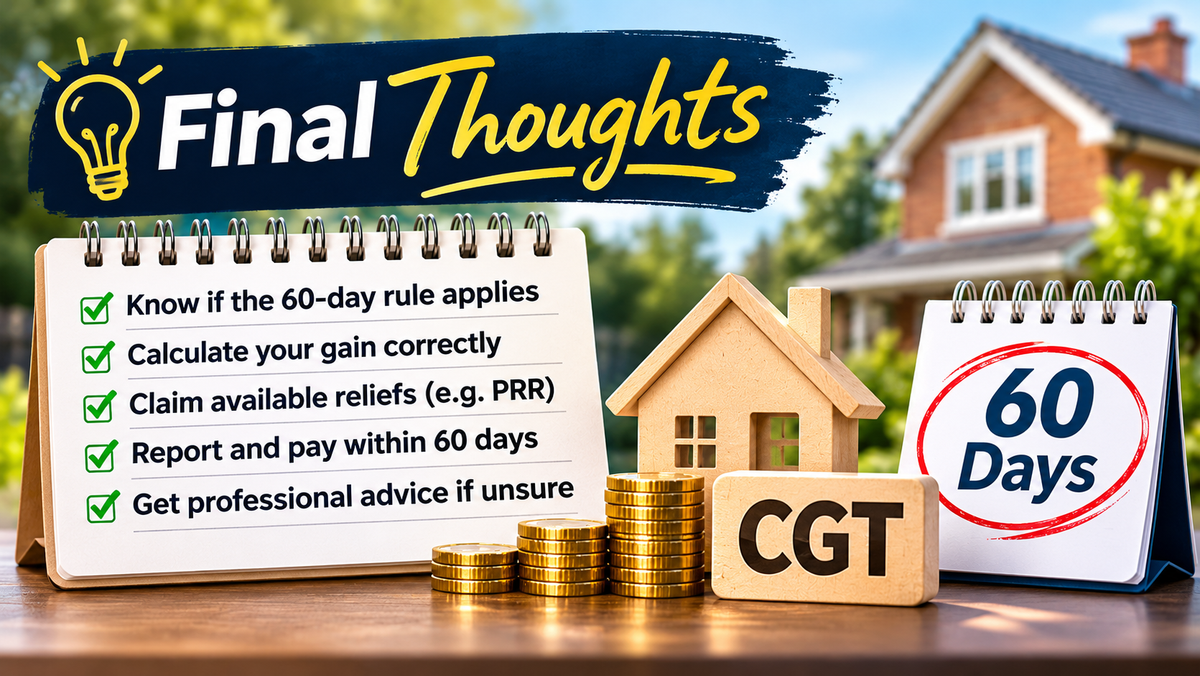
The 60-day CGT reporting rule is one of the most important compliance obligations affecting UK residential property sellers.
While the requirement may appear straightforward, errors involving completion dates, allowable expenses, Private Residence Relief, joint ownership and CGT rates can have significant financial consequences.
The safest approach is to establish the likely CGT liability before completion, retain the relevant documentation and arrange the return promptly.
Importantly, paying the correct amount of tax is only one part of compliance. Meeting the reporting deadline is equally essential.
At Taxes Done Right Ltd, we help landlords, property investors and homeowners calculate Capital Gains Tax, identify applicable reliefs and prepare UK property disposal returns.
Whether you are selling a buy-to-let property, disposing of a former main residence or dealing with more complex ownership arrangements, obtaining advice early can help prevent costly mistakes.
Need help with your 60-day Capital Gains Tax return?
📞 Call: 0161 710 1901
📧 Email: Tax@TaxesDoneRight.co.uk
Visit: www.taxesdoneright.co.uk
Get professional support to ensure your business expenses are recorded correctly and your tax position is managed efficiently.