Staff vs Client Entertaining: Tax Treatment Explained for UK Businesses
October 28, 2026
HMRC Scam Messages: Warning Signs to Watch For
October 30, 2026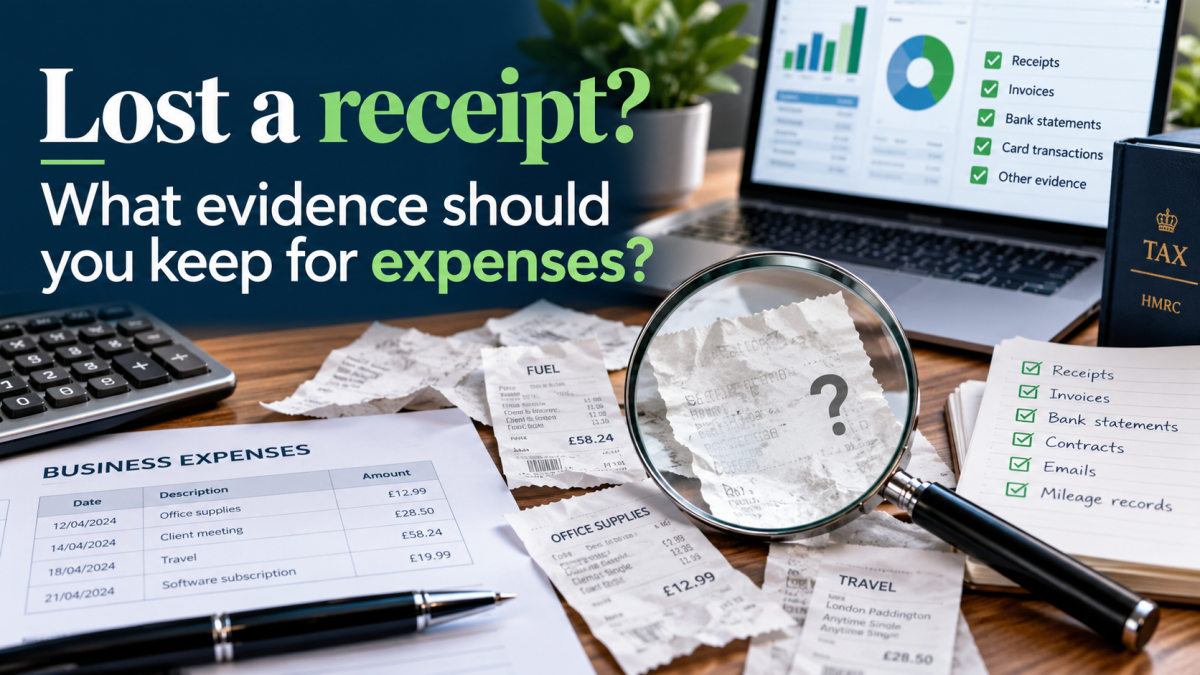
Lost receipt? What evidence should you keep for expenses?
Lost Recipt? Discover what evidence HMRC accepts when business receipts go missing and how to support your expense claims without the original paperwork.
Running a business involves countless transactions, from purchasing office supplies and paying contractors to covering travel costs and maintaining rental properties. Keeping receipts for every expense sounds straightforward, but in reality, paperwork can easily go missing.
Perhaps you paid for materials at a hardware store, misplaced a restaurant receipt after a business meeting, or accidentally deleted an email containing an important invoice.
Whatever the circumstances, discovering that a receipt is missing can raise an important question: Can you still claim the expense against your tax bill?
The reassuring news is that losing a receipt does not automatically mean losing your entitlement to tax relief. However, HM Revenue & Customs (HMRC) expects businesses to maintain reliable records and provide sufficient evidence supporting their claims.
Understanding what alternative evidence may be accepted, how to reconstruct missing records, and when additional documentation is necessary can help protect your business from unnecessary tax liabilities.
This guide explains what to do when receipts disappear, the evidence you should retain, and how to keep your accounting records compliant.
1. Can You Claim Business Expenses Without a Receipt?
One of the most common misconceptions among business owners is that every tax-deductible expense must have a physical receipt.
Although receipts are an important form of evidence, HMRC does not automatically reject every expense simply because its original receipt has been misplaced.
What matters is whether you can demonstrate that the expense genuinely occurred, establish its amount, and show that it qualifies for tax relief.
Under the general business expense rules, expenditure must normally be incurred wholly and exclusively for business purposes to qualify as a trading deduction.
For example, imagine a self-employed electrician purchases £180 of equipment required for a customer installation.
The electrician pays using a business debit card but loses the shop receipt.
The transaction appears on the business bank statement, and supporting evidence includes a supplier order confirmation and details of the installation.
Taken together, these documents may provide sufficient evidence to substantiate the expense.
However, a bank transaction alone does not necessarily prove that a purchase was business-related.
HMRC may ask for additional information explaining what was purchased and why the expenditure was necessary for the business.
According to HMRC’s guidance on keeping business records, businesses should retain evidence including receipts, bank statements and other documentation supporting their transactions.
The important distinction is between proving that money was spent and establishing that the expenditure qualifies for tax relief.
2. What Evidence Can Replace a Lost Receipt?
When an original receipt cannot be located, several alternative records may help support your expense claim.
The strength of the evidence depends on the circumstances and whether the documents collectively establish the nature, amount, date and business purpose of the transaction.
Bank and Credit Card Statements
Bank statements are often the first place to look when reconstructing missing expenses.
They normally identify the payment date, transaction value and merchant or recipient.
For example, a bank statement showing a £95 payment to an office equipment supplier establishes that money was paid.
However, it may not identify the specific items purchased.
Therefore, combining a bank statement with an order confirmation or other supporting documentation offers stronger evidence.
Email Confirmations
Many suppliers automatically send purchase confirmations by email.
These records may identify the products purchased, purchase date, delivery address and total expenditure.
Searching your email account using the supplier’s name or payment amount can often recover information that would otherwise be lost.
Duplicate Invoices
Businesses can request replacement invoices from their suppliers.
Many retailers and service providers maintain transaction histories and can issue duplicate documentation.
This is particularly useful for larger purchases, professional services, equipment and subcontractor payments.
Online Account Histories
Online shopping platforms frequently retain purchase histories.
Downloading invoices from supplier portals can provide detailed supporting documentation without needing the original paper receipt.
Contracts and Purchase Orders
Signed contracts, purchase orders and supplier agreements can help establish why expenditure occurred.
These documents become particularly valuable when accompanied by evidence of payment.
Delivery Notes
Delivery notes demonstrate that goods were supplied.
Although they do not always establish the amount paid, they can strengthen other evidence.
The objective should be to build a consistent, credible record rather than relying on one incomplete document.
3. Is a Bank Statement Enough for HMRC?
A bank statement can be valuable evidence, but it is not automatically sufficient for every expense.
Consider two transactions.
Example A: Monthly Software Subscription
A company pays £35 each month for accounting software.
The bank statement identifies the software provider, and the company can demonstrate that the subscription relates to its accounting activities.
Even if an individual receipt disappears, the recurring payment history and subscription agreement provide useful evidence.
Example B: Supermarket Purchase
A business owner spends £120 at a supermarket using a company debit card.
Without an itemised receipt, HMRC cannot readily determine whether the purchase involved business supplies, staff refreshments or personal groceries.
A bank statement confirms the expenditure but does not establish its business purpose.
This demonstrates why the type of transaction matters.
Where a supplier sells both business and personal products, additional evidence becomes particularly important.
Business owners should record a brief explanation for transactions that could otherwise appear ambiguous.
For example:
“Office cleaning supplies purchased for business premises.”
A note of this nature, supported by genuine transaction records, can help explain the expense during an enquiry.
However, retrospective notes should be accurate and must never be used to disguise private spending as business expenditure.
4. What Should You Do Immediately After Losing a Receipt?
Discovering a missing receipt does not require immediate removal of the transaction from your accounts.
Instead, follow a structured approach to reconstruct the supporting evidence.
Step 1: Identify the Transaction
Review your bank statements, credit card records or bookkeeping software.
Confirm the amount paid, supplier name and approximate transaction date.
Step 2: Contact the Supplier
Ask whether the supplier can provide a duplicate invoice or purchase confirmation.
For online purchases, check your account before contacting customer support.
Step 3: Search Existing Records
Look through emails, messages, digital folders and accounting attachments.
Invoices are sometimes stored automatically by payment providers or bookkeeping applications.
Step 4: Record the Business Purpose
Prepare a factual note explaining what was purchased and how it related to your business activities.
Where relevant, include a customer reference, project name or property address.
Step 5: Save the Supporting Evidence
Attach the available documents to the relevant transaction within your accounting software.
Keep the records together so they can be retrieved if HMRC requests further information.
Step 6: Ask Your Accountant
If the amount is substantial, the business purpose is unclear, or VAT recovery is involved, obtain professional advice before finalising the claim.
Following these steps promptly can significantly improve the reliability of reconstructed records.
5. Lost Receipts and VAT: Why the Rules Are Different
VAT-registered businesses must be particularly careful when supporting purchase transactions.
There is an important difference between deducting an allowable business expense for Income Tax or Corporation Tax purposes and reclaiming input VAT.
For VAT recovery, businesses generally need to hold a valid VAT invoice or other evidence specifically permitted under the VAT rules.
A bank statement showing that £120 was paid to a supplier does not automatically establish that £20 of recoverable VAT was charged.
The supplier might not be VAT registered, or the purchase could include zero-rated, exempt or non-business items.
HMRC may exceptionally accept alternative evidence where a VAT invoice has been lost, destroyed or cannot reasonably be obtained.
However, this is discretionary rather than an automatic entitlement.
HMRC’s alternative evidence guidance for input VAT confirms that such treatment is considered only in exceptional circumstances.
Example: Missing VAT Invoice
A VAT-registered consultancy purchases computer equipment costing £600, including £100 VAT.
The invoice disappears, but the company retains the bank payment record and an order confirmation.
The business should request a replacement VAT invoice from the supplier.
It should not assume that the £100 VAT can automatically be reclaimed simply because the payment appears on its bank statement.
This distinction is especially important for businesses preparing quarterly VAT returns.
Where sufficient VAT evidence cannot be obtained, the underlying business expense may still be allowable while the VAT recovery position requires separate consideration.
6. What About Cash Purchases Without Receipts?
Cash transactions can present additional record-keeping challenges because they may not generate a clear bank payment trail.
Small businesses frequently make cash purchases for parking, minor materials or everyday supplies.
If a receipt is missing, the business should document as much information as possible.
Useful details include:
- Date of purchase.
- Amount spent.
- Supplier or location.
- Description of the goods or services.
- Reason for the business expenditure.
- Any additional supporting evidence.
For example, a decorator might pay £15 cash for materials required to complete a customer project.
If the receipt is lost, the decorator could record the purchase in the petty cash book and connect it to the relevant job.
Any supplier confirmation or other independent documentation would strengthen the record.
However, creating an internal expense note does not guarantee that HMRC will accept the claim.
Cash expenditure without independent evidence can be more difficult to substantiate, particularly where amounts are substantial or repeated regularly.
Businesses should therefore avoid treating cash payments as exempt from normal record-keeping requirements.
7. Which Business Expenses Need Particularly Strong Evidence?
Although every business expense should be supported appropriately, certain categories warrant additional attention.
Travel and Mileage
Business travel claims should include information showing where the journey started and ended, its purpose and the relevant dates.
When claiming mileage using an approved or applicable flat-rate method, recording qualifying business mileage is essential.
Fuel receipts alone generally cannot establish the number of qualifying business miles travelled.
Drivers should maintain a mileage log or reliable digital record.
Meals and Subsistence
A meal purchased during qualifying business travel may receive different tax treatment from an ordinary personal lunch.
Evidence should establish the business journey and circumstances, not merely the restaurant payment.
Professional Subscriptions
Membership invoices, renewal confirmations and evidence of professional relevance can support subscription claims.
However, not every membership fee qualifies for tax relief.
Repairs and Maintenance
Landlords and property businesses should retain contractor invoices, descriptions of work and supporting correspondence.
The distinction between repairs and capital improvements can affect the applicable tax treatment.
Equipment and Assets
Purchases of computers, machinery and other equipment may require consideration under capital allowance rules.
Supporting records should establish acquisition cost, date, ownership and business use.
Keeping evidence of these details can be important long after the original purchase.
8. How Long Must You Keep Expense Records?
The required retention period depends on the type of business and applicable tax rules.
| Business or tax category | General record-keeping period |
|---|---|
| Self-employed individuals | At least five years after the relevant 31 January Self Assessment filing deadline |
| Limited companies | Generally six years from the end of the relevant company financial year for tax purposes |
| VAT-registered businesses | Generally six years, subject to exceptions |
| Other individual Self Assessment taxpayers | Normally at least 22 months after the tax year, where returns are submitted on time |
These periods represent general requirements, and certain circumstances require records to be retained longer.
For example, documents relating to capital assets may remain important when those assets are eventually disposed of.
Similarly, ongoing HMRC enquiries, late returns and transactions spanning several accounting periods can affect retention requirements.
Limited companies should follow the HMRC guidance on company accounting records, which explains the relevant obligations.
A practical approach is to maintain a secure digital archive organised by financial year.
Doing so reduces the likelihood of missing evidence when older transactions are reviewed.
9. Can Digital Receipts Replace Paper Receipts?
Yes. Digital records can generally provide acceptable evidence, provided they are accurate, readable, accessible and retained appropriately.
For many businesses, digital record-keeping is considerably more practical than storing large quantities of paper receipts.
A clear photograph or scan can preserve the information on a receipt that might otherwise fade or become damaged.
Businesses can also store supplier invoices received electronically without printing unnecessary copies.
The key consideration is whether the digital records preserve the relevant information and can be produced when required.
For VAT-registered businesses, additional requirements apply to record-keeping and Making Tax Digital.
HMRC’s VAT record-keeping guidance explains which information must be retained and recorded digitally.
Popular accounting platforms such as FreeAgent and Xero can help businesses attach supporting documentation directly to transactions.
This creates a useful connection between the accounting entry and the evidence behind it.
However, using accounting software does not automatically make every expense claim valid.
Business owners must still check that transactions are correctly categorised, supported and treated for tax purposes.
Digital systems improve organisation, but accurate bookkeeping remains essential.
10. What Happens if HMRC Questions an Expense?
HMRC can review expense claims during a compliance check or tax enquiry.
Where questions arise, the business may be asked to provide supporting records and explain the purpose of particular transactions.
An inspector could examine bank statements, invoices, contracts, correspondence and accounting records.
Missing receipts do not necessarily result in automatic disallowance.
Instead, HMRC considers the available evidence and the circumstances surrounding the expenditure.
Its guidance on establishing business purpose recognises that a range of documents and other relevant evidence may be considered.
Nevertheless, an unsupported claim can be challenged.
If HMRC concludes that expenditure does not qualify, the tax calculation may need to be amended.
Additional tax, interest and potentially penalties could arise depending on the circumstances.
This is why consistency matters.
A business that records transactions promptly, separates private spending and maintains supporting documentation will generally be better prepared to explain its tax position.
Where records have genuinely been lost, explaining the circumstances and demonstrating reasonable attempts to recover them can also be important.
Never create fabricated receipts or alter documents to support a tax deduction.
Accurate reconstruction is acceptable; manufacturing evidence is not.
11. What if Several Months of Receipts Are Missing?
Losing one receipt is inconvenient. Losing an entire folder or several months of financial records presents a more significant challenge.
However, businesses should still attempt to reconstruct the information using available evidence.
Start by downloading bank and credit card statements for the affected period.
Next, contact major suppliers and retrieve purchase histories from online platforms.
Review accounting software, payment processors, email accounts and existing digital backups.
Where relevant, customer records and project documentation may also help establish expenditure.
If records cannot be fully restored, HMRC provides guidance about using provisional or estimated figures in appropriate circumstances.
A provisional figure is temporary because the business expects to obtain the actual information later.
An estimated figure represents a reasonable calculation where the actual information cannot be recovered.
These approaches should not be confused with inventing expenses or making unsupported deductions.
HMRC explains the relevant reporting requirements in its guidance on lost or destroyed tax records.
Businesses should also distinguish between missing supporting paperwork and uncertainty over the transaction amount itself.
If the exact payment is known from bank records, there may be no need to estimate that amount.
The remaining issue could simply be establishing whether the expenditure qualifies for tax relief.
12. Common Mistakes That Could Put Expense Claims at Risk
Even well-organised businesses can make errors when dealing with incomplete documentation.
One frequent mistake is assuming that every payment made from a business bank account qualifies automatically as a business expense.
A company debit card can still be used for personal purchases, which may require different accounting treatment.
Another mistake is reclaiming VAT without sufficient evidence that recoverable VAT was actually charged.
Business owners also sometimes record an expense twice after locating a replacement invoice.
For example, a purchase may initially be entered from the bank statement and subsequently recorded again when the supplier sends a duplicate invoice.
This could overstate expenses and distort taxable profits.
Other common problems include misclassifying capital expenditure, claiming private travel, recording unsupported cash transactions and failing to document mixed-use costs.
Avoiding these errors requires more than simply collecting receipts.
Businesses should reconcile accounts regularly and review whether the underlying transactions have been classified correctly.
Where expenditure contains both business and private elements, the allowable proportion must be determined under the relevant tax rules.
An expense should never be claimed in full merely because the original receipt is unavailable.
13. Practical Ways to Prevent Missing Receipts
Prevention is usually easier than reconstructing financial records after they disappear.
A consistent bookkeeping routine can reduce administration and improve confidence in your tax calculations.
Consider adopting the following practices:
Capture receipts immediately: Photograph paper receipts as soon as purchases are made.
Use dedicated business accounts: Separating business and personal transactions makes expenditure easier to identify.
Save electronic invoices: Create a dedicated folder for supplier invoices and purchase confirmations.
Attach documents to transactions: Link each invoice or receipt to its corresponding accounting entry.
Review bookkeeping monthly: Investigate transactions with missing documentation while the details remain fresh.
Maintain reliable backups: Ensure important accounting information remains accessible if equipment fails or an account becomes unavailable.
Record unusual transactions: Add explanatory notes for expenses that might otherwise appear personal or unclear.
Request VAT invoices promptly: Do not leave missing VAT evidence unresolved until a return deadline approaches.
These habits are particularly beneficial for growing businesses processing hundreds of transactions every month.
Reliable record-keeping also provides benefits beyond tax compliance.
It improves expense monitoring, cash-flow visibility and the accuracy of financial reports.
14. How an Accountant Can Help With Missing Expense Evidence
An experienced accountant can help determine whether an expense is likely to qualify for tax relief and whether the available evidence is sufficient.
This becomes especially valuable when dealing with complicated transactions, missing VAT invoices or expenditure involving personal and business use.
An accountant may also identify transactions that have been duplicated, incorrectly categorised or omitted from the accounts.
For limited companies, reviewing director-paid expenses and reimbursements can help prevent incorrect postings to the director’s loan account.
For landlords, professional advice can help distinguish allowable property running costs from expenditure requiring capital treatment.
Self-employed individuals may benefit from reviewing alternative expense methods where these are permitted.
The aim should be to claim every legitimate deduction while maintaining records capable of supporting the calculation.
At Taxes Done Right Ltd, we help sole traders, landlords and limited companies maintain accurate financial records, review allowable expenses and meet their UK tax obligations.
15. Frequently Asked Questions
Can HMRC reject an expense without a receipt?
Yes. HMRC may challenge an expense if insufficient evidence exists to establish that it occurred or qualifies for tax relief. However, the absence of an original receipt does not automatically mean a claim must be rejected.
Can I claim an expense paid from my personal bank account?
Potentially, yes. A genuine business expense does not automatically become disallowable because it was paid personally. Correct accounting treatment and supporting evidence remain important, particularly for limited companies.
Can I reclaim VAT using only a bank statement?
Generally, no. A valid VAT invoice is normally required. HMRC may consider alternative evidence in exceptional circumstances, but acceptance is not guaranteed.
Are photographs of receipts acceptable?
Generally, yes, provided the records meet applicable requirements and the information remains complete, legible and accessible.
What if I cannot obtain a duplicate invoice?
Retain all available evidence, document your attempts to obtain a replacement and ask your accountant to assess whether the transaction can still be supported.
Final Thoughts
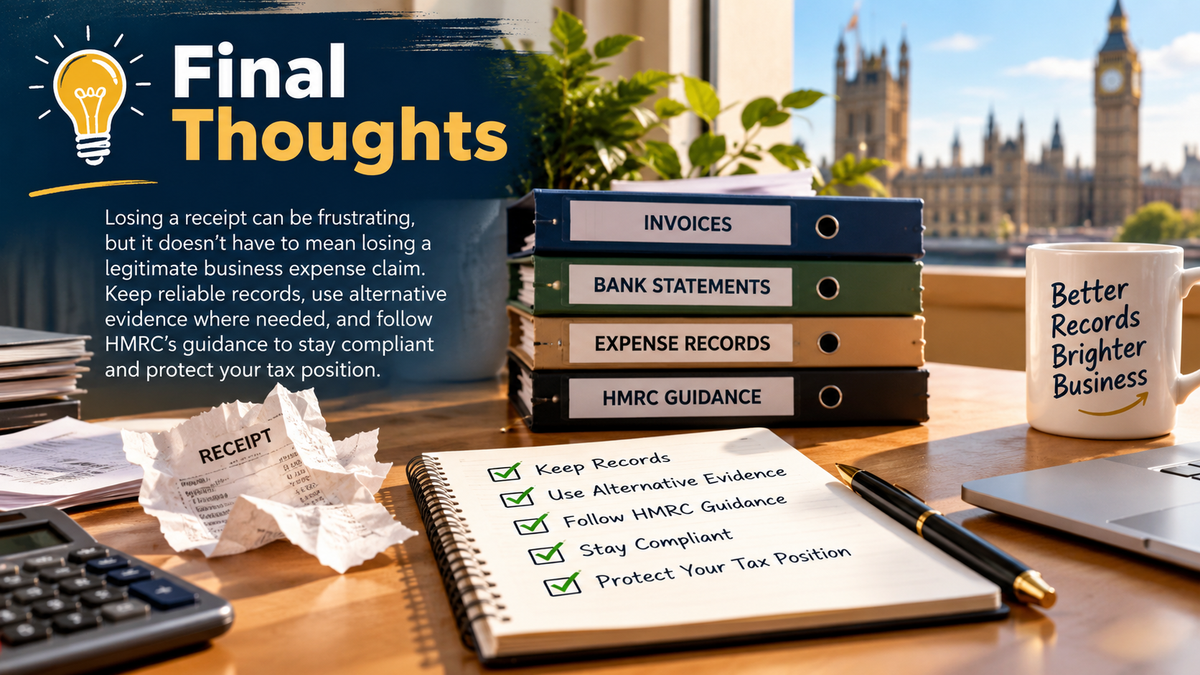
Losing a receipt can be frustrating, but it does not necessarily mean losing a legitimate business expense claim.
The important question is whether you can provide reliable evidence showing what was purchased, how much was paid and why the expenditure related to your business.
Bank statements, duplicate invoices, email confirmations, purchase histories and contemporaneous records can all help establish the facts.
However, VAT recovery has stricter documentary requirements, and businesses should never assume that alternative evidence will automatically be accepted.
Good bookkeeping remains the most effective way to protect legitimate tax deductions and avoid unnecessary disputes.
Need help reviewing business expenses or preparing accurate tax returns?
Taxes Done Right Ltd provides professional accounting, bookkeeping, VAT and tax services for sole traders, landlords and limited companies throughout the UK.
Contact Taxes Done Right Ltd
📞 Call: 0161 710 1901
📧 Email: Tax@TaxesDoneRight.co.uk
Visit: www.taxesdoneright.co.uk
Get professional support to ensure your business expenses are recorded correctly and your tax position is managed efficiently.