
Registered office services: what they cover and what to check
November 11, 2026
Selling a home that was partly used for business: Private Residence Relief explained
November 13, 2026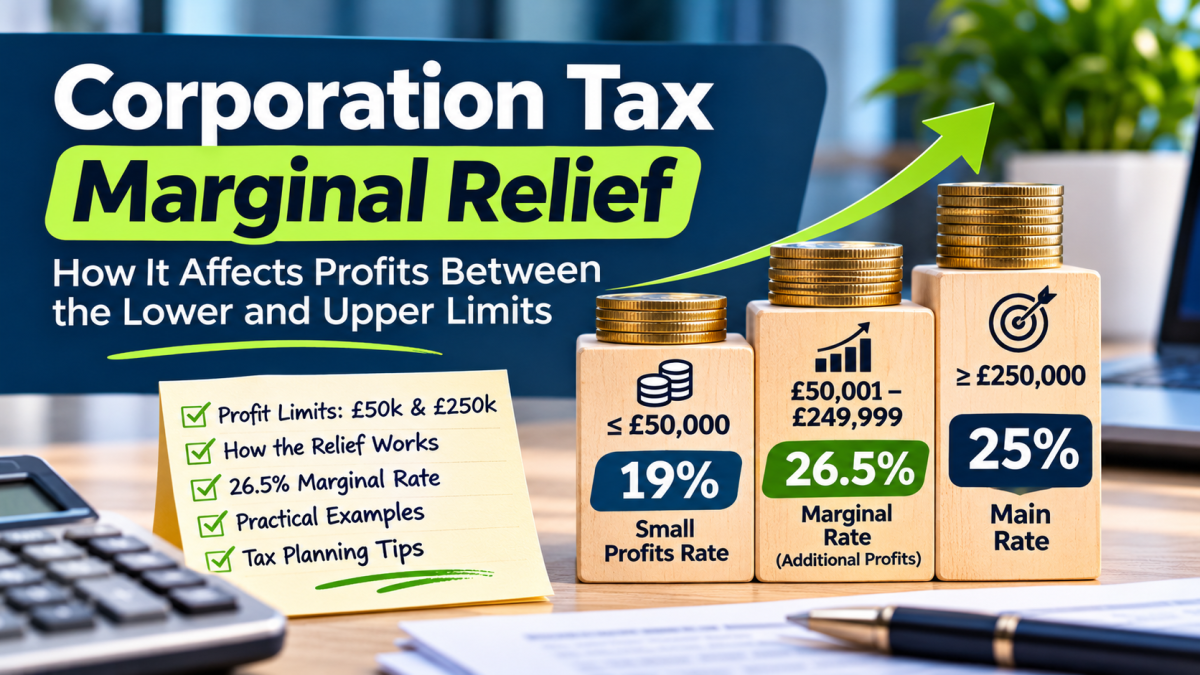
Corporation Tax marginal relief: how it affects profits between the lower and upper limits
Understanding Corporation Tax is essential for every UK limited company, particularly when profits begin to increase.
Want to see how marginal relief could affect your company’s tax bill? Use our Corporation Tax Calculator to estimate your Corporation Tax liability and plan ahead with greater confidence.
While many business owners are familiar with the headline Corporation Tax rates of 19% and 25%, fewer understand how tax is calculated when company profits fall between these thresholds.
This is where Corporation Tax marginal relief becomes particularly important.
Since 1 April 2023, the UK has operated a system that generally applies different Corporation Tax rates depending on a company’s taxable profits.
Companies with smaller profits may qualify for the 19% small profits rate, while companies with higher profits generally pay the 25% main rate.
However, businesses earning profits between £50,000 and £250,000 do not simply move from one rate to the other.
Instead, marginal relief provides a gradual transition between the two rates.
Although this sounds straightforward, the calculation can become complicated when businesses have associated companies, receive dividend income or operate for accounting periods shorter than twelve months.
One particularly surprising feature is that companies within the marginal relief band can face an effective marginal Corporation Tax rate of 26.5% on additional taxable profits.
For company directors, this makes understanding the rules an important part of financial planning.
In this guide, we explain how marginal relief works, provide practical calculations, highlight common mistakes and explore legitimate strategies for managing your company’s Corporation Tax liability.
1. What Is Corporation Tax Marginal Relief?
Corporation Tax marginal relief is a mechanism that reduces the Corporation Tax payable by qualifying companies whose augmented profits fall between the applicable lower and upper limits.
It was introduced under the current Corporation Tax rate structure from 1 April 2023.
The purpose is to prevent companies from experiencing an immediate increase from 19% to 25% on all their taxable profits simply because they exceed £50,000.
Instead, eligible businesses receive relief against tax initially calculated at the 25% main rate.
As profits increase towards the upper threshold, the amount of available relief gradually decreases.
Once augmented profits reach the upper limit, marginal relief is eliminated.
For a UK-resident trading company with no associated companies, a twelve-month accounting period and no relevant exempt distributions, the standard thresholds are:
| Taxable profits | Corporation Tax treatment |
|---|---|
| £50,000 or less | 19% small profits rate |
| £50,001–£249,999 | Marginal relief calculation |
| £250,000 or more | 25% main rate |
These thresholds have remained unchanged for financial year 2026, and the published rates maintain the same structure for the following financial years.
However, the thresholds can be reduced where a company has associated companies or a shorter accounting period.
You can find the relevant rules in the HMRC guidance on marginal relief.
Understanding these thresholds is the first step towards estimating your tax liability accurately.
2. Why Is the Marginal Corporation Tax Rate 26.5%?
One of the most misunderstood aspects of the Corporation Tax system is the 26.5% marginal rate.
Many directors assume that because the main Corporation Tax rate is 25%, their company cannot face a higher tax rate on additional profits.
However, this is not quite correct.
For a qualifying company within the marginal relief band, each additional £1 of taxable profit generally attracts Corporation Tax of 26.5p, assuming the standard thresholds apply and taxable profits equal augmented profits.
This occurs because the company pays additional Corporation Tax while simultaneously losing some of its marginal relief.
The resulting marginal rate is therefore higher than the headline main rate.
Understanding the difference between marginal and effective rates
The marginal rate is the rate of tax charged on the next pound of taxable profit.
The effective rate is the company’s total Corporation Tax divided by its total taxable profits.
These figures are not necessarily the same.
For example, a company earning £100,000 in taxable profits does not pay 26.5% on the entire £100,000.
Instead, its total liability is £22,750, representing an effective rate of 22.75%.
The 26.5% rate applies to the additional profits falling within the marginal relief band under the simplified assumptions.
How the standard marginal rate works
19%
Below lower limit
26.5%
Between limits
25%
Above upper limit
This distinction is particularly useful when considering additional contracts, business expenditure, investment decisions or changes to director remuneration.
It demonstrates why calculating Corporation Tax using only the headline rates can produce inaccurate results.
3. How Is Corporation Tax Marginal Relief Calculated?
HMRC uses a statutory formula to determine the amount of marginal relief available.
For ordinary non-ring-fence profits, the calculation is:
\[ \text{Marginal Relief}=F\times(U-A)\times\frac{N}{A} \]
Where:
- F = Standard marginal relief fraction, currently 3/200 or 1.5%.
- U = Applicable upper profit limit.
- A = Augmented profits.
- N = Taxable total profits.
Corporation Tax is initially calculated using the 25% main rate.
The marginal relief amount is then deducted to determine the final tax liability.
The distinction between taxable profits and augmented profits is particularly important.
In straightforward cases, both figures will be identical.
However, certain exempt distributions received by a company can increase augmented profits without increasing taxable total profits.
Where this happens, using a simplified 26.5% calculation may produce the wrong answer.
The statutory calculation is explained in HMRC’s Company Taxation Manual CTM03925.
Example: Company with £100,000 taxable profits
Assume a UK trading company has:
- Taxable total profits: £100,000
- Augmented profits: £100,000
- No associated companies
- Twelve-month accounting period
First, calculate Corporation Tax at 25%.
£100,000 × 25% = £25,000
Next, calculate marginal relief.
1.5% × (£250,000 − £100,000) = £2,250
Finally, subtract marginal relief from the initial Corporation Tax.
£25,000 − £2,250 = £22,750
CORPORATION TAX EXAMPLE
Taxable profits
£100,000
Final Corporation Tax
£22,750
Marginal relief
£2,250
Effective tax rate
22.75%
Without applying marginal relief, the company would have calculated £25,000 of tax.
The relief therefore reduces its liability by £2,250.
4. Corporation Tax Examples at Different Profit Levels
Comparing Corporation Tax across different profit levels helps illustrate how the effective rate increases.
The following figures assume a twelve-month accounting period, no associated companies, no relevant exempt distributions and ordinary taxable profits.
| Taxable profits | Corporation Tax | Effective rate |
|---|---|---|
| £30,000 | £5,700 | 19.00% |
| £50,000 | £9,500 | 19.00% |
| £75,000 | £16,125 | 21.50% |
| £100,000 | £22,750 | 22.75% |
| £150,000 | £36,000 | 24.00% |
| £200,000 | £49,250 | 24.63% |
| £250,000 | £62,500 | 25.00% |
| £300,000 | £75,000 | 25.00% |
5. How Associated Companies Affect Marginal Relief
Associated companies are one of the most important considerations in Corporation Tax calculations.
The standard £50,000 and £250,000 thresholds do not necessarily apply where a company is associated with other companies.
Broadly, companies may be associated where one controls another or both are under the control of the same person or persons.
Control involves more than simply comparing company names or identifying common directors.
Share ownership, voting rights and other relevant rights may need to be considered.
How the thresholds are divided
Where associated companies exist, the standard limits are divided by the total number of associated companies plus the company itself.
| Total companies counted | Lower limit | Upper limit |
|---|---|---|
| 1 | £50,000 | £250,000 |
| 2 | £25,000 | £125,000 |
| 3 | £16,666.67 | £83,333.33 |
| 4 | £12,500 | £62,500 |
| 5 | £10,000 | £50,000 |
For example, suppose an individual controls two active limited companies.
Company A earns £75,000 in taxable profits.
Company B earns £40,000.
Assuming the companies are associated under the relevant rules, each company’s lower and upper limits are reduced to £25,000 and £125,000.
Company A’s tax calculation becomes:
Corporation Tax at 25%: £18,750
Marginal relief: 1.5% × (£125,000 − £75,000) = £750
Final Corporation Tax: £18,000
Without the associated company adjustment, Company A’s liability would have been £16,125.
The difference is £1,875.
This demonstrates why associated company rules can significantly affect Corporation Tax costs.
What about dormant companies?
Certain dormant companies are excluded from the associated-company count, subject to the statutory conditions.
A company that exists on the Companies House register is therefore not automatically counted simply because it has the same shareholder.
However, dormant status for Companies House purposes does not necessarily establish whether a company meets the relevant Corporation Tax exclusion.
The facts must be reviewed carefully.
6. Do Property Investment Companies Qualify?
Property investment companies frequently encounter the marginal relief rules, particularly where landlords operate several property SPVs.
A company receiving rental income may qualify for the small profits rate or marginal relief, provided it satisfies the relevant statutory conditions.
However, there is an important distinction between an ordinary property investment company and a close investment-holding company.
Certain close investment-holding companies are excluded from the small profits rate and marginal relief.
Broadly, a company that mainly holds investments may fall within these restrictions unless an applicable exception is satisfied.
For example, companies carrying on qualifying activities involving the letting of land to unconnected persons may fall outside the close investment-holding company definition.
Consequently, not every property investment company automatically pays 25% Corporation Tax.
The company’s activities, ownership structure and relevant statutory exceptions must be considered.
Example: Property SPV earning £60,000
Assume a qualifying property company generates £60,000 of taxable profits, has no associated companies and meets the requirements for marginal relief.
Its Corporation Tax would be:
£60,000 × 25% = £15,000
Marginal relief:
1.5% × (£250,000 − £60,000) = £2,850
Final Corporation Tax:
£12,150
However, if the company has an associated company, the calculation may change significantly.
Landlords with multiple SPVs should therefore review associated company relationships and tax thresholds rather than assuming every company has a separate £50,000 small profits limit.
7. How Short Accounting Periods Change the Thresholds
Another frequently overlooked rule concerns accounting periods shorter than twelve months.
Corporation Tax profit thresholds must be proportionately reduced where the company’s accounting period is shorter than a year.
This can affect newly incorporated businesses, companies changing their accounting dates and businesses ceasing operations.
Example: Six-month accounting period
A company has a six-month Corporation Tax accounting period and no associated companies.
Its thresholds are reduced to:
Lower limit: £25,000
Upper limit: £125,000
Suppose the company earns £60,000 of taxable profits during those six months.
Corporation Tax before marginal relief:
£60,000 × 25% = £15,000
Marginal relief:
1.5% × (£125,000 − £60,000) = £975
Final Corporation Tax:
£14,025
Applying the full twelve-month thresholds would incorrectly produce a lower tax figure.
Businesses must therefore establish the correct Corporation Tax accounting period before calculating their liability.
This is particularly important during a company’s first financial year, when its statutory accounts and Corporation Tax periods may not align.
8. What Are Augmented Profits?
Marginal relief calculations do not always depend solely on taxable profits.
The legislation uses augmented profits to determine which Corporation Tax rate or relief applies.
Augmented profits generally include taxable total profits plus certain qualifying exempt distributions that are not excluded under the relevant rules.
For example, certain dividends received from companies outside the relevant group may increase augmented profits.
This can reduce marginal relief even where the dividend itself is exempt from Corporation Tax.
Example: Taxable profits plus dividend income
Assume a company has:
- Taxable profits: £80,000
- Relevant exempt dividends: £20,000
- Augmented profits: £100,000
- No associated companies
Corporation Tax is initially calculated on taxable profits of £80,000.
£80,000 × 25% = £20,000
However, marginal relief uses augmented profits of £100,000.
Marginal relief:
1.5% × (£250,000 − £100,000) × (£80,000 ÷ £100,000)
Marginal relief = £1,800
Final Corporation Tax = £18,200
If the company had incorrectly ignored the relevant dividends when calculating augmented profits, it would have overstated its relief.
The detailed rules are explained in HMRC’s definition of augmented profits.
Not every dividend is included. The nature of the distribution and relationship between the companies must be examined.
9. Tax Planning Strategies for Companies Within the Marginal Relief Band
Understanding the 26.5% marginal rate can help directors make more informed financial decisions.
However, tax planning should always reflect genuine commercial requirements.
Reducing taxable profits is not automatically beneficial if doing so requires unnecessary expenditure.
Make pension contributions
Employer pension contributions can be an effective way of managing taxable profits while providing retirement benefits for directors or employees.
Qualifying employer contributions may be deductible for Corporation Tax purposes, subject to the relevant rules.
For example, where a company is within the marginal relief band, an allowable £10,000 employer pension contribution could potentially reduce Corporation Tax by £2,650.
The actual saving depends on the company’s circumstances and whether the contribution is deductible in the relevant period.
Claim legitimate business expenses
Companies should ensure that all allowable expenditure is recorded correctly.
This may include professional fees, software subscriptions, insurance, business travel and qualifying operating costs.
Expenses must satisfy the relevant tax rules, and personal expenditure cannot simply be treated as a business deduction.
Review capital allowances
Investments in qualifying equipment or machinery may generate valuable tax deductions.
Depending on the asset and circumstances, the company may qualify for the Annual Investment Allowance, full expensing or other capital allowances.
The timing of eligible expenditure can affect taxable profits and marginal relief.
Review director remuneration
Director salary and dividend decisions should consider both company and personal tax implications.
A qualifying salary expense may reduce taxable company profits, whereas dividends do not reduce Corporation Tax.
However, salary payments may attract PAYE and National Insurance liabilities.
The most efficient arrangement therefore requires a combined assessment rather than focusing only on Corporation Tax.
Monitor associated companies
Business owners controlling several limited companies should assess whether those companies are associated.
This can be particularly important for property investors, entrepreneurs and family businesses.
Artificially restructuring companies solely to obtain tax advantages may introduce commercial, legal and tax risks.
Any restructuring should have genuine business justification and receive appropriate professional review.
Forecast profits throughout the year
Regular management accounts allow directors to estimate taxable profits before the financial year ends.
This provides time to assess pension contributions, investment plans, available reliefs and expected Corporation Tax payments.
Effective planning is generally easier before transactions occur than after the accounting period has closed.
10. Common Corporation Tax Marginal Relief Mistakes
Despite the availability of accounting software, companies can still make errors when applying marginal relief.
Mistake 1: Applying 19% to all profits below £250,000.
The 19% small profits rate generally applies only where augmented profits do not exceed the applicable lower limit.
Mistake 2: Applying 25% to all profits above £50,000 without considering relief.
Qualifying companies within the marginal relief band may receive a reduction against the main-rate liability.
Mistake 3: Ignoring associated companies.
This can result in the wrong thresholds being used and Corporation Tax being understated.
Mistake 4: Forgetting short accounting periods.
Thresholds are adjusted proportionately, so using annual limits for a shorter period can produce incorrect results.
Mistake 5: Confusing accounting profit with taxable profit.
The profit reported in company accounts may differ from taxable profits after adjustments and allowances.
Mistake 6: Overlooking relevant dividend income.
Certain exempt distributions may increase augmented profits and reduce marginal relief.
Mistake 7: Assuming all investment companies qualify.
Close investment-holding company restrictions can prevent access to the small profits rate and marginal relief.
Accurate calculations require the company’s complete tax position to be considered rather than simply entering accounting profit into a calculator.
11. How to Check Your Corporation Tax Marginal Relief
Business owners can use HMRC’s official calculation tools or appropriate Corporation Tax software to estimate marginal relief.
The calculation should be based on accurate information, including taxable profits, augmented profits, associated companies and accounting period dates.
Directors should also verify whether special rules apply to the company’s activities.
At Taxes Done Right Ltd, we provide a dedicated Corporation Tax consultancy and calculation support for UK businesses.
A professional review can be particularly valuable where a business owns multiple companies, receives investment income or has complicated tax adjustments.
It may also identify legitimate tax deductions and planning opportunities that could otherwise be missed.
Remember that Corporation Tax calculations should form part of the company’s wider financial planning.
A company may report healthy accounting profits while still facing cash-flow difficulties when its tax payment becomes due.
12. Corporation Tax Payment and Filing Deadlines
Marginal relief affects the amount of Corporation Tax payable, but it does not ordinarily change the company’s filing and payment deadlines.
For most smaller UK limited companies, Corporation Tax must be paid within nine months and one day after the end of the relevant accounting period.
The Company Tax Return is normally due within twelve months of the accounting period ending.
For example, a company with an accounting period ending on 31 March 2026 would ordinarily have:
- Corporation Tax payment deadline: 1 January 2027.
- Company Tax Return deadline: 31 March 2027.
Different payment arrangements can apply to companies falling within the large or very large company instalment payment regimes.
Companies should therefore calculate their estimated Corporation Tax before the payment deadline rather than waiting until their return is due.
Further details are available in the official Company Tax Return guidance.
13. Frequently Asked Questions
Is Corporation Tax marginal relief automatically applied?
Marginal relief is calculated through the company’s Corporation Tax computation. Appropriate tax software may calculate it, but the company remains responsible for ensuring the information submitted is accurate.
Is the Corporation Tax rate between £50,000 and £250,000 always 26.5%?
No. The 26.5% figure represents the marginal tax rate on additional qualifying profits under the standard simplified circumstances, not the effective rate on total profits.
Do dividends paid to shareholders reduce Corporation Tax?
No. Dividends paid to shareholders are distributions of post-tax profits and are not deductible business expenses for Corporation Tax purposes.
Can a property SPV claim marginal relief?
Potentially, yes. Eligibility depends on the company’s activities, classification, augmented profits and associated company position.
Does every limited company receive its own £50,000 lower limit?
No. The limits can be reduced where associated companies exist or where the accounting period is shorter than twelve months.
Can pension contributions reduce Corporation Tax?
Qualifying employer pension contributions may reduce taxable profits, subject to the applicable deduction rules and relevant timing requirements.
Will marginal relief disappear when profits reach £250,000?
For a company with the full standard thresholds, marginal relief reaches zero at £250,000 of augmented profits. The applicable upper limit may be lower where associated companies or short accounting periods are involved.
Final Thoughts: Understanding Marginal Relief Can Improve Tax Planning
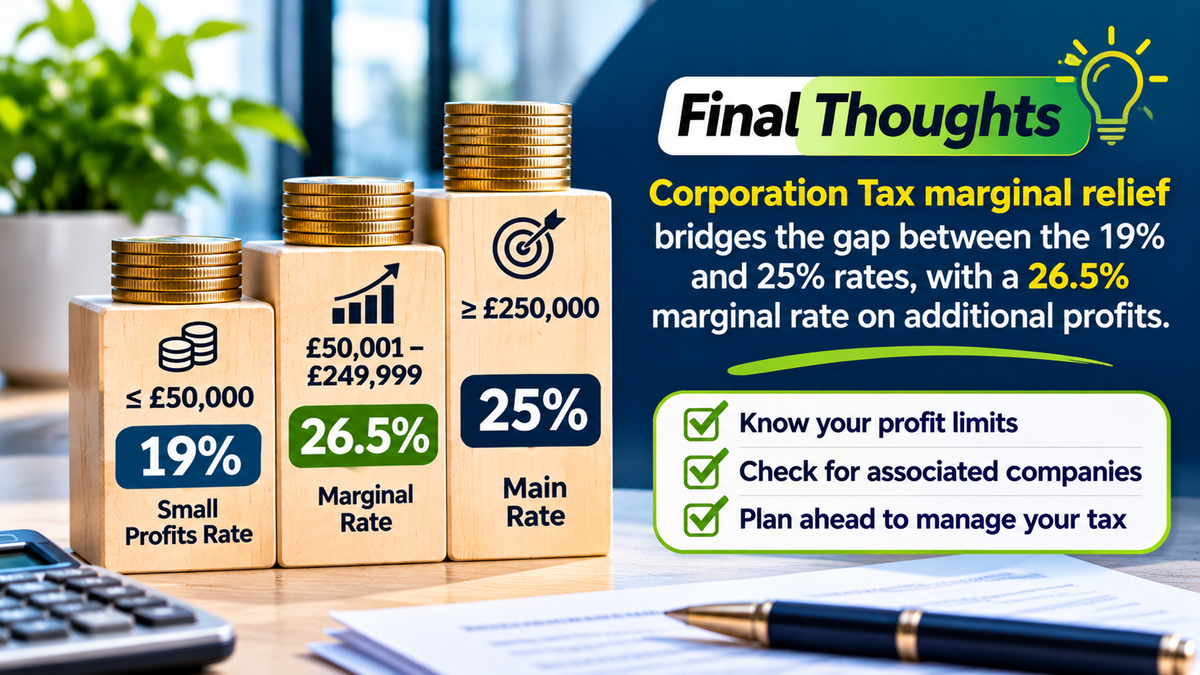
Corporation Tax marginal relief is an important consideration for UK limited companies with profits between the applicable lower and upper thresholds.
Although the headline Corporation Tax rates are 19% and 25%, companies operating within the marginal relief band can face a 26.5% marginal rate on additional profits.
Understanding the difference between effective and marginal tax rates is therefore essential.
The calculation becomes particularly important where companies have associated businesses, short accounting periods, investment income or property SPV structures.
By maintaining accurate management accounts, reviewing available tax deductions and forecasting profits, directors can make more informed financial decisions.
However, tax planning should always support genuine commercial objectives rather than encourage unnecessary spending simply to reduce a tax bill.
Professional advice can help businesses understand their actual Corporation Tax position and identify appropriate opportunities for tax efficiency.
Need Help Calculating Your Company’s Corporation Tax?
At Taxes Done Right Ltd, we help UK limited companies understand their Corporation Tax obligations, prepare accurate tax computations and identify legitimate tax-saving opportunities.
Whether you operate a trading company, property SPV or several associated companies, our team can provide professional guidance tailored to your circumstances.
📞 Call: 0161 710 1901
📧 Email: Tax@TaxesDoneRight.co.uk
Visit: www.taxesdoneright.co.uk
Get professional support to ensure your business expenses are recorded correctly and your tax position is managed efficiently.