Corporation Tax marginal relief: how it affects profits between the lower and upper limits
November 12, 2026
Using your ISA, pension and other allowances before reset
November 16, 2026
Selling a home that was partly used for business: Private Residence Relief explained
Selling your main home is generally one of the few major financial transactions that can be completely free from Capital Gains Tax (CGT). However, the position becomes more complicated when part of your property has been used for business purposes.
Whether you are self-employed, operate a limited company from home, run a salon in a converted room or own a property combining residential and commercial accommodation, understanding Private Residence Relief is essential.
Many homeowners assume that living in a property automatically makes the entire sale exempt from Capital Gains Tax. Unfortunately, that is not always the case.
Where part of a home has been used exclusively for business, HM Revenue & Customs (HMRC) may restrict the relief available, potentially creating a taxable capital gain.
However, simply working from home does not automatically mean that Capital Gains Tax will be payable.
The distinction between occasional business activities, mixed-use rooms and areas dedicated exclusively to business can make a significant difference.
This guide explains the rules, how business use affects Private Residence Relief, how to calculate potentially taxable gains and the common mistakes homeowners should avoid.
1. What Is Private Residence Relief?
Private Residence Relief, also known as Principal Private Residence Relief (PPR), is a Capital Gains Tax relief available when an individual sells or disposes of a property that has been their only or main residence.
Where the necessary conditions are satisfied, the entire gain can be exempt from Capital Gains Tax.
Generally, full relief is available where:
- The property has been your only or main residence throughout ownership.
- You have not had disqualifying periods of absence.
- No part of the home has been used exclusively for business.
- The garden and grounds are within the permitted area.
- The property was not acquired solely to make a gain.
Under the usual rules, the permitted area is up to 5,000 square metres, including the house and other buildings. Larger grounds may qualify where reasonably required for enjoying the property as a residence.
If the conditions for full relief are not met, partial relief may still be available.
This is particularly important for homeowners who have changed how they use their property over time.
HMRC provides detailed information in its Private Residence Relief guidance.
Why does business use matter?
The legislation generally restricts relief where an identifiable part of the home has been used exclusively for a trade, business, profession or vocation.
The relevant provision is Section 224 of the Taxation of Chargeable Gains Act 1992.
Consequently, a house containing a permanently dedicated business area may qualify for relief on the residential portion but not necessarily the business portion.
The challenge is determining how much of the property was genuinely used for business and whether that use was exclusive.
2. Does Working From Home Affect Private Residence Relief?
Working from home has become increasingly common among employees, contractors, company directors and self-employed professionals.
Fortunately, ordinary home working does not normally remove the CGT exemption on a main residence.
HMRC distinguishes between rooms used partly for business and rooms used exclusively for business.
For example, consider a homeowner who works at a desk in their spare bedroom during the day.
The room is also used for guests, personal storage or ordinary family activities.
Provided that the residential use is genuine, this would generally be considered mixed use rather than exclusive business use.
In these circumstances, working from home would not normally restrict Private Residence Relief.
By comparison, a homeowner who converts an entire room into a permanent commercial treatment room, with no meaningful residential use, may have a different tax position.
The room could be treated as exclusively used for business purposes.
Importantly, HMRC applies a stringent test when deciding whether an area is used exclusively for business.
Occasional or insignificant private use may not be sufficient to establish genuine mixed use.
Its Capital Gains Manual on exclusive business use explains this distinction.
Examples of mixed-use rooms
A room may retain its residential character where it is genuinely used for:
- Home working during office hours and family activities afterwards.
- An office during weekdays and a guest bedroom at weekends.
- Business administration alongside regular personal computer use.
- Professional work and meaningful household storage or recreational activities.
The facts matter more than the room’s name or the presence of office furniture.
Key takeaway: Having a home office does not automatically mean losing Private Residence Relief.
3. What Counts as Exclusive Business Use?
Exclusive business use is one of the most important factors in determining whether Private Residence Relief must be restricted.
An area may be considered exclusively used for business where it is permanently dedicated to commercial activities and has little or no genuine domestic use.
Examples include:
- A purpose-built treatment room used by a self-employed beautician.
- A converted garage operating solely as a commercial workshop.
- A dedicated consulting room for private clients.
- Part of a residential property permanently operating as a shop.
- A room used exclusively for storing commercial stock.
The nature, extent and duration of business use are all relevant.
For instance, a physiotherapist who operates a dedicated treatment room from their home may need to exclude the attributable gain from Private Residence Relief.
However, someone who occasionally sees clients in a family living room would generally have a stronger argument that the space remains residential.
Does putting personal belongings in the room help?
Not necessarily.
HMRC specifically recognises that occasional or very minor residential use may be disregarded.
Placing a few personal possessions inside an otherwise dedicated commercial room does not automatically establish mixed use.
The important consideration is whether there is meaningful residential use, supported by the actual circumstances.
Property owners should therefore avoid assuming that insignificant domestic activities will protect their CGT exemption.
4. How Is Private Residence Relief Calculated on Mixed-Use Property?
Where a home has been partly used exclusively for business, the capital gain may need to be divided between the residential and business elements.
The residential portion may qualify for Private Residence Relief, while the business element may remain chargeable.
A simplified approach involves:
- Calculating the overall capital gain.
- Identifying the residential and business portions.
- Apportioning the gain on a just and reasonable basis.
- Applying Private Residence Relief to the qualifying residential element.
- Applying relevant exemptions, losses and CGT rates to the remaining gain.
The calculation is not always determined simply by counting rooms.
The respective floor areas, property values, physical arrangements and periods of use may all be relevant.
For example, a small commercial unit with separate access could represent a greater proportion of the property’s value than its floor area suggests.
HMRC’s guidance on apportioning gains confirms that the residential and business elements should be considered separately.
Example: Selling a home with a permanent business area
Assume a homeowner purchased a property for £250,000 and subsequently sold it for £450,000.
After deducting allowable costs, the total capital gain is £180,000.
Suppose 20% of the gain is reasonably attributable to a permanent business area used exclusively throughout ownership, while the remaining 80% qualifies for full Private Residence Relief.
| Description | Amount |
|---|---|
| Total capital gain | £180,000 |
| Residential element (80%) | £144,000 |
| Business element (20%) | £36,000 |
| Private Residence Relief | (£144,000) |
| Remaining chargeable gain | £36,000 |
| Annual CGT exemption (2026/27) | (£3,000) |
| Taxable gain | £33,000 |
If the entire taxable gain falls within the 24% CGT band, the estimated liability would be £7,920.
Alternatively, where the full taxable gain falls within the available basic-rate band, the applicable rate would be 18%.
This example assumes that the individual qualifies for the annual exemption, has no other gains or losses, and is not eligible for any further relief.
It is illustrative rather than a universal method of apportionment.
Important: A property being 20% commercial by floor area does not automatically establish that 20% of the gain is taxable.
5. What Happens if Business Use Started Partway Through Ownership?
Business use does not necessarily remain unchanged throughout property ownership.
A homeowner might initially occupy the entire property residentially before converting a room into business premises several years later.
Alternatively, a commercial area may be converted back into residential accommodation before the property is sold.
In these situations, the amount of Private Residence Relief may need to reflect the changes in use.
Section 224(2) of the Taxation of Chargeable Gains Act 1992 allows an adjustment that is just and reasonable.
Practical example
Consider a homeowner who owns a property for ten years.
For the first six years, the property is used entirely as a family home.
During the following four years, 25% is converted into an exclusively used business area.
Assuming the gain is evenly attributable across the relevant areas and periods, a simplified illustration might identify:
25% business area × 4/10 years = 10% potentially unrelieved gain.
However, the actual result depends on the property’s facts, changes in value, use and any relevant statutory provisions.
A time-based calculation should not automatically be applied without examining the circumstances.
HMRC’s change-of-use guidance addresses these situations.
6. Does Claiming Home Office Expenses Affect CGT?
Many self-employed individuals and company directors claim expenses associated with working from home.
These may include an appropriate proportion of electricity, heating, internet or other allowable household expenditure.
A common concern is whether claiming these expenses automatically results in Capital Gains Tax when the property is sold.
The answer is no.
Claiming legitimate home-working expenses does not, by itself, mean that a room has been used exclusively for business.
The CGT treatment depends on the actual use of the property.
For example, a self-employed accountant may claim a reasonable proportion of household electricity while using a spare bedroom as a mixed-use office.
That does not automatically prevent full Private Residence Relief.
HMRC recognises the distinction between expenses deductible when calculating business profits and the separate CGT rules applicable to selling a home.
However, a room genuinely dedicated exclusively to business could create a CGT restriction regardless of whether home-working expenses were claimed.
The treatment of a director’s employment-related office arrangements may require additional consideration, particularly where a substantial part of the home is used exclusively as an office.
The safest approach is to ensure that expense claims reflect actual circumstances and that the eventual CGT position is reviewed independently.
7. Mixed Residential and Commercial Property: Special Considerations
Some properties combine residential accommodation with substantial commercial premises.
Examples include shops with flats above, guesthouses, professional practices and properties incorporating dedicated business units.
These arrangements may create more complicated calculations than a simple home office.
Shop with accommodation above
Consider an individual who owns a building consisting of a ground-floor shop and a first-floor flat.
The owner lives in the flat and operates a retail business from the shop.
When the entire building is sold, Private Residence Relief would generally be considered in relation to the qualifying residential accommodation.
The gain attributable to the commercial shop would not normally qualify for that relief.
A reasonable allocation of the overall gain between the components is therefore required.
Depending on the particular circumstances, professional valuation evidence may be appropriate.
Guesthouses and home-based accommodation businesses
Properties operating as guesthouses or bed-and-breakfast businesses can present different issues.
Where rooms are used to accommodate paying guests and are not genuinely occupied as part of the owner’s residence, full Private Residence Relief may not be available across the entire building.
However, shared facilities genuinely used both domestically and commercially require separate consideration.
The extent of relief depends on the actual layout, occupation arrangements and use of the property.
Owners should not assume that all guest accommodation is automatically equivalent to a permanently dedicated commercial unit.
8. Can You Claim Other Capital Gains Tax Reliefs?
Private Residence Relief is not necessarily the only relief potentially relevant when selling property involving business use.
Depending on the circumstances, other CGT provisions may require consideration.
Business Asset Disposal Relief
Business Asset Disposal Relief (BADR) can reduce the CGT rate on certain qualifying business disposals.
For qualifying disposals during 2026/27, the rate is 18%.
However, merely using part of a home for business does not automatically make its disposal eligible for BADR.
The disposal must satisfy the relevant statutory conditions, which may involve disposing of a business, an interest in a business or qualifying associated assets.
Residential and business elements may therefore receive different tax treatment.
Business Asset Rollover Relief
In qualifying circumstances, Business Asset Rollover Relief can defer CGT when proceeds from qualifying business assets are reinvested in replacement business assets.
The conditions are restrictive, and not every home-based business premises qualifies.
This should not be confused with Private Residence Relief, which can exempt rather than merely defer qualifying gains.
More information is available through HMRC’s business Capital Gains Tax relief guidance.
Professional advice is particularly important before relying on these provisions.
9. Seven Common Private Residence Relief Mistakes to Avoid
Understanding the rules is important, but avoiding practical errors can be equally valuable.
Mistake 1: Assuming every home sale is completely tax-free
Living in a property does not guarantee that the entire gain qualifies for relief.
Exclusive business use, periods of non-occupation and other restrictions can affect the exemption.
Mistake 2: Treating all home offices as commercial premises
Ordinary home working does not automatically restrict Private Residence Relief.
The difference between genuine mixed use and exclusive business use is crucial.
Mistake 3: Using an arbitrary property percentage
Dividing the gain according to the number of rooms may produce an inaccurate result.
A reasonable allocation should reflect the actual property, the relevant areas and their use.
Mistake 4: Ignoring changes in business use
If an area was used commercially for only part of the ownership period, this should be reflected in the calculation where appropriate.
Mistake 5: Overlooking allowable acquisition and disposal costs
Legal fees, Stamp Duty Land Tax, estate agent fees and qualifying capital improvements may reduce the chargeable gain.
Keeping appropriate records can prevent unnecessary tax.
Mistake 6: Applying the wrong CGT rate
For the 2026/27 tax year, the standard individual CGT rates are 18% and 24%, depending on taxable income and the available basic-rate band.
The annual exempt amount is generally £3,000 for qualifying individuals.
Check the current CGT rates and allowances when preparing your calculation.
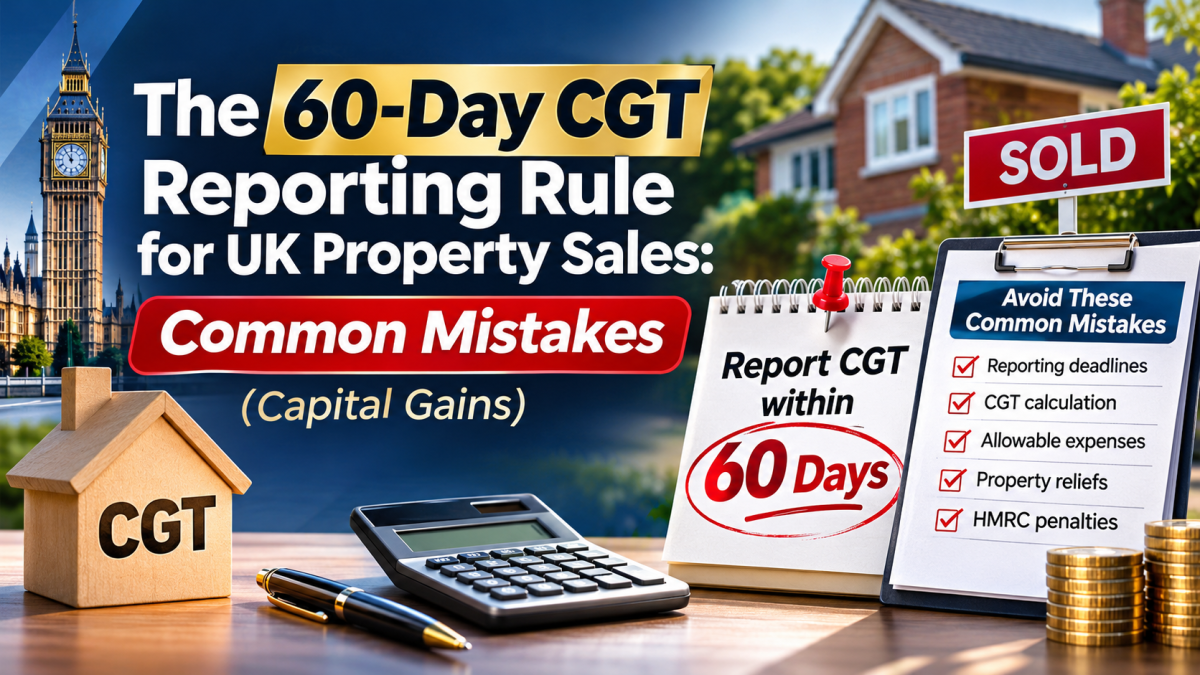
Mistake 7: Missing the 60-day reporting deadline
Where a UK-resident individual has CGT payable on a reportable UK residential property disposal, the gain generally must be reported and the estimated tax paid within 60 days of completion.
Mixed-use disposals can require additional analysis to determine the correct reporting treatment.
The HMRC property CGT reporting service provides the relevant reporting arrangements.
Do not wait until the annual Self Assessment deadline without checking your obligations.
10. Frequently Asked Questions
Can I use my spare bedroom as an office without losing Private Residence Relief?
Yes, generally. Where a bedroom is genuinely used for both business and domestic purposes, working from that room would not normally restrict relief. The actual use matters more than the room’s label.
What if I run a limited company from home?
Operating a limited company from your residential address does not automatically create a CGT liability. However, an area used exclusively for company business may require further investigation.
Does using my home as a registered office affect Private Residence Relief?
Using a residential address as a company’s registered office does not, by itself, restrict relief. What matters is the actual use of the property, rather than merely the address registered at Companies House.
What if I converted my garage into a salon?
A garage permanently used as a commercial salon may create a taxable business element when the property is sold. The exact position depends on its use, connection to the dwelling, ownership history and relevant property valuations.
Can I avoid CGT by stopping business use before selling?
Not automatically. Previous exclusive business use can remain relevant to the overall calculation. Changing an area back to residential use may affect relief, but the adjustment must be supported by the circumstances.
Do joint owners each receive Private Residence Relief?
Each owner is assessed according to their own entitlement and beneficial ownership. Married couples and civil partners also have special main-residence rules. Separate CGT calculations may be needed.
Final Thoughts
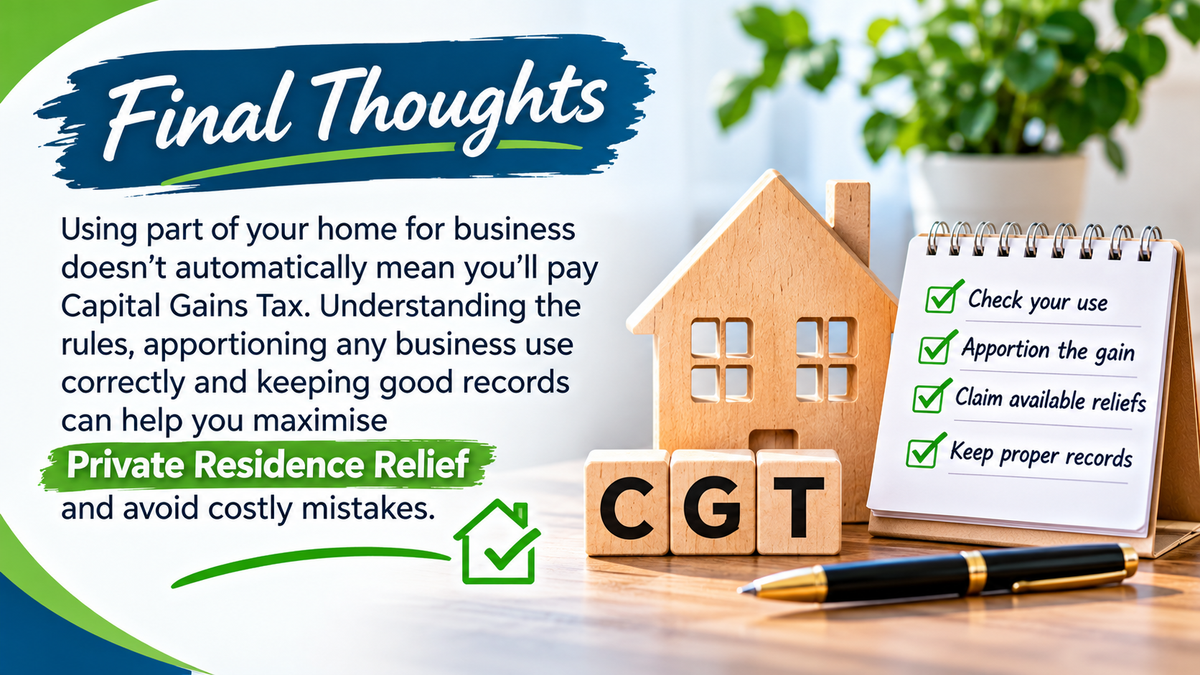
Selling a home that has been partly used for business does not automatically mean that Capital Gains Tax is payable.
For many homeowners, especially those simply working remotely or operating from a genuinely mixed-use room, full Private Residence Relief may still be available.
However, where an identifiable part of the property has been used exclusively for commercial purposes, the tax consequences can be significantly different.
The key is understanding exactly how the property was used, for how long, and what proportion of the gain may qualify for relief.
Accurate records, reasonable apportionment and early tax planning can help homeowners avoid unnecessary CGT liabilities and reporting mistakes.
At Taxes Done Right Ltd, we assist homeowners, landlords, business owners and property investors with Capital Gains Tax calculations, Private Residence Relief claims and HMRC reporting requirements.
If you are selling a property with a home office, commercial premises, converted workspace or mixed residential and business use, obtaining professional advice before completion can help you understand your obligations.
Need help calculating Private Residence Relief?
📞 Call: 0161 710 1901
📧 Email: Tax@TaxesDoneRight.co.uk
Visit: www.taxesdoneright.co.uk
Get professional support to ensure your business expenses are recorded correctly and your tax position is managed efficiently.