The £1,000 Trading & Property Allowance Explained in Simple Terms
March 10, 2026
HMRC Late Filing Penalties: How They Add Up Quickly
March 12, 2026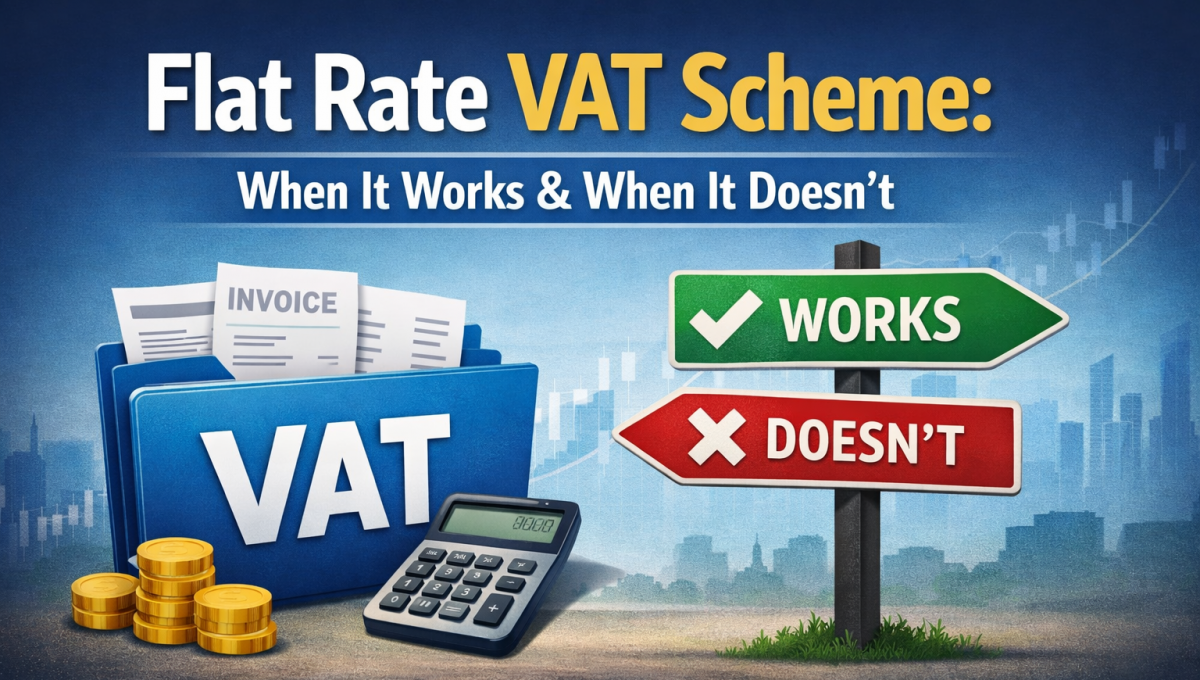
The Flat Rate VAT Scheme (FRS) was introduced by HM Revenue and Customs to simplify VAT reporting for small businesses. Instead of calculating VAT on every sale and purchase, businesses pay a fixed percentage of their gross turnover to HMRC.
While it sounds simple, the scheme does not suit every business. Understanding when it works and when it doesn’t can save you money.
What Is the Flat Rate VAT Scheme?
Under the Flat Rate Scheme, you:
• Charge customers the standard 20 %VAT (in most cases)
• Pay HMRC a fixed percentage of your VAT-inclusive turnover
• Usually cannot reclaim VAT on most purchases
The percentage you pay depends on your business sector. For example, many service-based businesses fall between 12 % and 14.5 %.
There is also a 1 % discount during your first year of VAT registration.
Example:
If you invoice £12,000 including VAT, you might pay HMRC 12 % of £12,000 = £1,440.
You keep the difference between what you charged and what you pay to HMRC.
When the Flat Rate Scheme Works Well
The scheme often works best for service-based businesses with low expenses.
Typical examples include:
• Consultants
• IT contractors
• Marketing agencies
• Accountants
• Freelancers
If you have very few VAT-able purchases, the flat rate percentage may be lower than the VAT you collect, meaning you keep the difference as additional profit.
The scheme is also helpful for businesses that want simpler bookkeeping and fewer VAT calculations.
When the Scheme Doesn’t Work
The scheme becomes less beneficial when businesses have high costs with VAT.
For example:
• Retail businesses buying stock
• Builders buying materials
• Restaurants purchasing food supplies
• Businesses with significant equipment purchases
Because you cannot normally reclaim VAT on purchases, you may lose money compared with the standard VAT scheme.
The “Limited Cost Trader” Rule
Since 2017, HMRC introduced the Limited Cost Trader rule, which significantly reduced the benefit of the scheme for many service businesses.
If your VAT-inclusive spending on goods is less than 2 % of turnover or less than £1,000 per year, you must use a 16.5 % flat rate.
This rate often removes most of the financial advantage of the scheme.
Eligibility for the Scheme
You can join the Flat Rate Scheme if your VAT taxable turnover is £150,000 or less (excluding VAT).
If your turnover rises above £230,000, you must leave the scheme.
Final Thoughts
The Flat Rate VAT Scheme can be beneficial for some small service businesses, especially those with minimal expenses. However, for businesses with higher costs or those affected by the Limited Cost Trader rules, the scheme may actually increase the VAT you pay.
This is why it’s important to run the numbers before joining.
At Taxes Done Right Ltd, we regularly review whether clients should remain on the Flat Rate Scheme or switch to the standard VAT method to ensure they are not paying more VAT than necessary.