What Happens After You Submit Your Self-Assessment?
January 23, 2026
How HMRC Matches Property Income to Land Registry Data
January 27, 2026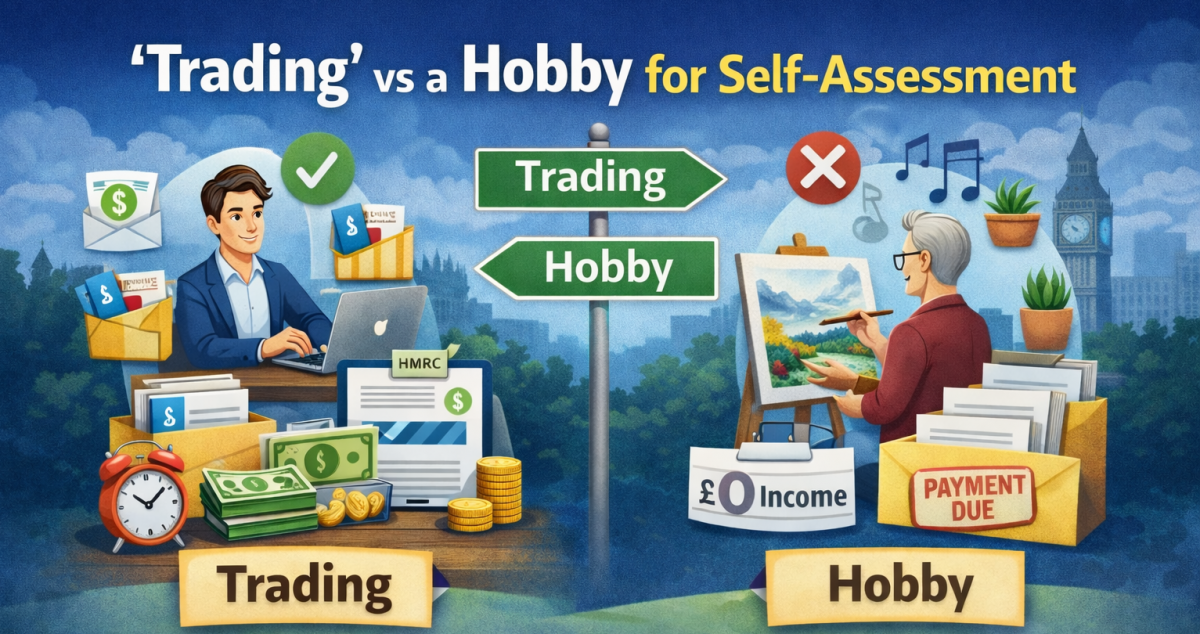
One of the most common questions people ask when earning money on the side is whether they need to declare it to HMRC. Many assume that if something feels casual or enjoyable, it counts as a hobby and is therefore tax free. In reality, HMRC looks at the facts, not the label you give it. Understanding the difference between trading and a hobby is essential to avoid penalties and unexpected tax bills.
Why the distinction matters
If HMRC decides you are trading, the income must be declared on a Self-Assessment tax return and may be subject to Income Tax and National Insurance. If the activity is genuinely a hobby, profits are not taxable. The risk arises where people treat income as a hobby, but HMRC later reclassifies it as trading.
HMRC’s approach
HMRC does not use a single definition of trading. Instead, it applies a set of indicators known as the “badges of trade”. No single badge is decisive on its own. HMRC looks at the overall picture.
The main badges of trade
Profit motive
If you are trying to make a profit, this strongly suggests trading. Even if you are not currently profitable, an intention to make money in the future can still point towards trading.
Frequency and repetition
Occasional or one-off sales are more likely to be a hobby. Regular, repeated transactions suggest a trade, particularly if they follow a pattern.
Organisation and business like behaviour
Keeping records, advertising, having a website or social media page, issuing invoices, or using a separate bank account all indicate trading rather than a hobby.
Nature of the activity
Some activities are inherently more commercial. Buying goods specifically to resell at a profit is more likely to be trading than selling unwanted personal items.
Level of skill or expertise
If you use specialist knowledge or skills to generate income, this can point towards trading, especially where those skills are marketed to others.
Scale of activity
As income grows, it becomes harder to argue that an activity is merely a hobby. Larger sums, even if earned part time, increase the likelihood of HMRC viewing it as trading.
Common examples
Selling personal belongings on online marketplaces from time to time is usually a hobby. Buying items with the intention of reselling them for profit is more likely to be trading.
Occasionally earning money from a pastime, such as photography or baking for friends, may start as a hobby. If it becomes regular, advertised, and profit-driven, it can quickly become a trade in HMRC’s eyes.
Content creation, tutoring, coaching, and freelance work are often treated as trading once income is earned with consistency and intent.
What about the trading allowance?
HMRC provides a £1,000 trading allowance each tax year. If your total gross income from trading or casual services is £1,000 or less, you may not need to register for Self-Assessment. However, this does not automatically make the activity a hobby. It simply provides a reporting and tax exemption up to that limit.
Once income exceeds £1,000, registration for Self-Assessment is normally required.
What happens if you get it wrong?
If HMRC later decides your hobby was actually trading, it can assess unpaid tax, charge interest, and apply penalties. In some cases, HMRC may look back several years.
Final thoughts
The key question is not whether you enjoy the activity, but whether you are carrying it out in a way that resembles a business. If there is regularity, organisation, and a profit motive, HMRC is likely to view it as trading.
If you are unsure where you stand, it is always better to get advice from TaxesDoneRight early rather than wait for HMRC to decide for you.