
VAT Registration Exception Explained (Avoid Costly Mistakes When Applying to HMRC)
May 1, 2026
Property Investors: Ltd Company vs Personal Ownership – Which Structure Is Right for You?
May 5, 2026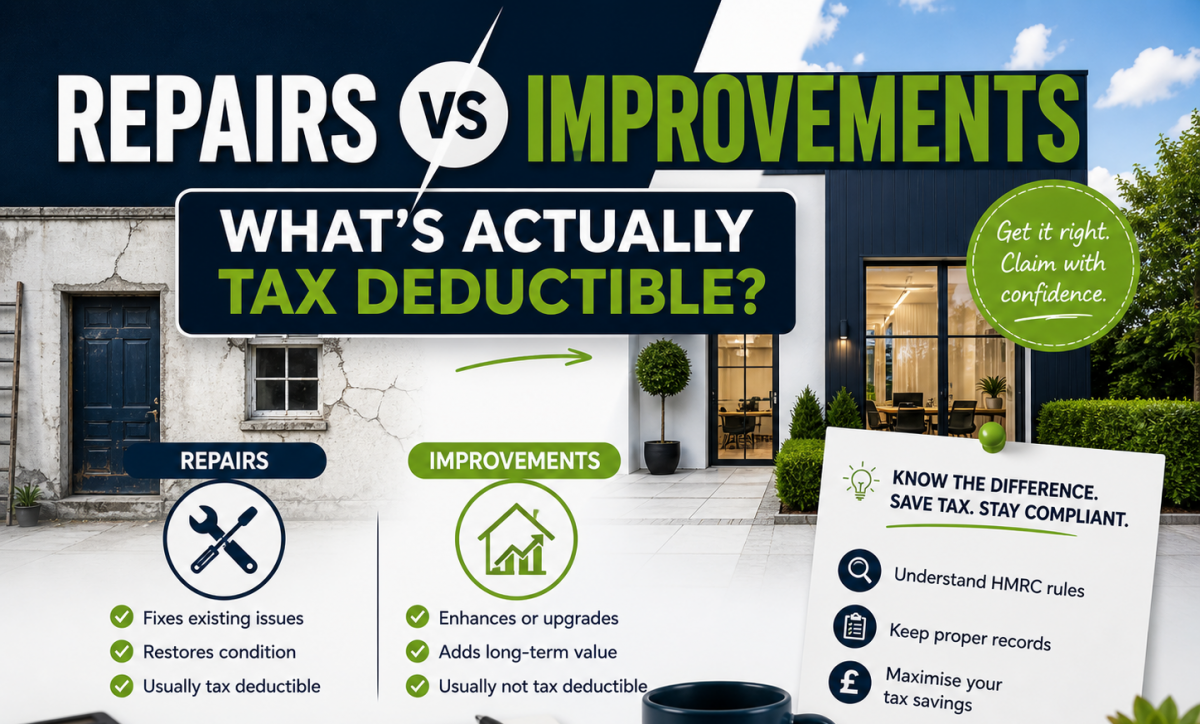
Tax Deductible: Repairs vs Improvements – What’s Actually Allowed?
Tax deductible expenses are one of the most misunderstood areas for landlords and business owners. Knowing whether a cost is tax deductible can make a significant difference to your tax bill.
A common issue is distinguishing between repairs and improvements. While both involve spending money on your property or assets, only certain costs are tax deductible against your income.
What Does Tax Deductible Mean?
A tax deductible expense is a cost that you can subtract from your income before calculating your tax liability. This reduces the amount of profit you are taxed on.
However, not all expenses qualify. HMRC has strict rules, especially when it comes to property and asset-related costs.
Tax Deductible Repairs – What Qualifies?
Repairs are generally tax deductible because they are considered maintenance costs that keep an asset in its current condition.
Examples of Tax Deductible Repairs:
- Fixing a broken boiler
- Repainting walls
- Replacing roof tiles like-for-like
- Repairing plumbing or electrics
- Fixing damaged flooring
These are all considered routine maintenance. They do not significantly improve the asset but simply restore it.
If the work is restoring something to its original state, it is usually tax deductible.
Improvements – Why They Are Not Always Tax Deductible
Improvements are different. These are costs that enhance or upgrade an asset beyond its original condition.
Examples of Improvements:
- Adding an extension
- Upgrading a kitchen to a significantly higher specification
- Converting a loft into a bedroom
- Installing something new that was not there before
These are not immediately tax deductible. Instead, they are treated as capital expenditure.
This means you may only benefit from tax relief when you sell the asset, typically through Capital Gains Tax calculations.
Tax Deductible vs Capital – Key Differences
Understanding the difference is critical:
- Repairs (Tax Deductible): Maintain or restore
- Improvements (Not Tax Deductible): Enhance or upgrade
A simple rule of thumb:
If the work puts the asset back to how it was, it is likely tax deductible.
If it makes it better than before, it is likely capital.
Grey Areas – Where It Gets Tricky
In reality, many situations are not clear-cut. Some work includes both repairs and improvements.
Example:
You replace a kitchen:
- Replacing broken units like-for-like → tax deductible
- Upgrading to a luxury kitchen → improvement (not tax deductible)
In such cases, you may need to apportion the costs between repair and improvement elements.
Tax Deductible Initial Repairs – A Common Trap
One key area where people get caught out is initial repairs.
If you purchase a property in poor condition and carry out work to bring it up to a usable standard, HMRC may treat this as capital expenditure.
Even though it feels like a repair, it may not be tax deductible because the asset was not in a usable condition when purchased.
Timing Matters for Tax Deductible Claims
For an expense to be tax deductible:
- It must relate to your business or rental activity
- It must not be capital in nature
- It must be incurred during the accounting period
Incorrect timing or classification can lead to errors in your tax return.
Why Getting This Right Is Important
Misclassifying expenses can lead to:
- Overpaying tax
- Underpaying tax and facing HMRC penalties
- Incorrect financial reporting
Getting clarity on what is tax deductible ensures your accounts are accurate and compliant.
Practical Tips for Business Owners and Landlords
To stay on the safe side:
- Keep detailed invoices and descriptions of work
- Clearly separate repair and improvement costs
- Avoid grouping all costs under one category
- Seek advice if the situation is unclear
Documentation is key. HMRC will expect evidence to support your claims.
Final Thoughts
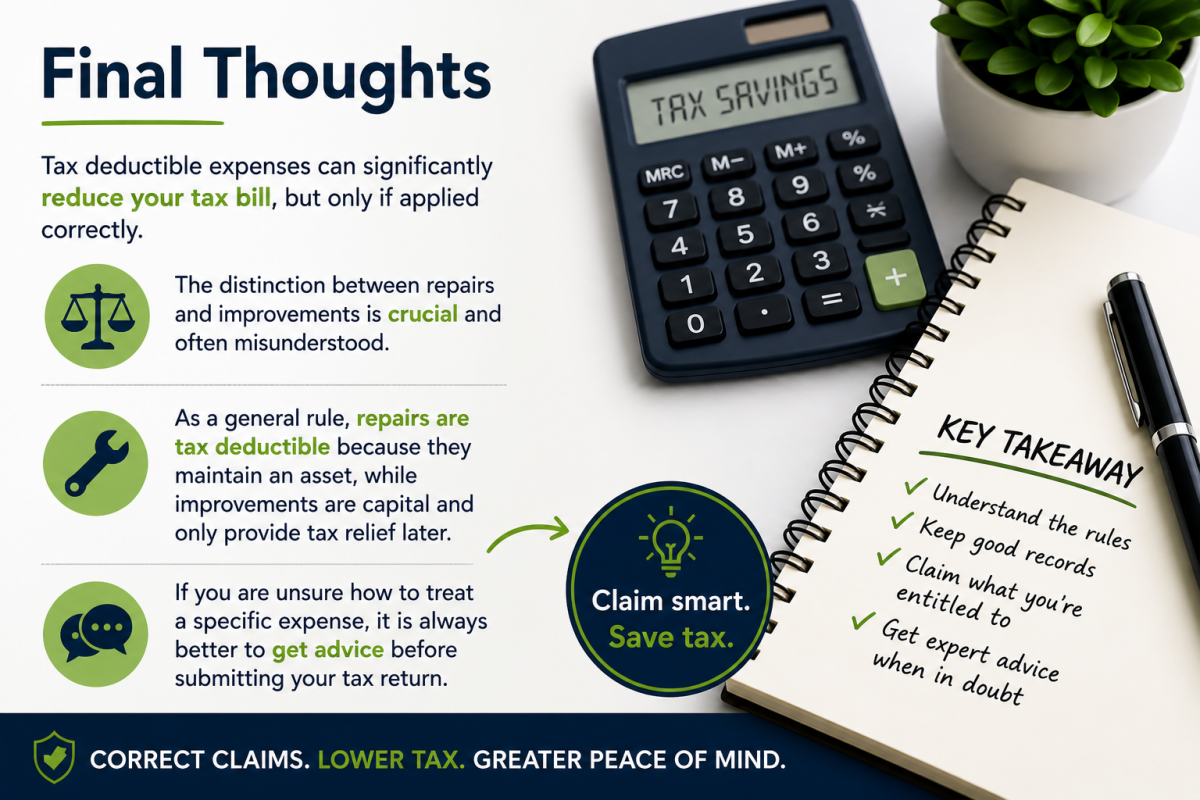
Tax deductible expenses can significantly reduce your tax bill, but only if applied correctly. The distinction between repairs and improvements is crucial and often misunderstood.
As a general rule, repairs are tax deductible because they maintain an asset, while improvements are capital and only provide tax relief later.
If you are unsure how to treat a specific expense, it is always better to get advice before submitting your tax return.
If you need help reviewing your expenses or ensuring everything claimed is tax deductible:
Call 0161 710 1901
Email Tax@TaxesDoneRight.co.uk
Visit www.taxesdoneright.co.uk