Reverse Charge VAT: How Reverse Charge VAT on Digital Services Works in the UK (2026 Guide)
July 22, 2026
Director Salary Sacrifice Pension: Should Company Directors Use It in 2026?
July 24, 2026
UK Business Bank Account: Which UK Business Bank Account Is Right for Your Company?
Choosing the right UK Business Bank Account is one of the first and most important decisions you will make when starting or growing a business. A business bank account is far more than just somewhere to receive customer payments. It helps separate your business finances from personal finances, improves bookkeeping, simplifies tax reporting, and gives your company a professional image.
With dozens of banks now offering business accounts, choosing the most suitable option can feel overwhelming. Some banks focus on digital-first banking, while others offer extensive branch networks, lending facilities, and dedicated relationship managers. The best choice depends entirely on your company’s size, industry, future plans, and banking requirements.
This guide explains the different types of business bank accounts available in the UK, the features you should compare, and how to determine which option is most suitable for your business.
Why Every Business Needs a Separate Business Bank Account
A dedicated business account keeps your company finances organised and makes managing income and expenses significantly easier.
For limited companies, having a separate business bank account is generally essential because the company is a separate legal entity from its directors and shareholders. Mixing personal and company transactions creates unnecessary bookkeeping complications and can increase the likelihood of accounting errors.
Even sole traders who are not legally required to have a business account often benefit from separating business and personal transactions. It saves time during bookkeeping, helps monitor cash flow, and makes preparing tax returns much simpler.
Other benefits include:
- Professional payment details for customers
- Easier expense tracking
- Simplified bookkeeping
- Better budgeting
- Faster reconciliation
- Improved cash flow visibility
- Easier access to finance
- Better integration with accounting software
A well-managed business account also provides a clearer financial history, which may assist when applying for loans or other financial products.
Types of UK Business Bank Account Options
There are several categories of business bank accounts available across the UK.
Traditional High Street Banks
Traditional banks remain popular with many businesses because they provide physical branches, cash deposit facilities, cheque processing, and access to wider banking services.
These banks often suit businesses that:
- Handle regular cash deposits
- Require face-to-face banking
- Need business lending
- Expect international banking support
- Value long-established banking relationships
Although they may charge monthly fees after introductory offers end, they often provide comprehensive banking services.
Digital Business Banks
Digital banks have become increasingly popular with startups, freelancers, consultants, contractors, and technology-focused businesses.
Many digital providers offer:
- Fast online applications
- Instant payment notifications
- Real-time spending alerts
- Expense categorisation
- Virtual and physical debit cards
- Mobile cheque deposits
- Invoice creation tools
- Multi-user access
Digital banking can significantly reduce administrative work for businesses operating almost entirely online.
Specialist Banking Providers
Some providers specialise in serving certain industries or types of businesses, such as contractors, charities, property investors, freelancers, or international trading companies.
These accounts may include features specifically designed around the needs of those sectors.
What Features Should You Compare?
Not every business account offers the same features.
Instead of choosing based purely on advertising, compare the practical benefits that matter most to your business.
Important factors include:
Monthly Fees
Some accounts are free while others charge monthly subscription fees.
A paid account may still represent excellent value if it includes accounting integrations, expense management, or additional banking services that save valuable administrative time.
Transaction Charges
Look carefully at:
- Electronic payments
- Cash deposits
- Cash withdrawals
- Cheque deposits
- International payments
- Foreign currency transfers
A seemingly low-cost account may become expensive if your business carries out large numbers of transactions each month.
Mobile Banking
Modern mobile banking apps allow business owners to:
- View balances instantly
- Make payments
- Approve transfers
- Freeze cards
- Receive notifications
- Upload receipts
- Monitor spending
For many businesses, mobile functionality has become an essential requirement.
Accounting Software Integration
Many business accounts integrate directly with cloud accounting software.
Automatic bank feeds reduce manual bookkeeping and allow transactions to flow directly into accounting systems, saving considerable time while reducing errors.
This is particularly helpful as businesses prepare for Making Tax Digital requirements.
Choosing the Right UK Business Bank Account for Your Business
Selecting the right UK Business Bank Account should be based on how your business actually operates rather than choosing the most recognised bank.
Consider asking yourself the following questions:
Do you receive mostly bank transfers?
Do you regularly deposit cash?
Will you trade internationally?
Do you need overdraft facilities?
Will multiple employees require debit cards?
Do you use accounting software?
Will you require business loans in the future?
How important is customer support?
Your answers will usually narrow down the most suitable providers very quickly.
For example, a retail shop accepting cash every day may benefit from a traditional bank with local branches, whereas a software consultancy working remotely may prioritise mobile banking and accounting software integration.
Opening a UK Business Bank Account
Opening a UK Business Bank Account has become much faster than it was a few years ago.
Many providers now complete applications entirely online.
Although requirements vary, banks commonly request:
- Company registration details
- Director identification
- Proof of address
- Nature of business activities
- Estimated annual turnover
- Information about beneficial owners
- Company registration number (for limited companies)
Some banks may ask additional questions as part of their anti-money laundering and identity verification procedures.
Approval times can range from a few hours to several days depending on the provider and complexity of the application.
Digital Banking vs Traditional Banking
There is no universal winner because different businesses have different priorities.
Digital banking generally offers:
- Faster setup
- Better mobile apps
- Instant notifications
- Modern expense management
- Real-time insights
- Excellent accounting integration
Traditional banking often provides:
- Physical branches
- Cash handling
- Relationship managers
- Lending facilities
- Larger product ranges
- Established business support
Many successful businesses actually use both—keeping their main account with one provider while maintaining additional accounts elsewhere for specialist purposes.
Common Mistakes When Choosing a Business Bank Account
Business owners often focus only on introductory offers without considering long-term suitability.
Some common mistakes include:
Choosing solely because an account is free.
Ignoring transaction charges.
Not checking accounting software compatibility.
Overlooking international payment costs.
Failing to consider future business growth.
Ignoring customer support quality.
Opening an account before deciding how bookkeeping will be managed.
The cheapest account is not always the most cost-effective if it increases bookkeeping time or administrative work.
Security Should Never Be Overlooked
Business banking security has become increasingly important.
Look for providers offering:
- Two-factor authentication
- Biometric login
- Instant payment alerts
- Card freezing
- Spending controls
- Fraud monitoring
- Secure payment approvals
Businesses should also establish internal controls around payment approvals, user permissions, and online banking access to reduce fraud risks.
Can You Have More Than One Business Bank Account?
Absolutely.
Many companies operate multiple business accounts for different purposes.
Examples include:
- Main trading account
- VAT savings account
- Corporation tax savings account
- Payroll account
- Client money account (where applicable)
- Foreign currency account
Separating funds can improve budgeting and reduce the temptation to spend money set aside for future tax liabilities.
Future-Proofing Your Banking
Business banking continues to evolve rapidly.
Many providers now include features that would previously have required separate software, including:
- Expense capture
- Invoice generation
- Receipt storage
- Payment requests
- Cash flow forecasting
- Budgeting tools
- Team spending controls
- Automated transaction categorisation
Choosing a provider that regularly updates its technology can help your business remain efficient as banking and tax requirements continue to develop.
Final Thoughts
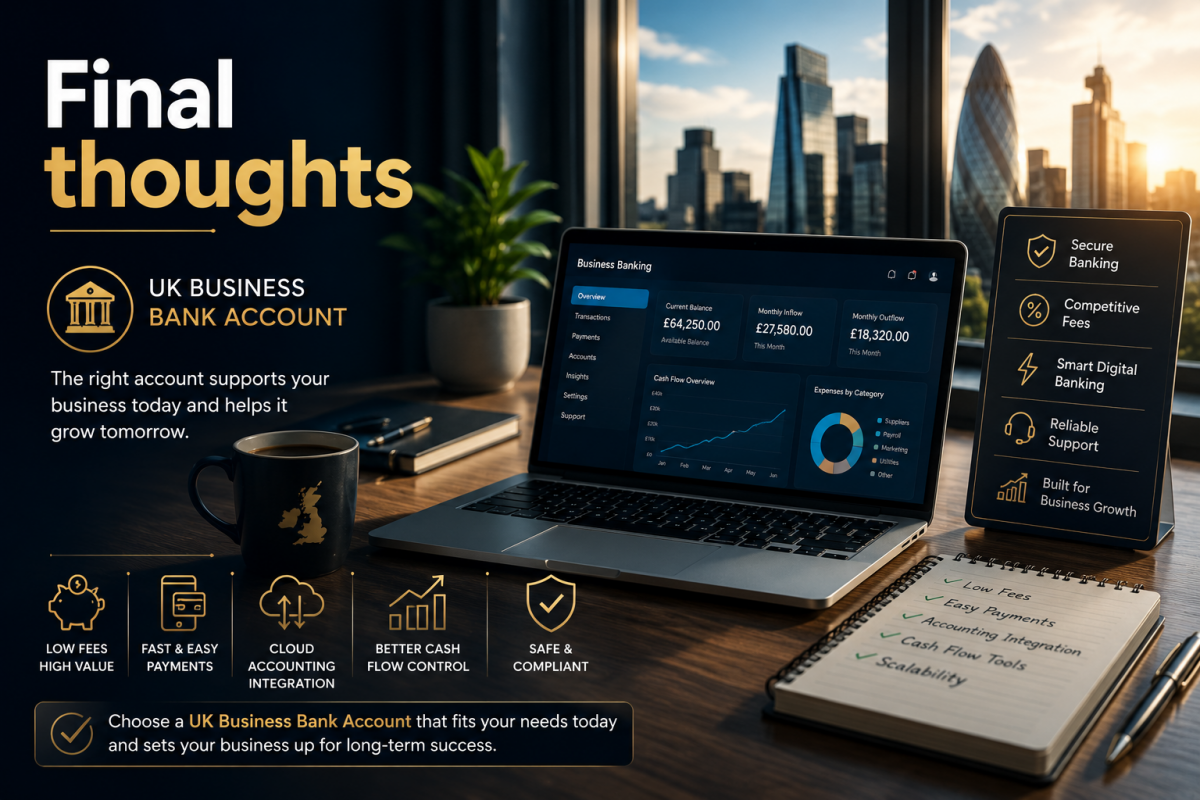
Selecting the right UK Business Bank Account is about much more than opening somewhere to hold your money. The ideal account should support your day-to-day operations, simplify bookkeeping, improve visibility over cash flow, integrate with your accounting software, and provide the flexibility your business needs as it grows.
Before making a decision of having UK Business Bank Account, compare the overall value rather than simply focusing on monthly fees and go for Making Tax Digital . Consider transaction costs, customer support, digital features, security, lending options, and integration with your existing business processes. Taking the time to choose the right account today can save considerable time, money, and administration in the future, allowing you to focus on growing your business with confidence.
Choosing the right UK Business Bank Account is an investment in your company’s future rather than simply opening another bank account. A well-selected UK Business Bank Account can streamline daily banking, improve cash flow management, simplify bookkeeping, and support tax compliance. Whether you are launching a start-up or expanding an established company, reviewing the features, fees, customer support, and technology offered by each UK Business Bank Account provider will help ensure your UK Business Bank Account continues to meet your business needs as your company grows
Before making your final decision, take the time to compare every UK Business Bank Account based on your current requirements and long-term business goals. The best UK Business Bank Account is not always the cheapest—it is the one that offers the right combination of digital banking, security, accounting software integration, payment flexibility, and reliable customer service. By choosing the right UK Business Bank Account today, your business can benefit from smoother financial management, improved efficiency, and a strong foundation for sustainable growth, making your UK Business Bank Account an essential part of your company’s long-term success.
Need help deciding what’s best for your situation?
📞 Call 0161 710 1901
📧 Email Tax@TaxesDoneRight.co.uk
Visit www.taxesdoneright.co.uk