Selling a home that was partly used for business: Private Residence Relief explained
November 13, 2026
Employing Your First Member of Staff: payroll, auto-enrolment and what to expect
November 17, 2026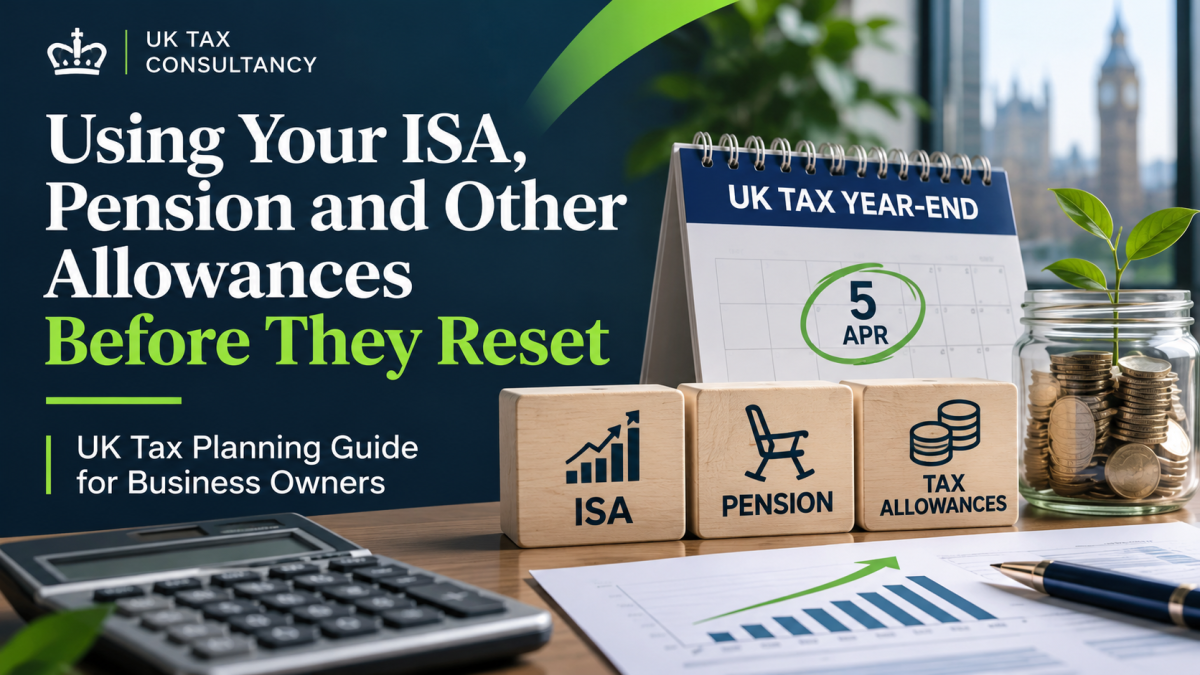
Using your ISA, pension and other allowances before reset
ISA, pension and other allowances can make a substantial difference to how much of your hard-earned money you keep. Yet many people only think about them when the end of the tax year is approaching.
Considering these, for the 2026/27 tax year, the key deadline is 5 April 2027. A new tax year begins on 6 April, resetting many annual limits. Some unused opportunities disappear completely, while others have specific carry-forward rules. Understanding which is which is central to effective planning.
When evaluating these, this guide explains the main opportunities available to UK taxpayers, including savers, families, employees, company directors and landlords. It focuses on sensible planning rather than encouraging unnecessary spending. These decisions benefit from careful timing.
Why the 5 April deadline matters
For ISA, pension and other allowances, the UK tax year runs from 6 April to the following 5 April. That timetable determines when most personal savings and tax allowances apply. A contribution recorded on 6 April 2027 generally uses the new year’s allowance rather than the previous year’s. These decisions benefit from careful timing.
Start by reviewing this against your actual finances. Record what you have already used across every provider, employer and relevant account.
In planning , not every allowance is interchangeable. An ISA shelters eligible investment income and gains, while pension contributions can attract tax relief but usually restrict access until later life. A gifting exemption affects potential Inheritance Tax, not your immediate Income Tax bill. These decisions benefit from careful timing.
1. ISA, pension and other allowances: use your adult ISA limit
Considering this , the adult ISA limit for 2026/27 is £20,000 per eligible individual. Income and gains within an ISA are generally free from UK Income Tax and Capital Gains Tax. Depending on your circumstances, you may choose a Cash ISA, Stocks and Shares ISA, Innovative Finance ISA or Lifetime ISA.
When evaluating this, a common mistake is thinking unused ISA capacity carries forward. It does not. If you only subscribe £8,000 by 5 April, the remaining £12,000 normally disappears when the tax year ends. These ISA, pension and other allowances decisions benefit from careful timing.
Consider these together rather than automatically putting every spare pound into investments. Cash may suit short-term goals and emergency savings; stocks and shares are generally more appropriate where you can tolerate fluctuations over a longer period.
For this, you can subscribe to more than one ISA of the same type within the tax year under current rules, subject to provider restrictions and the overall annual limit. Always check how much you have paid into all accounts, particularly if you use several banking or investment apps. These decisions benefit from careful timing.
2. Understand the Cash ISA change from April 2027
In planning ISA, pension and other allowances, from 6 April 2027, the overall adult ISA limit remains £20,000, but people under 65 will generally be limited to £12,000 of new subscriptions into Cash ISAs. Those aged 65 or over can continue using the full overall allowance in Cash ISAs. Separate rules affect cash held within investment ISAs, so check the latest provider guidance. These decisions benefit from careful timing.
Considering this, this makes the 2026/27 position particularly important for some cash savers. Eligible adults can still use the existing £20,000 overall ISA subscription limit during this tax year, without that future £12,000 Cash ISA sublimit. These decisions benefit from careful timing.
When reviewing this, distinguish a change in future subscription rules from a tax charge on existing balances. Money already held in a compliant ISA does not lose its tax-free status merely because the next year’s rules change.
3. Check Lifetime ISA eligibility and bonuses
When evaluating ISA, pension and other allowances, a Lifetime ISA can be useful for an eligible first-time buyer or for later-life saving. You can contribute up to £4,000 each tax year, with a government bonus of 25%, worth up to £1,000 annually.
For ISA, pension and other allowances, you must normally open a Lifetime ISA and make your first payment before turning 40. Contributions and bonuses can continue until age 50.
Withdrawals for non-qualifying purposes normally incur a 25% withdrawal charge, which can remove part of your original savings as well as the bonus. Therefore, this should be considered alongside flexibility.
4. Build savings for children through Junior ISAs
In planning ISA, pension and other allowances, a Junior ISA allows up to £9,000 of subscriptions per eligible child during 2026/27. Family members and other contributors can pay in, subject to the shared annual limit.
Considering htis, a child can hold Cash and Stocks and Shares Junior ISAs, with the annual allowance divided between them. Growth and eligible income remain sheltered from UK tax.
Before adding this to your family plan, check whether the child already has a Child Trust Fund. A child cannot subscribe to a Junior ISA while retaining a Child Trust Fund; a formal transfer may be required.
5. ISA, pension and other allowances: review pension tax relief
When evaluating this the standard pension annual allowance for 2026/27 is £60,000. This normally covers pension input from you, your employer and anyone else, including the relevant growth in defined benefit pension rights.
For ISA, pension and other allowances, personal contributions generally qualify for tax relief up to 100% of relevant UK earnings, subject to annual allowance rules. Someone with little or no relevant earnings may still qualify for relief on gross contributions of up to £3,600, generally funded by a £2,880 net payment under relief at source.
In planning this, a basic-rate taxpayer paying £800 into a relief-at-source pension ordinarily receives £200 basic-rate relief added by the provider, creating a £1,000 gross contribution. Higher- and additional-rate taxpayers may be entitled to further relief, subject to their circumstances and tax bands.
Review this together before deciding where to allocate a windfall. Pensions can be particularly attractive for retirement saving but are subject to investment risk, withdrawal tax rules and minimum access ages.
Considering this , employees should check workplace pension statements and salary sacrifice arrangements. Company directors can also explore genuine employer pension contributions, which may have Corporation Tax implications and are assessed under business expense rules.
6. Investigate carry-forward rules before they expire
When evaluating this, pension carry forward can permit unused annual allowance from the previous three tax years to be used, where conditions are met. For 2026/27, the potentially available years are 2023/24, 2024/25 and 2025/26.
For this use the current year’s allowance first, then the oldest eligible unused allowance. Importantly, carry forward does not remove the separate limit on tax relief for personal contributions based on relevant earnings.
In planning this the 2023/24 unused amount is especially time-sensitive: any eligible balance not used by 5 April 2027 will generally drop out of the three-year window. Review records before paying large sums, especially if you changed employers, held multiple pensions or belong to a defined benefit scheme.
For high earners, this require additional calculations. Pension annual allowance tapering can apply where threshold income exceeds £200,000 and adjusted income exceeds £260,000, potentially reducing the standard allowance to £10,000. If you have flexibly accessed taxable defined contribution benefits, the money purchase annual allowance may also be relevant.
7. Review Capital Gains Tax before selling investments
Considering this, the annual Capital Gains Tax exempt amount for most individuals is £3,000 in 2026/27. This usually cannot be carried forward.
When evaluating this, suppose you expect a taxable gain of £5,000 from shares held outside an ISA. Ignoring other gains, losses and special circumstances, the £3,000 exemption may leave £2,000 potentially chargeable.
Do not sell an investment solely to use an exemption. Market movements, fees and your investment strategy may outweigh a modest tax saving.
As you review thses, remember that moving investments into an ISA can require a disposal outside the wrapper, potentially triggering a gain. A formal bed-and-ISA transaction is not automatically tax-free.
8. Make the most of savings and dividend allowances
When assessing thses in 2026/27, the Personal Savings Allowance is generally £1,000 for basic-rate taxpayers, £500 for higher-rate taxpayers and zero for additional-rate taxpayers. Depending on income, the starting rate for savings and unused Personal Allowance may provide further tax-free capacity.
Rising savings balances or interest rates can produce unexpected taxable interest. Check interest across every non-ISA account, not merely your main savings provider.
In planning this, the dividend allowance is £500 for 2026/27. Dividend income exceeding available reliefs may be taxable at 10.75%, 35.75% or 39.35%, depending on your band. Dividends within ISAs are generally sheltered. The allowance is not a cash payment and cannot be carried into a future year.
For limited company owners, this interact with salary, dividends and business profits. Taking a dividend merely to use an allowance may be inappropriate if profits are unavailable or your overall tax position makes another route better.
9. Consider Marriage Allowance and household planning
Considering this, Marriage Allowance can allow an eligible spouse or civil partner to transfer £1,260 of their Personal Allowance, potentially reducing the recipient’s Income Tax by up to £252 for 2026/27. Generally, one partner must be a non-taxpayer and the recipient must pay tax at the basic rate, with specific rules for Scotland.
When evaluating this, unlike many annual limits, a qualifying claim may be backdated for up to four previous tax years. This makes it worth checking historic eligibility as well as the current year.
For this, household reviews should also consider genuine ownership of savings and investments. Transferring an asset to a spouse can have tax consequences and must reflect real beneficial ownership. Arrangements should be properly documented, not merely described differently on a tax return.
Use this to inform a household strategy rather than treating each individual return in isolation. One partner may have substantial spare ISA capacity while another has a lower tax rate on savings.
10. Consider gifts and Inheritance Tax exemptions
In planning, the annual Inheritance Tax gifting exemption is £3,000 per individual. Unused exemption can be carried forward by one tax year only, potentially allowing up to £6,000 where the previous year’s exemption remains unused. The previous year’s amount must be used according to the applicable ordering rules.
Considering this, other exemptions may help, including small gifts of up to £250 per recipient, subject to restrictions, and qualifying wedding or civil partnership gifts. Regular gifts from surplus income can also be exempt where statutory conditions are met, including affordability and a normal pattern of expenditure.
When evaluating this, good records are essential. Save dates, recipient names, gift amounts and evidence of income and ordinary living costs. A bank transfer does not automatically establish that a gift qualifies for the normal expenditure out of income exemption.
When combining these with estate planning, avoid giving away money needed for your own security. Tax efficiency is not worth undermining retirement income, emergency savings or future care needs.
11. Review Gift Aid and income thresholds
For this, Gift Aid can help eligible charitable donations benefit from basic-rate tax relief claimed by the charity. Higher- and additional-rate taxpayers may be entitled to further relief through their own tax position.
In planning this, grossed-up Gift Aid contributions and certain pension contributions can reduce adjusted net income. This may matter where income exceeds £100,000 and the Personal Allowance is gradually withdrawn, or where the High Income Child Benefit Charge applies above £60,000.
However, you should give to charity because you wish to support the cause. Tax relief does not make the donation free.
A review of this should always include adjusted net income, not merely gross salary. Rental profits, dividends, bank interest, bonuses and benefits can change eligibility.
Practical checklist for a smoother year end
Considering this, begin several weeks before the deadline. Obtain current ISA subscription figures, workplace pension statements and details of any other pension inputs. Review salary, self-employment income, rental profits and expected dividends.
When evaluating this, next, rank possible actions according to their purpose: emergency access, retirement, education, giving or managing a foreseeable tax bill. Verify eligibility before moving funds. Leave enough time for bank payments and providers to process subscriptions.
Document these decisions with dates, amounts and supporting evidence. If you are making sizeable pension contributions, calculate the annual allowance position before paying. If you are transferring investments, check dealing costs, tax implications and platform deadlines.
For ISA, pension and other allowances, avoid using borrowed money just to consume an allowance. Similarly, do not sacrifice a suitable emergency fund for a tax advantage that is unavailable until retirement.
Common mistakes to avoid
In planning this, one mistake is assuming all unused limits roll forward automatically. Most ISA and annual tax exemptions do not. Another is overlooking employer pension contributions when calculating annual allowance usage.
Considering this, some taxpayers focus on one account and forget the wider household. Others act on an estimated dividend or capital gain without checking costs, tax bands or ownership.
The best approach is to review regularly rather than making a single hurried decision in April. A short review every quarter makes it easier to adjust savings plans, document transactions and spot developing problems before they become expensive.
Final thoughts: plan before the reset
When evaluating ISA, pension and other allowances, the tax year ending 5 April 2027 offers several useful planning opportunities, but each comes with its own eligibility criteria and deadlines. The £20,000 adult ISA limit, £60,000 standard pension annual allowance and £3,000 annual Capital Gains Tax exemption are not interchangeable, and different carry-forward rules apply.
For this, the right starting point is to understand your goals, available cash and complete tax position. Calculate the potential benefit, weigh up restrictions and take care with deadlines.
Taking action well before the end of the tax year gives individuals and business owners greater flexibility to make informed financial decisions. Reviewing your taxable income, investment performance and retirement savings throughout the year can help identify potential tax-saving opportunities before important deadlines approach. Early planning also allows time to assess changes in government legislation, adjust financial contributions and prepare for unexpected expenses. Working with a qualified accountant can provide valuable insights into available tax reliefs and help ensure compliance with HMRC requirements. A well-structured financial strategy not only supports immediate tax efficiency but also contributes to long-term wealth protection, financial confidence and sustainable growth.
Effective tax planning should be an ongoing process rather than a last-minute exercise before the financial year ends. Regularly reviewing your income, savings, investments and retirement contributions can help identify opportunities to reduce unnecessary tax liabilities while building long-term financial security. Changes in employment, family circumstances, property ownership or business profits may also affect your eligibility for valuable tax reliefs. Seeking professional advice can help ensure your financial decisions remain aligned with your personal goals, current legislation and future financial needs. By taking a proactive approach, you can make informed decisions, avoid missed opportunities and establish a stronger foundation for financial stability.
At Taxes Done Right Ltd, we help individuals, landlords and company directors review tax-efficient options and understand how personal decisions interact with their wider circumstances. For tailored guide, contact our team before the year-end deadline rather than leaving important decisions until the final days.
Need help deciding what’s best for your situation?
📞 Call 0161 710 1901
📧 Email Tax@TaxesDoneRight.co.uk
Visit www.taxesdoneright.co.uk