
Can Your Company Pay for Gym Memberships, Phones and Home Internet?
June 7, 2026
Electric Cars Through a Limited Company – Still Worth It?
June 9, 2026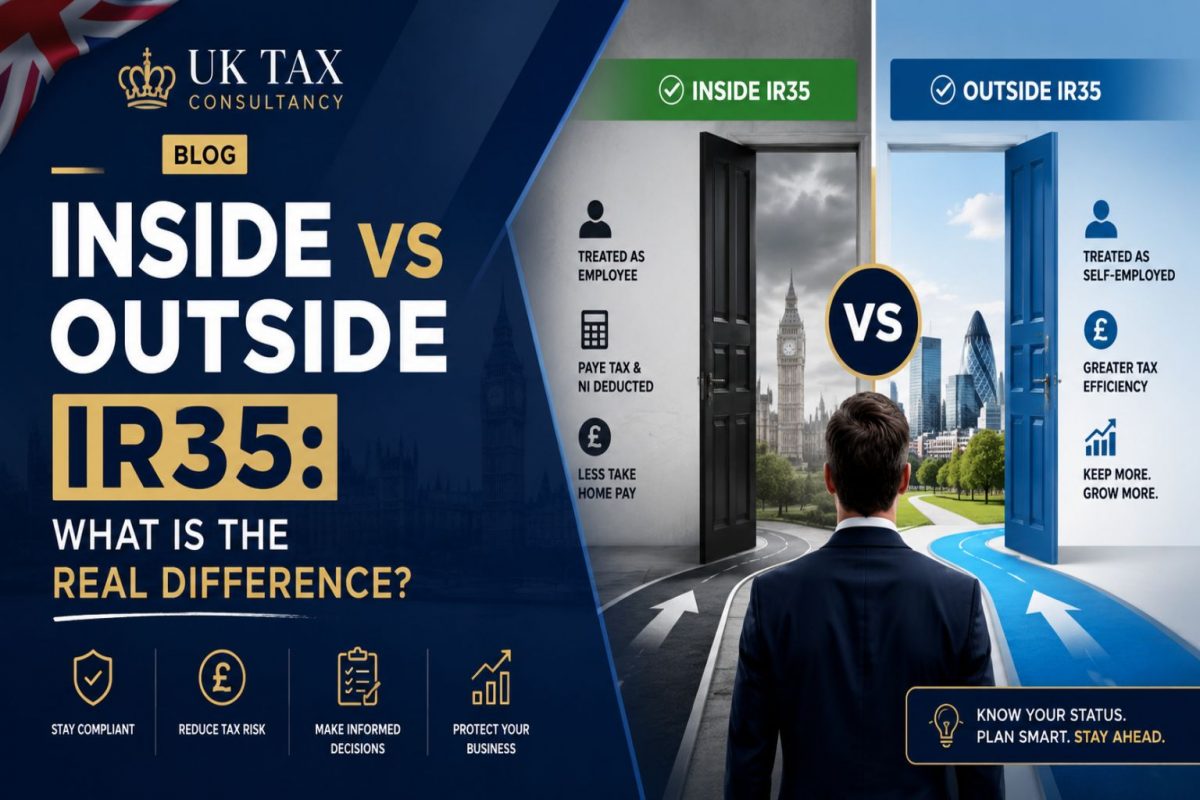
Inside vs Outside IR35: What Is the Real Difference
IR35: Understanding the Difference Between Inside and Outside IR35
IR35 is one of the most important tax rules affecting contractors, freelancers, and businesses that engage workers through limited companies. Whether a contract falls inside or outside IR35 can have a substantial impact on the amount of tax paid and the way income is treated.
Many contractors hear the terms “Inside IR35” and “Outside IR35” but are often unsure what they actually mean. Understanding the distinction is essential if you operate through a personal service company (PSC) or engage contractors within your business.
In this guide, we explain the key differences and what they mean in practice.
What Is IR35?
IR35 is UK tax legislation designed to prevent what HMRC refers to as “disguised employment.”
The rules apply when an individual provides services through an intermediary, usually a limited company, but would effectively be regarded as an employee if the intermediary did not exist.
HMRC introduced IR35 to ensure that workers who perform similar roles to employees pay broadly similar levels of tax and National Insurance.
The purpose of IR35 is not to stop contracting. Instead, it aims to determine whether a contractor is genuinely self-employed or effectively working as an employee.
What Does Inside IR35 Mean?
When a contract is deemed Inside IR35, HMRC considers the working arrangement to be similar to employment.
This means that the contractor is treated as an employee for tax purposes, even though they may continue to operate through their limited company.
Under an Inside IR35 contract:
- Income is subject to PAYE tax.
- National Insurance contributions are deducted.
- Take-home pay is generally lower.
- Dividend tax planning opportunities are reduced.
- The contractor may not receive employee benefits despite paying employment-style taxes.
In practical terms, the contractor pays broadly similar tax to an employee performing the same role.
What Does Outside IR35 Mean?
When a contract is determined to be Outside IR35, the contractor is considered genuinely self-employed.
This allows the contractor’s limited company to continue operating under normal business taxation rules.
Under an Outside IR35 contract:
- The company invoices the client directly.
- Profits are subject to corporation tax.
- Directors can choose a tax-efficient salary and dividend structure.
- Business expenses can generally be claimed where allowable.
- The contractor retains greater flexibility over how profits are extracted.
Outside IR35 status is generally more tax-efficient, provided the working practices genuinely support self-employment.
IR35 Status: Key Factors HMRC Considers
Control
One of the most important IR35 tests is the level of control exercised by the client.
HMRC will consider:
- Who decides how the work is carried out?
- Who determines working hours?
- Who controls where the work is performed?
The more control the client has, the more likely the arrangement may fall Inside IR35.
Right of Substitution
A genuine business should generally have the ability to provide a substitute to carry out the work.
If the client requires the contractor personally and would not accept a replacement, this may indicate employment rather than self-employment.
Mutuality of Obligation
HMRC also considers whether there is an obligation for work to be offered and accepted.
Employees typically expect ongoing work and employers are expected to provide it.
A contractor operating Outside IR35 is more likely to work on specific projects without any guarantee of future engagements.
Who Determines IR35 Status?

The responsibility for determining IR35 status depends on the type of client.
Medium and Large Private Sector Businesses
For medium and large businesses, the end client is generally responsible for assessing IR35 status and issuing a Status Determination Statement (SDS).
Small Private Sector Businesses
Where the client qualifies as a small company, the contractor’s limited company usually remains responsible for determining whether IR35 applies.
Understanding who carries responsibility is important because getting the assessment wrong can lead to significant tax liabilities.
Why IR35 Matters
IR35 can have a major financial impact.
For example, two contractors earning the same contract income may end up with very different take-home pay depending on whether the engagement falls inside or outside the rules.
Being incorrectly classified can result in:
- Additional tax assessments.
- National Insurance liabilities.
- Interest charges.
- HMRC penalties.
For businesses, incorrect assessments may also create financial and compliance risks.
This is why contracts should always reflect the actual working relationship rather than simply containing favourable wording.
Common IR35 Misconceptions
Many people assume that having a limited company automatically means they are Outside IR35. This is not correct.
Similarly, simply working from home or having multiple clients does not guarantee Outside IR35 status.
HMRC looks at the overall reality of the working arrangement, including day-to-day practices, contractual terms, and the degree of independence demonstrated by the contractor.
Each contract should therefore be reviewed individually.
Final Thoughts on IR35

IR35 remains one of the most important tax considerations for UK contractors and businesses engaging freelance workers. The distinction between Inside IR35 and Outside IR35 ultimately comes down to whether the working relationship resembles employment or genuine self-employment.
Inside IR35 engagements generally result in employment-style taxation, while Outside IR35 contracts allow contractors to continue benefiting from the flexibility and tax treatment associated with running a limited company.
Given the potential financial consequences, obtaining professional advice and reviewing contracts regularly can help ensure compliance and reduce the risk of unexpected tax liabilities.
Need help?
📞 Call 0161 710 1901
📧 Email Tax@TaxesDoneRight.co.uk
Visit www.taxesdoneright.co.uk