HMRC’s Major Mileage Rule Shake-Up Explained
May 28, 2026
The £5,000 Starting Rate for Savings limit is frozen from 2026/27 through to 2030/31
June 1, 2026
Can You Pay Yourself Only in Dividends?
Dividends are often seen as one of the most tax-efficient ways for limited company directors to extract profits from their business. Many new company owners hear that taking Dividends instead of a salary can reduce tax and National Insurance contributions, leading to an obvious question: can you pay yourself only in Dividends?
The short answer is yes, in some circumstances. However, there are several important rules, tax considerations, and potential drawbacks that business owners should understand before deciding on this approach.
In this article, we explain how exactly can you pay yourself only in Dividends, whether you can rely on them as your sole source of income, and why many directors choose a combination of salary and Dividends instead.
What Are Dividends?
Dividends are payments made by a limited company to its shareholders from after-tax profits.
Unlike salary payments, Dividends are not treated as a business expense for corporation tax purposes. Before Dividends can be paid, the company must have sufficient retained profits available for distribution.
If a company has not generated enough profit, paying Dividends could be unlawful and potentially create accounting and tax complications.
For owner-managed businesses, directors are often also shareholders, meaning they can receive Dividends in addition to any salary they take.
Can You Pay Yourself Only in Dividends?
Yes, it is possible to pay yourself entirely through Dividends if you are a shareholder and the company generates sufficient profits.
There is no legal requirement for a company director to take a salary.
However, while paying yourself only through Dividends may appear attractive from a tax perspective, it is not always the most efficient option overall.
To pay yourself only in dividends, Several factors need to be considered, including National Insurance records, pension entitlement, mortgage applications, and the availability of distributable profits.
Why Many Directors Use a Salary and Dividends Strategy
Although Dividends are generally taxed more favourably than employment income, many accountants recommend a combination of salary and Dividends.
A modest salary can provide several benefits:
- Maintains National Insurance contribution records
- Helps preserve entitlement to certain state benefits
- May increase pension qualifying years
- Creates an employment income history
- Can be deductible for corporation tax purposes
The remaining profits can then be extracted through Dividends.
This combination often provides a balance between tax efficiency and maintaining valuable personal financial records.
Dividends and Corporation Tax
One common misconception is that Dividends avoid tax altogether.
In reality, the company will generally pay corporation tax on its profits before any Dividends are distributed.
The sequence usually works as follows:
- The company earns profit.
- Corporation tax is calculated.
- Remaining profits become available for Dividends.
- Shareholders pay any personal tax due on Dividends received.
This means Dividends are paid from profits that have already been subject to corporation tax.
Dividends and Personal Tax
Dividends are subject to their own tax rates, which differ from income tax rates applied to salary.
The amount of tax payable depends on:
- Total taxable income
- Dividend income received
- Available allowances
- Tax band position
Because Dividends are taxed differently, many directors can achieve a lower overall tax burden compared to taking the same amount entirely as salary.
However, the exact savings depend on individual circumstances and tax legislation in force at the time.
When Dividends May Not Be Suitable
Although Dividends can be tax efficient, there are situations where relying solely on Dividends may not be ideal.
Limited Profits
Dividends can only be paid if the company has sufficient distributable profits. If profits fluctuate, income drawn solely from Dividends may become unpredictable.
Mortgage Applications
Some lenders prefer applicants to have a combination of salary and Dividends. While many lenders consider Dividend income, requirements can vary significantly.
Pension and State Benefits
Taking only Dividends may affect National Insurance contribution records if no qualifying salary is paid.
This could potentially impact future entitlement to the State Pension or certain contributory benefits.
Business Growth Plans
If profits are intended to remain within the company for future expansion, extracting funds through Dividends may not align with long-term business objectives.
Dividends and Director’s Loan Accounts
Some directors mistakenly withdraw money from their company and assume it can simply be treated as Dividends later.
This can create problems if there are insufficient profits available when the withdrawals occur.
In these situations, the payments may instead create a director’s loan account balance, potentially resulting in additional tax consequences and compliance issues.
Proper planning and documentation are essential whenever Dividends are declared.
Key Records Required for Dividends
HMRC expects companies to maintain appropriate records when paying Dividends.
Good practice includes:
- Dividend vouchers
- Board meeting minutes or written resolutions
- Up-to-date accounts
- Evidence of available profits
Maintaining accurate records helps demonstrate that Dividends were legally declared and properly supported.
Final Thoughts on Dividends
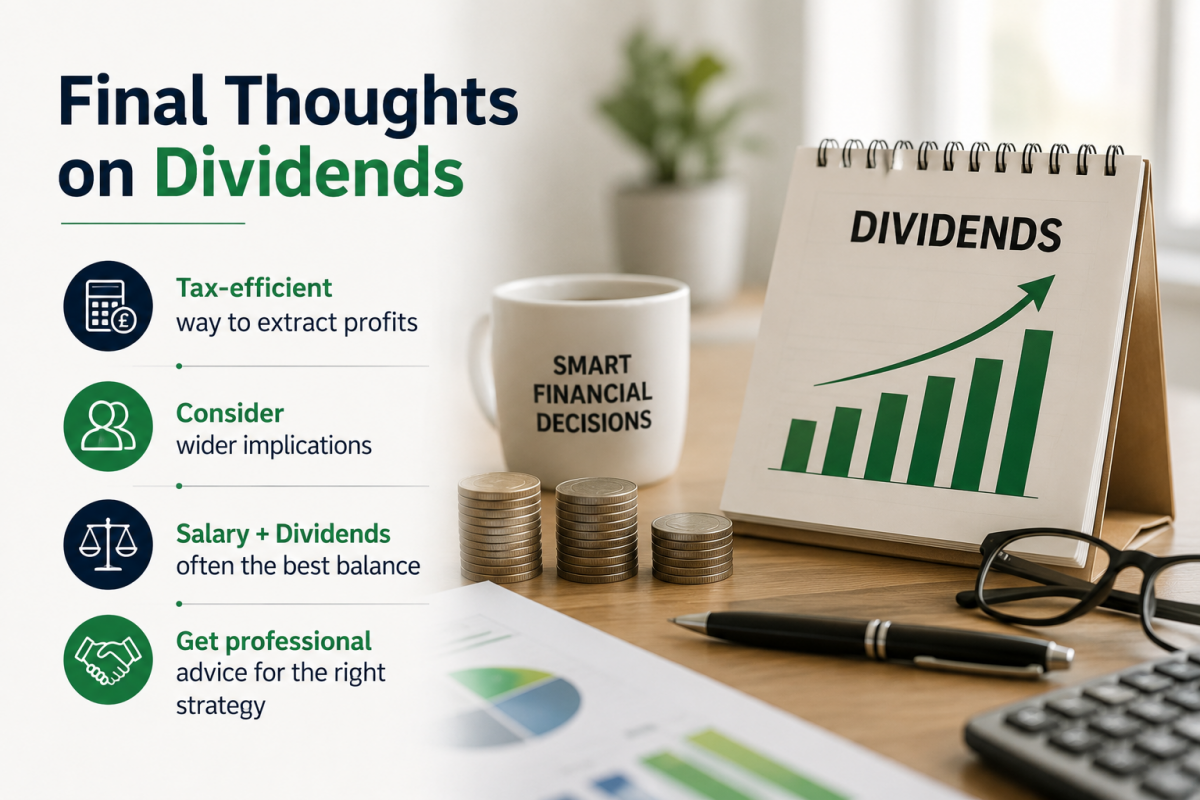
Dividends can be an effective and tax-efficient way for limited company owners to extract profits from their business. In many cases, it is possible to pay yourself entirely through Dividends.
However, tax efficiency should not be the only consideration. National Insurance records, pension entitlement, mortgage applications, cash flow requirements, and the availability of distributable profits can all influence the best approach.
For many directors, a combination of salary and Dividends remains the most balanced strategy. The right solution will depend on your personal circumstances, business goals, and overall tax position.
Before changing how you take income from your company, it is always sensible to obtain professional advice tailored to your specific situation.
Need help deciding what’s best for your situation?
📞 Call 0161 710 1901
📧 Email Tax@TaxesDoneRight.co.uk
Visit www.taxesdoneright.co.uk