Account Deadline Is Approaching – Are You Ready for Your Payments on Account?
July 8, 2026
Making Tax Digital UK: Who Must Use It in the UK? Complete Guide :2026
July 10, 2026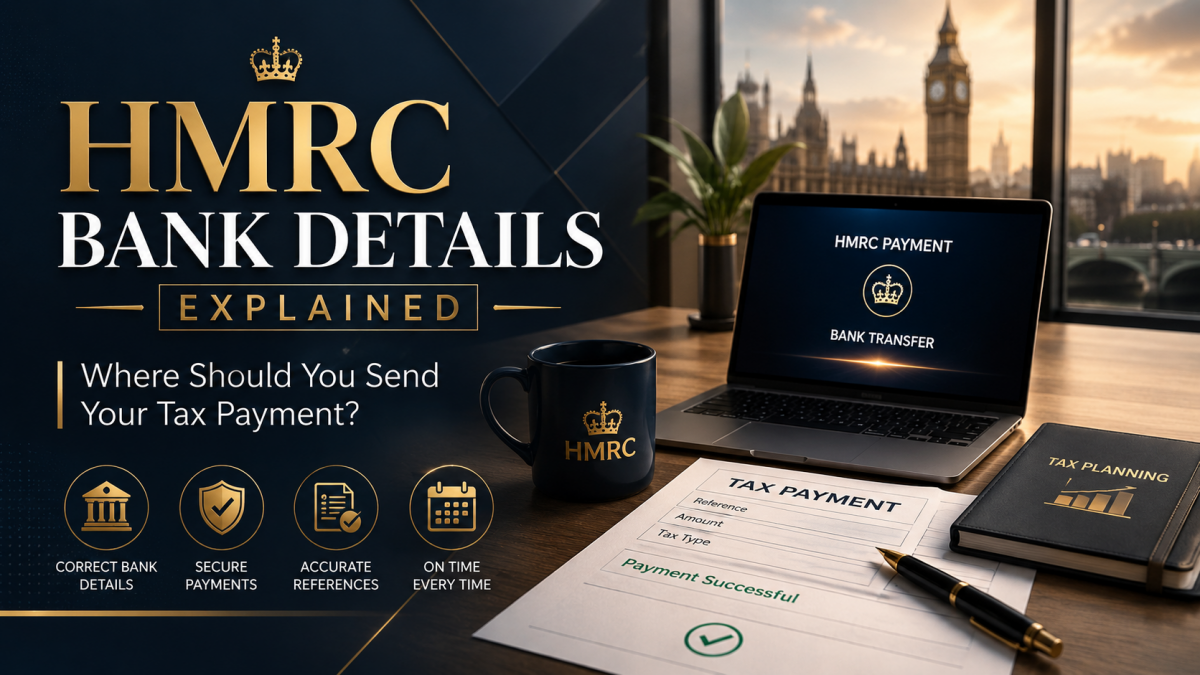
HMRC Bank Details are one of the most searched topics by UK taxpayers when it comes to making tax payments. Whether you are paying Self Assessment tax, Corporation Tax, VAT, or PAYE, using the correct bank details is essential. Sending money to the wrong account or using the wrong payment reference can result in delays, penalties, or interest charges.
In this guide, we’ll explain how HMRC bank payments work, why different taxes have different bank accounts, and what you should check before transferring your money.
Why Correct Bank Details Matter
Many taxpayers assume HMRC has one bank account for every payment. In reality, HMRC operates different accounts for different taxes. This means that the bank details used for a VAT payment may not be the same as those used for Corporation Tax or Self Assessment.
Using the incorrect account can delay your payment being allocated correctly, even if the money reaches HMRC.
Before making any payment, always confirm:
- The type of tax you are paying.
- The correct payment reference.
- The payment deadline.
- The bank details provided by HMRC.
Spending a few extra minutes checking these details can save significant time and prevent unnecessary correspondence with HMRC.
HMRC Bank Details for Different Taxes
The HMRC Bank Details you need depend on the tax you are paying. Common taxes include:
- Self Assessment Income Tax
- Corporation Tax
- VAT
- PAYE and National Insurance
- Capital Gains Tax
- Construction Industry Scheme (CIS)
Each payment type has its own reference number and, in many cases, its own receiving bank account.
Rather than relying on old payment details or previous bank transfers, always verify the latest information before sending money.
What Information Do You Need Before Making a Payment?
When paying HMRC by bank transfer, you will usually need:
- The correct HMRC bank account.
- Your Unique Taxpayer Reference (UTR), Corporation Tax reference, VAT Registration Number, or Accounts Office Reference.
- The correct payment reference exactly as instructed.
- Your online banking service or telephone banking.
- Sufficient time for the payment to clear before the deadline.
Entering an incorrect payment reference is one of the most common mistakes. Even if the money reaches HMRC, it may not automatically be matched to your account.
How to Find Official HMRC Bank Details
Never rely on information from unofficial websites or outdated screenshots.
The safest approach is to obtain the latest payment instructions directly from HMRC before making your transfer.
This ensures you are using:
- The correct sort code.
- The correct account number.
- The correct payment reference.
- The correct payment method.
HMRC occasionally updates payment guidance, so checking official information before every payment is considered good practice.
HMRC Bank Details and Payment References
Using the correct HMRC Bank Details is only part of the process. Your payment reference is equally important.
Depending on the tax involved, the payment reference could be:
- Your 10-digit UTR followed by a suffix.
- Your Corporation Tax payment reference.
- Your VAT Registration Number.
- Your Accounts Office Reference for PAYE.
If the reference is entered incorrectly, HMRC may be unable to allocate your payment automatically. This can lead to unnecessary payment reminders or late payment interest, even though you transferred the funds on time.
Always double-check the reference before confirming your payment.
Common Mistakes When Paying HMRC
Several errors regularly cause problems for taxpayers.
These include:
- Using bank details for the wrong tax.
- Copying old payment details from previous years.
- Entering an incorrect payment reference.
- Paying on the deadline rather than allowing time for bank processing.
- Sending payment to the wrong HMRC account.
- Forgetting to include all required digits in the payment reference.
Most of these mistakes are easily avoided by checking the payment instructions immediately before making the transfer.
When Should You Make Your Payment?
Different taxes have different payment deadlines.
For example:
- Self Assessment balancing payments are generally due by 31 January.
- Payments on Account are usually due on 31 January and 31 July.
- Corporation Tax deadlines depend on your company’s accounting period.
- VAT deadlines depend on your VAT return period.
- PAYE payments are generally monthly or quarterly.
Remember that bank transfers are not always instant, particularly during weekends and bank holidays. It is sensible to make your payment several working days before the deadline.
What Happens If You Pay the Wrong HMRC Account?
If you accidentally send money using the wrong bank details, don’t panic.
Contact HMRC as soon as possible and provide:
- The payment date.
- The amount transferred.
- The bank account used.
- The payment reference entered.
- Your tax reference.
HMRC may be able to trace and reallocate the payment, although this can take time.
The sooner you notify them, the quicker the issue can usually be resolved.
Final Thoughts
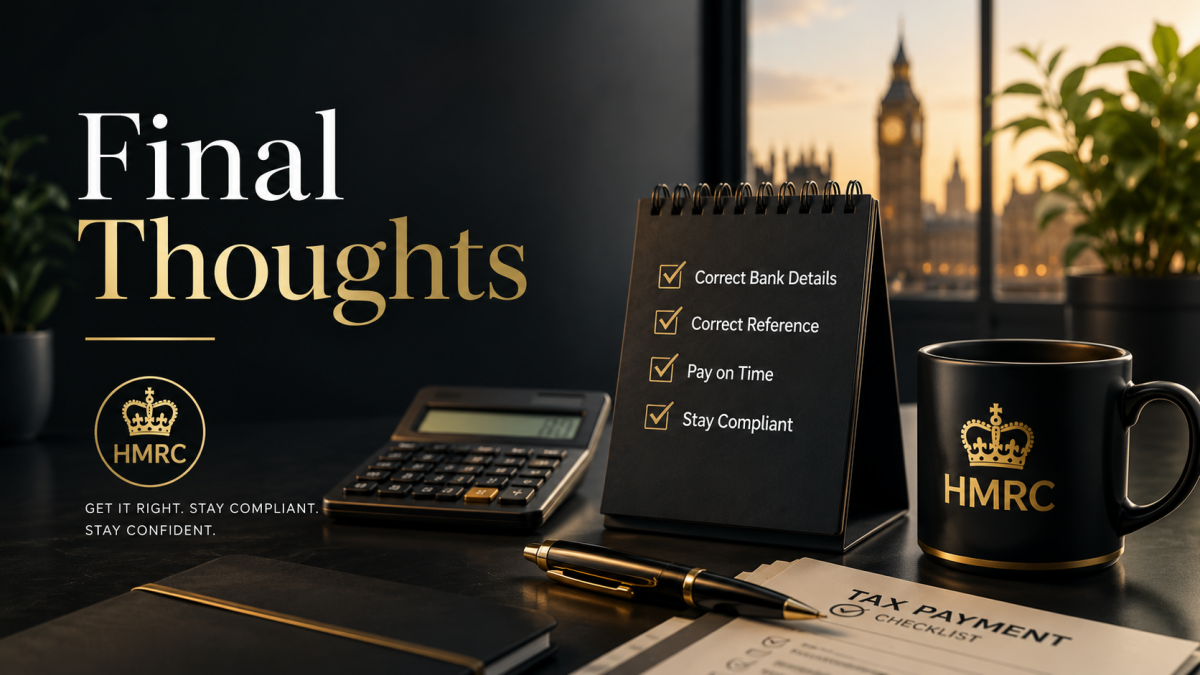
Making tax payments doesn’t have to be stressful. The key is ensuring you use the correct HMRC Bank Details, enter the correct payment reference, and make your payment before the deadline.
Taking a few moments to verify the payment information can help you avoid unnecessary delays, penalties, and interest charges. If you’re ever unsure which bank details or payment reference apply to your tax, it’s always worth checking the latest HMRC guidance or seeking advice from a qualified tax professional before sending your payment.
Need help deciding what’s best for your situation?
📞 Call 0161 710 1901
📧 Email Tax@TaxesDoneRight.co.uk
Visit www.taxesdoneright.co.uk